
A mature tree can become a concern long before it looks obviously dangerous. Branches may be pressing towards a roof, shading a garden, catching the wind heavily or extending over a road, driveway or neighbouring property. This guide to crown reduction work explains how professional pruning can manage those issues while protecting the tree’s health, shape and future growth.
Crown reduction is skilled tree work, not simply cutting a tree back. Done well, it makes a crown smaller, lighter and better balanced without leaving it bare, misshapen or vulnerable to decay. Done poorly, it can create weak regrowth, large wounds and a tree that becomes harder to manage in the years ahead.
What crown reduction work involves
The crown is the network of branches and foliage above the main trunk. A crown reduction reduces the overall height, spread or both, usually by selectively shortening suitable branches back to smaller side branches that can continue growth.
The aim is to retain a natural-looking outline. Rather than cutting every branch to the same point, an arborist assesses the structure of the tree and removes length where it will make the greatest difference. The finished tree should still look like itself, just proportionately smaller and more manageable.
A reduction may be recommended where a tree has outgrown its setting, is putting excessive weight on long limbs, or needs more clearance from a building, utility line or neighbouring boundary. It is also used to reduce wind resistance in an exposed position, although it is not a guaranteed solution for a tree with serious structural defects or root problems.
Crown reduction is not tree topping
Topping means cutting major branches back harshly, often leaving stubs or blunt ends. It can remove a large proportion of the canopy in one visit and encourages fast, weakly attached shoots. The tree may look smaller for a short time, but it can be left stressed, unattractive and more costly to maintain.
Professional crown reduction uses considered pruning points and avoids unnecessary large cuts. The difference matters. A tree is a living structure, and every cut has an effect on how it responds.
When is a reduction the right choice?
Crown reduction is useful, but it is not the answer to every tree concern. A careful site assessment should come first. Sometimes selective crown thinning, deadwood removal or clearance pruning will solve the issue with less intervention. In other cases, a tree may be in decline or have defects that mean reduction alone would not provide an acceptable level of safety.
A reduction often suits trees that are fundamentally healthy but have become too large for the available space. Common reasons include branches overhanging roofs, excessive shade, contact with structures, loss of light to a garden, and heavy lateral limbs extending over paths or parking areas.
It also depends on the species, age and previous pruning history. Some trees tolerate pruning better than others. A tree that has been repeatedly cut back hard may already carry weak regrowth or signs of decay around older wounds. Reducing it again needs a measured approach, and the best long-term recommendation may be different from the work first requested.
For homeowners and property managers, the key point is straightforward: ask what problem the pruning is intended to solve. “Make it smaller” is understandable, but a clear objective gives the arborist a better basis for specifying safe, proportionate work.
How much can a tree be reduced?
There is no responsible one-size-fits-all percentage. The amount of reduction is based on the tree’s condition, species, canopy structure, growing environment and the reason for the work. Removing too much foliage can reduce the tree’s ability to produce energy and may trigger stressed, dense regrowth.
As a general principle, a sensible reduction leaves enough live canopy for the tree to recover and retains appropriate smaller branches at pruning points. The work should remove the minimum necessary to achieve the agreed result.
A request to halve a mature tree, for example, may not be realistic or beneficial. If there is no safe way to make cuts that large while retaining a viable shape, an experienced arborist should explain that clearly. Options may include a smaller staged reduction, alternative pruning, ongoing management, or, where justified, removal and replacement with a more suitable species.
The professional process from survey to clean-up
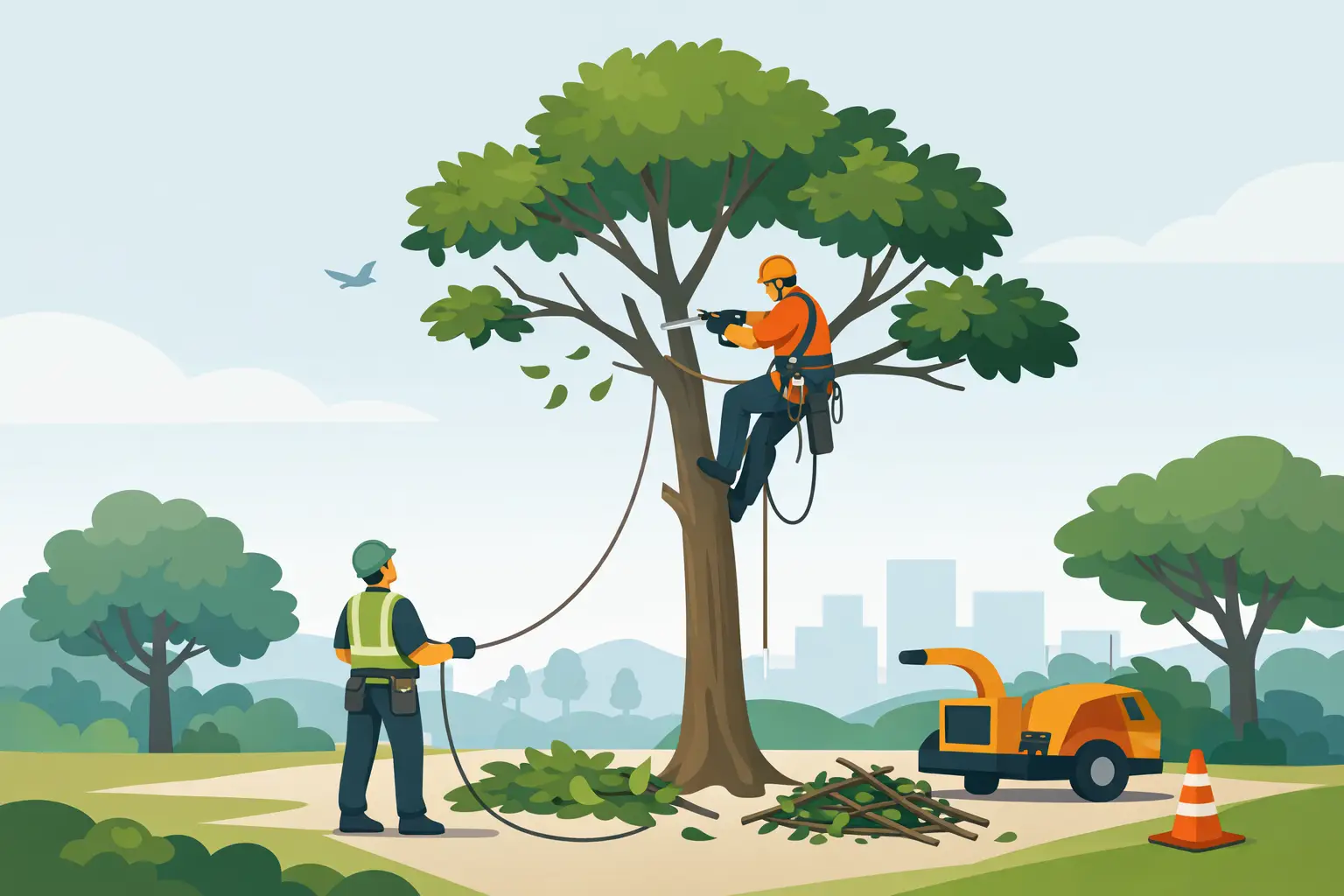
Good crown reduction begins on the ground. Before climbing or using access equipment, the arborist considers the tree’s condition, nearby buildings, access, ground conditions, overhead hazards and the likely direction of falling material. This is particularly important around conservatories, fences, gardens, public footpaths and busy commercial sites.
The work area is then set up to protect people and property. Depending on the location, this may involve exclusion zones, controlled lowering of branches by rope, traffic or pedestrian management, and suitable machinery for processing or removing arisings. A branch that looks modest from below can be heavy and unpredictable once cut, which is why untrained work from ladders is a serious risk.
Once in the tree, the climber works to the agreed specification, making selective cuts and continually checking the balance of the crown. Larger sections are lowered carefully where there is limited drop space. The team then clears the site, removes or processes green waste as agreed, and leaves paths, lawns and driveways tidy.
For commercial premises, this planning also helps minimise disruption. Work can often be scheduled around access requirements, staff movements, residents or customers, provided the practical risks are understood in advance.
Permissions, nesting birds and timing
Before crown reduction starts, check whether the tree is protected by a Tree Preservation Order or stands within a conservation area. Local planning authority consent may be needed for protected trees, and unauthorised work can lead to enforcement action and significant penalties. The rules can vary by location and circumstance, so this should be confirmed before arranging any pruning.
Wildlife also needs proper consideration. Birds are protected while nesting, and active nests must not be damaged or disturbed. Nesting activity is common in spring and summer, but it can occur outside those months as well. A professional team will inspect the tree before work and postpone or adapt the job if active nesting is found.
Timing can affect the tree too. Many reductions are carried out during the dormant season, when the structure is easier to see and there is less leaf material to handle. However, there is no universal season for every species or every objective. Some trees bleed sap if pruned at certain times, while others respond better to work after flowering. Urgent safety work may need to be completed whenever conditions require it.
What to expect after the work
A properly reduced tree can look more open at first, particularly when viewed from close range. It should not look butchered or stripped of all character. Over the following growing seasons, it will produce new shoots and gradually settle into its revised form.
The result is not permanent. Trees continue growing, and future maintenance may be needed, especially where the tree is close to a property or has limited space to develop. Establishing a sensible maintenance cycle is usually kinder to the tree and easier on a budget than allowing it to become oversized before demanding a severe cutback.
Keep an eye on the tree after work, particularly after storms. Report any new cracks, hanging branches, fungal growth at the base, sudden leaf loss or changes in lean. These signs do not always mean the tree is unsafe, but they justify a fresh professional inspection.
Choosing the right contractor for crown reduction
The lowest quote is not always the lowest overall cost. Crown reduction requires competent pruning knowledge, safe climbing or access methods, appropriate insurance and a clear plan for protecting the site. Ask what level of reduction is proposed, how the work will be carried out, whether arisings will be removed, and whether any permissions need attention.
A reliable contractor should be willing to explain the recommended work in plain language rather than promising an unrealistic result. They should also consider nearby structures, neighbours, wildlife and the future condition of the tree, not just the quickest way to remove branches.
At T.G. Bird Tree Services, crown reductions are planned around the condition of the tree, the risks on site and the result the customer needs. The focus is on careful workmanship, controlled operations and a clean, safe finish for homes and commercial properties across Norfolk and Suffolk.
If a tree is causing concern, do not wait until a branch fails or a storm turns a manageable issue into an emergency. A professional assessment can show whether crown reduction is appropriate and help keep the tree, property and people around it in good order.