
A cracked branch hanging over the drive, a fallen tree across an access road, or roots lifting after days of heavy rain can turn a normal day into a safety issue very quickly. This guide to emergency tree response explains the sensible first actions to take, when to contact the emergency services, and why damaged trees should be assessed by a qualified, properly equipped arborist.
Tree emergencies are not limited to major storms. A tree can fail after prolonged wet weather, high winds, decay, vehicle impact, construction damage or a branch that has gradually become too heavy. The priority is always the same: keep people away from the danger, protect the area where possible, and avoid making the situation worse.
What counts as a tree emergency?
An emergency is any situation where a tree, branch or root plate presents an immediate risk to people, property, vehicles, roads or essential access. It may be obvious, such as a tree lying on a roof, but warning signs can also point to a developing failure that needs urgent attention.
Look out for a tree that is leaning suddenly, particularly if the soil has lifted or cracked around its base. Large split limbs, branches caught in the canopy, fresh cracks in the trunk, exposed roots, or a tree resting on a fence or building also need prompt professional assessment. A tree does not need to have fallen completely to be dangerous.
For businesses, farms, landlords and property managers, emergency response also includes obstructed entrances, blocked footpaths, damage near parking areas and trees affecting public-facing parts of a site. Acting quickly can prevent a manageable issue from becoming an injury, claim or costly repair.
Your guide to emergency tree response: first actions
The temptation to pull a branch clear or cut it down yourself is understandable, especially when it is blocking a driveway or has damaged a fence. However, storm-damaged timber can be under considerable tension. What looks stable may shift without warning when weight is removed, and overhead branches can fall unexpectedly.
Start by moving people, pets and vehicles well away from the affected area. Keep clear of the tree’s full height where possible, as branches can travel farther than expected when they break. Do not stand beneath hanging limbs, climb the tree, use a ladder, or attempt to cut timber that is trapped, bent or resting on another object.
If the tree has brought down, touched or is close to electricity cables, stay well back. Do not touch the tree, the cables, nearby fencing or standing water. Contact the electricity network operator by calling 105, and call 999 if there is an immediate threat to life, a fire risk, or danger to the public.
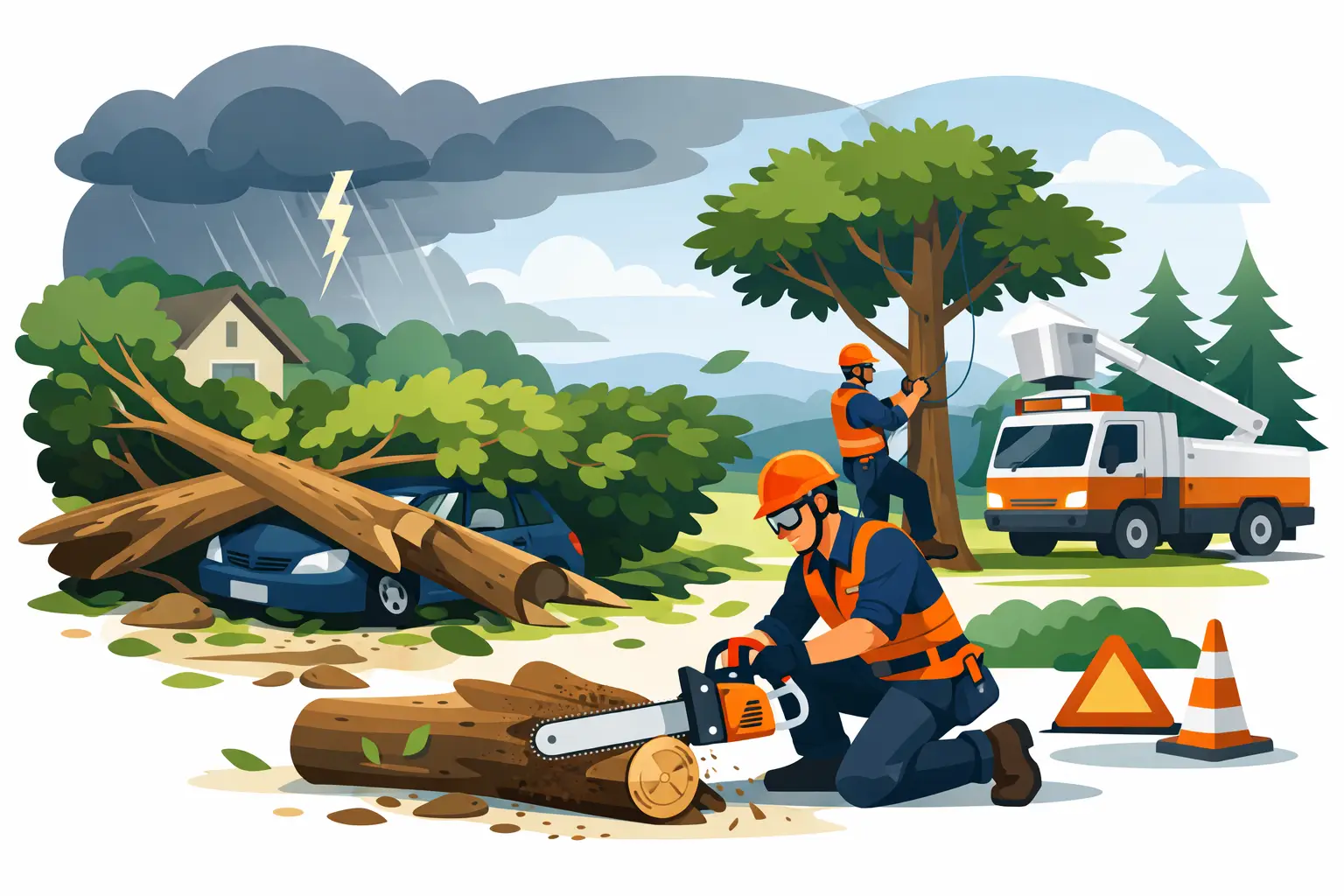
Where safe to do so, keep others out with a visible barrier, such as cones, tape or a parked vehicle positioned at a safe distance. Take photographs from a secure location for your insurer and arborist. Clear photographs of the whole tree, the damage and its position in relation to buildings or roads can help establish the right response before a team arrives.
When to call the emergency services
Call 999 when a tree has caused, or is likely to cause, an immediate danger to life. This includes a tree blocking a public highway, threatening passing traffic, damaging a property that cannot safely be occupied, or making contact with power infrastructure. Follow the advice given and do not enter any restricted area.
A fallen tree entirely within your garden may not require the emergency services, but it may still need urgent tree work. The distinction depends on the risk. A branch on a lawn away from buildings can often be dealt with during a planned visit. A branch suspended over a conservatory, footpath or driveway should be treated as an urgent callout.
If there is any doubt, take the cautious route. Trees are heavy, unpredictable structures, particularly after wind damage or when the ground is saturated.
What a professional emergency response involves
A professional arborist does more than arrive with a chainsaw. The first job is to assess the tree, the direction of likely movement, nearby structures, access, overhead services and the condition of the ground. This determines whether the tree can be dismantled safely, whether climbing is appropriate, or whether specialist access equipment and traffic management are required.
The safest solution is not always full removal. In some cases, an arborist can remove a dangerous hanging limb, reduce the canopy to relieve strain, or make the tree safe until further work can be completed. Where a tree has failed at the roots, it may need controlled dismantling in sections to avoid additional damage to sheds, fences, roofs or neighbouring land.
This is particularly relevant in confined gardens around Norwich, Norfolk and Suffolk, where trees are often close to homes, garages, telephone lines and neighbouring boundaries. Careful lowering techniques allow sections to be brought down in a controlled way rather than dropped. It takes experience, suitable equipment and a clear exclusion zone.
A proper emergency service should also include dealing with the aftermath. Once the immediate hazard is removed, timber can be processed, brash cleared, and the site left tidy and safe. Stump grinding can be arranged separately where a remaining stump presents a trip hazard, obstructs replanting or affects future landscaping plans.
Avoid these common mistakes after storm damage
The greatest risk often comes from well-meaning action before help arrives. Avoid pulling at a fallen tree with a car, tractor or winch unless the work is planned and carried out by competent professionals. A line under tension can fail violently, and the tree may roll or pivot in an unexpected direction.
Do not burn damaged timber in a pile near buildings, fencing or overhanging branches. Freshly cut wood is often unsuitable for immediate burning anyway, and an uncontrolled fire can create a second emergency. If you want to keep suitable timber for logs, ask whether it can be cut to manageable lengths and stored to season correctly.
It is also wise not to rely on a quick visual judgement that a partially fallen tree is secure. Branches can be held up only by smaller limbs, unstable root systems or damaged fibres in the trunk. Wind, rain and even a change in temperature can alter the situation.
Finally, do not assume that a neighbour’s tree is automatically your responsibility to cut back or remove. If it has crossed a boundary, caused damage or threatens your property, document the issue and communicate clearly. Emergency safety work should not be delayed where there is a genuine risk, but ownership, access and insurance matters may need to be resolved afterwards.
What to tell your arborist when you call
A clear description helps an emergency tree team prepare the right equipment and prioritise the risk. Explain whether the tree has fallen, is leaning, has split branches, or is resting on a structure. Mention its approximate size, access restrictions, overhead cables, nearby roads, and whether anyone or anything is currently at risk.
Photographs are useful, but never take them from underneath the tree or from a position that puts you in danger. Let the arborist know if the tree is blocking a drive, business entrance, farm track or public route. Access problems may affect the type of machinery needed and how quickly work can be carried out.
At T.G. Bird Tree Services, emergency tree work is approached with the same care as planned tree surgery: assess the hazard properly, use the right methods for the site, and leave the area clean and safe once the immediate danger has been dealt with.
Reducing the chance of the next emergency
Not every failure can be predicted, especially in severe weather, but regular maintenance significantly reduces avoidable risks. Deadwood removal, careful crown reduction, pruning heavy or poorly formed branches, and checking trees for decay or root disturbance can identify issues before high winds expose them.
Hedges and trees close to roads, roofs, power lines and access routes deserve particular attention. The right timing depends on the species, condition of the tree, nesting activity and the work required. A professional assessment can recommend practical work without removing more of the tree than necessary.
If a tree on your property looks different after a storm, trust that change. Keep people clear, avoid DIY cutting, and arrange an assessment before the next spell of wind turns a warning sign into an emergency.