

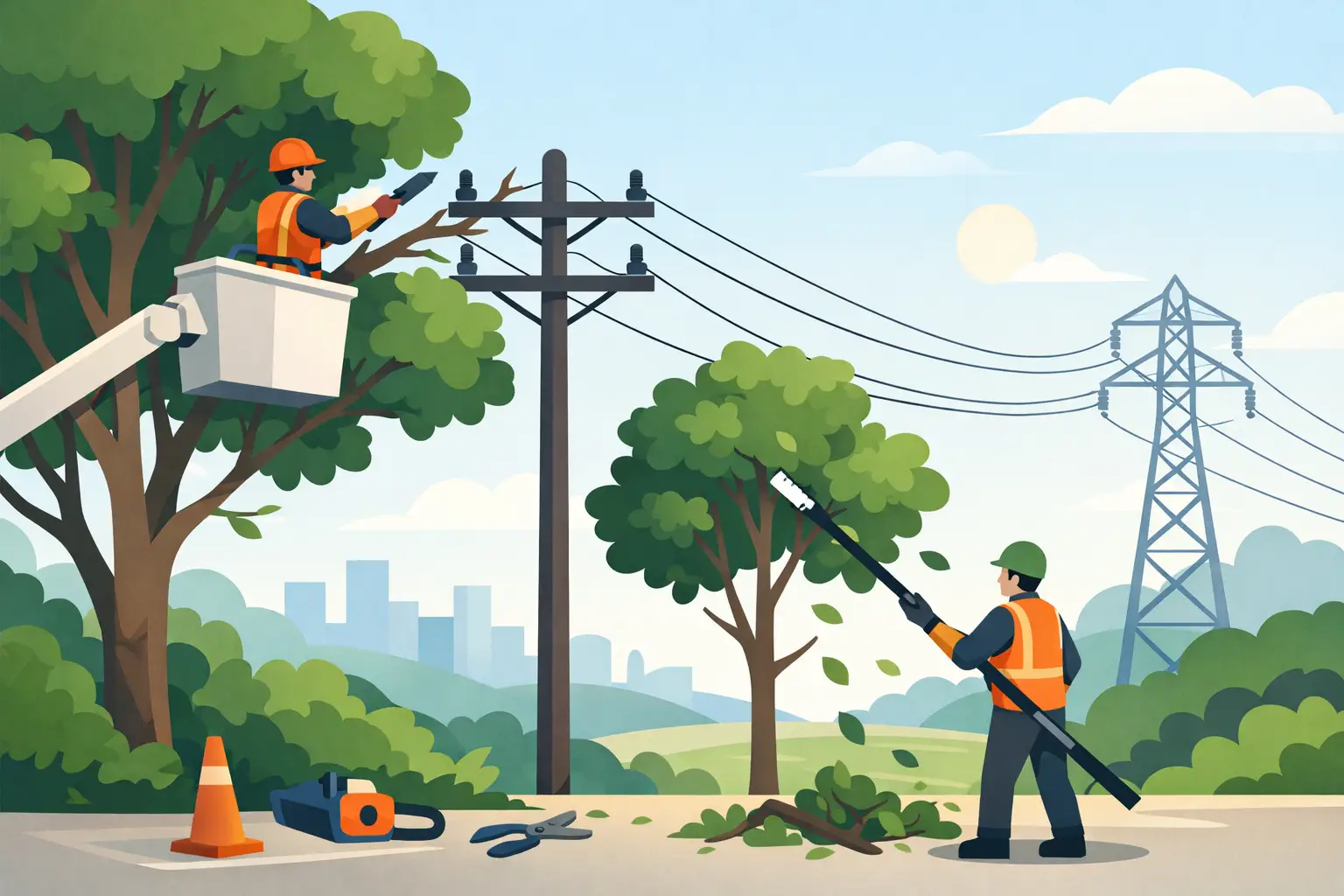
A branch rubbing against an overhead cable is not a job to leave for the weekend. Wind, wet weather and the weight of further growth can quickly turn a manageable issue into a power cut, property damage or a serious safety risk. Knowing how to manage trees near power lines starts with one clear rule: never attempt to cut, climb or pull a tree that could contact electrical equipment yourself.
For homeowners, landowners and site managers across Norfolk and Suffolk, the safest solution depends on the tree’s condition, its distance from the line and who owns the equipment. A qualified arborist can assess the tree and carry out suitable work, while the electricity network operator must be involved where there is any possibility of contact with live lines.
Why trees near overhead lines need specialist attention
Trees and power lines are a difficult combination because both change over time. A tree that was safely clear when planted may grow into the line over several years. Mature branches can also move significantly in high winds, while decay, disease or storm damage can cause an otherwise healthy-looking limb to fail without warning.
Electricity can travel through a tree, a ladder, pruning equipment or even a person standing nearby. That means the risk is not limited to a branch physically resting on a cable. Working too close to overhead lines can be dangerous, particularly when using long-handled tools, chainsaws, ropes or access equipment.
There is also a practical concern. A tree pressing on cables may affect the electricity supply to your property or neighbouring homes and businesses. Delaying action can make the eventual work more complex, more disruptive and more costly.
Check the situation from a safe distance
Do not inspect a tree near power lines by climbing it or using a ladder. Instead, look from the ground and note what you can see without approaching the equipment. Is a branch touching, hanging over or growing towards the line? Is the tree leaning? Are there split limbs, cracks in the trunk, deadwood, fungal growth or roots lifting the ground?
Storms deserve particular attention. If a tree has fallen onto a line, a cable is on the ground, or you can see sparking, smoke or damaged poles, keep everyone well away. Do not touch the tree, the cable, nearby fencing or anything in contact with it. Call 105 to report a power network emergency. If there is an immediate threat to life, fire or public safety, call 999.
Even if the cable appears intact, treat it as live. Power lines can remain energised after damage, and it is not possible to judge their safety by sight alone.
Understand who is responsible for what
As a property owner or manager, you are generally responsible for maintaining trees on your land. However, you do not have the authority to interfere with overhead electricity lines, poles or other network equipment. The local electricity network operator is responsible for the network and will decide what safety measures are needed around its equipment.
Where planned tree work is required near overhead lines, contact the network operator before arranging cutting. They may inspect the site, advise on safe working distances or, in higher-risk situations, arrange for the supply to be isolated. This needs to be planned properly, as an isolation may affect neighbouring properties or require a scheduled outage.
A professional arborist can help identify the scope of work and coordinate the job around the network operator’s requirements. This is especially valuable on larger domestic sites, farms, commercial premises, private roads and developments with multiple trees close to overhead lines.
How to manage trees near power lines safely
The right approach is usually planned pruning rather than drastic cutting. The aim is to create appropriate clearance while keeping the tree healthy, stable and visually balanced. Removing too much canopy at once can encourage weak, fast regrowth, leave large wounds or make a tree more vulnerable to wind damage.
An arborist will first assess the species, age, condition and growth pattern of the tree. A fast-growing willow, poplar or leylandii may need a different management plan from an established oak, beech or conifer. The work might involve carefully reducing selected limbs, removing deadwood, lifting lower branches or, where the tree is unsuitable for its position, felling it in controlled sections.
The method depends on access and risk. Some trees can be managed using rope-and-harness climbing techniques, but this is not appropriate where electrical clearance is limited. Others may require a mobile elevated work platform, traffic management, a temporary network isolation or a combination of specialist measures.
Never assume that cutting the branch nearest the line is a safe fix. Once weight is removed, the remaining branch can swing, spring back or fall in an unexpected direction. A tree surgeon working near utilities plans each cut, controls the drop zone and uses the right equipment to protect people, buildings and the network.
Avoid common DIY mistakes
The most dangerous mistake is using a ladder, pole pruner or chainsaw near overhead lines. Long tools can reduce the gap between you and the cable far more quickly than expected. Wet timber and wet ground add further risk.
It is also unwise to tie branches back from cables, pull on a fallen limb, burn garden waste beneath lines or park machinery where access may be needed in an emergency. If a tree needs attention, keep the area clear and let trained professionals assess it.
Choose pruning that supports the tree’s long-term health
Clearance from power lines should not mean indiscriminate topping. Topping leaves large wounds, can stimulate dense, weak shoots and often creates a repeat problem within a short period. It may also spoil the shape of the tree and reduce its lifespan.
A better approach is selective reduction, where suitable growth points are chosen to reduce the canopy gradually and direct future growth away from the line. In some cases, pollarding may be appropriate for species and trees that have historically been managed in that way. It is not a one-off solution, though. Pollarded trees need a regular maintenance cycle to remain safe and healthy.
If a tree is already heavily compromised by decay, root damage or poor structure, removal can be the responsible option. This is particularly true where it is directly beneath a line, has limited room to grow safely, or could damage a building, road or public area if it fails. Replacement planting can then be planned with a suitable small-growing species positioned well away from services.
Plan for permissions, wildlife and access
Before major pruning or felling, check whether the tree is protected by a Tree Preservation Order or lies within a conservation area. Permission or formal notice may be required before work starts. The same care applies to leasehold sites, managed estates and commercial land, where ownership and maintenance responsibilities are not always straightforward.
Wildlife also needs to be considered. Birds’ nests are protected, and the main nesting season commonly runs from spring into summer. Nest checks should be carried out before work, with timings adjusted if active nests are found. Bats and their roosts are protected too, so trees with cavities, loose bark or other potential roost features may need further assessment.
Good preparation makes the work safer and tidier. An experienced contractor will consider access for equipment, safe exclusion zones, protection for lawns and driveways, where timber and chip will go, and how the site will be left once the work is complete.
Set a sensible inspection and maintenance cycle
A single pruning job is rarely the end of the matter. Trees continue to grow, and their condition can change after drought, storms, construction work or disease. For trees near power lines, a regular inspection helps spot issues before clearance becomes urgent.
The right interval depends on the species, age and location. Fast-growing trees may need attention more frequently, while slower-growing, well-managed specimens may simply need periodic checks. Commercial sites and landlords should keep clear records of inspections and completed work, particularly where trees stand near car parks, footpaths, access roads or occupied buildings.
T.G. Bird Tree Services provides professional tree care for properties across Norfolk and Suffolk, with practical advice and safe, tidy workmanship for routine maintenance and urgent tree problems. Where overhead lines are involved, the priority is always to assess the risk properly and work within the required safety arrangements.
A tree near a power line does not have to become an emergency. Acting early, keeping clear of the hazard and arranging qualified advice gives you the best chance of protecting your property, your supply and everyone around it.