
A tree that has grown too large for its setting can quickly become more than a visual concern. Heavy limbs over a roof, branches catching in overhead lines or a dense canopy blocking light all need careful attention. When comparing pollarding vs crown reduction, the right choice depends on the tree species, its condition, its location and the result you need to achieve. These are not interchangeable cuts, and using the wrong approach can leave a tree looking poor, structurally weakened or unable to recover properly.
Pollarding vs crown reduction: the key difference
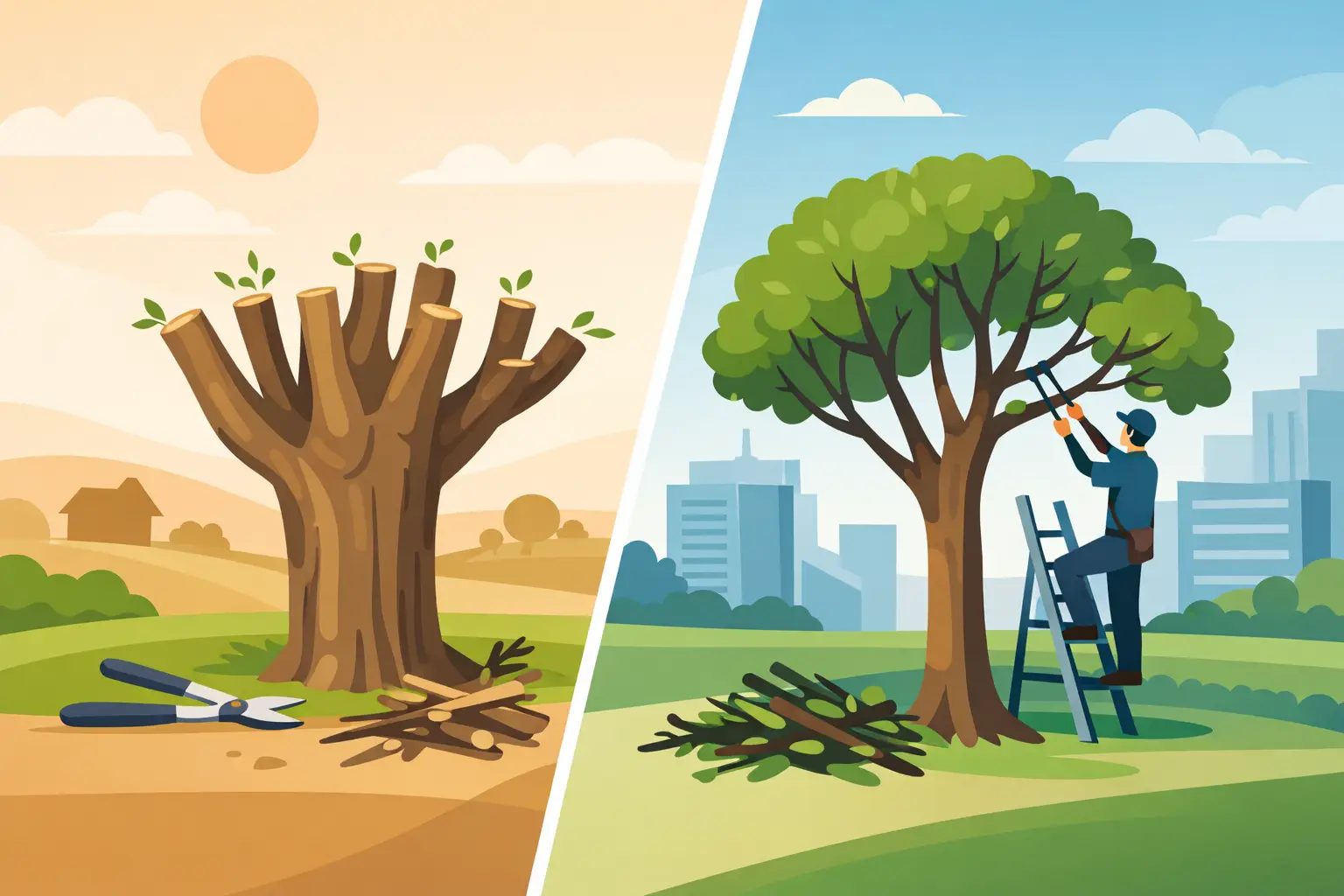
Pollarding is a more significant and repeatable form of pruning. It involves removing the upper growth of a suitable tree back to established points on the main branches or stem. Over time, new shoots grow from these points, creating the familiar rounded or knuckled appearance seen on many mature street trees and boundary trees.
Crown reduction is a lighter, more selective operation. It reduces the overall height and spread of a tree by shortening selected branches back to suitable growth points. The aim is to retain the tree’s natural shape while making the crown smaller, lighter and more manageable.
Put simply, pollarding resets a tree’s upper growth on a planned cycle. Crown reduction refines and reduces an existing crown. Both can be valuable tree management techniques, but they solve different problems.
What is pollarding?
Pollarding is traditionally used on species that respond well to hard pruning, including willow, lime, plane and certain maples. It is often chosen where a tree must be kept within a fixed space year after year, such as beside a road, near buildings, along a boundary or in a managed landscape.
The first pollard is a major intervention. Once started, however, it needs regular maintenance. New shoots can grow quickly and become heavy, so a neglected pollard may develop weak attachments and place extra strain on the tree. Returning at suitable intervals keeps the new growth controlled and reduces the risk of oversized, poorly attached branches developing.
When pollarding is the right option
Pollarding can be appropriate when a tree has been pollarded before and needs its regular cycle of maintenance. It may also be used to manage vigorous species in restricted spaces, particularly where long-term height control is needed and there is no room for the canopy to develop naturally.
It is not normally suitable as a quick fix for every overgrown tree. Starting a pollard on an old, stressed or unsuitable specimen can cause serious decline. Large pruning wounds may not close well, and the sudden loss of canopy can reduce the tree’s ability to produce energy and defend itself from decay.
A professional assessment should consider the species, age, vitality and existing branch structure before pollarding is recommended. Where it is the correct method, the work should be carried out cleanly and with a clear plan for future pruning.
The practical trade-off with pollarding
The main benefit of pollarding is reliable size control. It can prevent a fast-growing tree from outgrowing its site and provides a predictable maintenance programme. It also allows light into gardens, access routes and nearby properties where a full-sized canopy would cause problems.
The trade-off is commitment. A pollarded tree needs ongoing care, rather than being left for many years. It will also look stark immediately after work, especially during the dormant season. That appearance is temporary, but it is worth understanding before the work begins.
What is crown reduction?
Crown reduction reduces a tree’s dimensions without removing its whole upper structure. An arborist selects branches that are too long, heavy, poorly balanced or close to a target, then shortens them back to smaller lateral branches that can take over as a new growing point.
A good crown reduction should leave the tree balanced and natural-looking. The difference may be subtle from the ground, but it can reduce wind loading, ease the weight on long limbs and create better clearance from roofs, gutters, roads and neighbouring properties.
The amount removed matters. Taking too much in one visit can stress the tree, trigger excessive weak regrowth and leave large wounds. For many trees, a modest and well-judged reduction is far safer than cutting back hard because the canopy has been neglected for too long.
When crown reduction is the better choice
Crown reduction is often the preferred option for a mature tree that is fundamentally healthy but has become too large for its surroundings. It can help manage branches overhanging a building, reduce the sail effect of a broad crown or rebalance a tree after storm damage.
It is also useful where retaining the tree’s natural character matters. A mature oak, beech or ornamental garden tree may provide privacy, shade and visual value, so reducing its crown carefully is usually more suitable than converting it into a pollard.
Crown reduction is not the same as topping. Topping means cutting branches abruptly at unsuitable points, leaving stubs and encouraging weak regrowth. Proper reduction pruning works with the tree’s existing branch structure, protecting its form and giving it the best chance of responding well.
How an arborist chooses between the two
The decision is never based on height alone. A small tree in poor condition may need more attention than a much taller tree that is healthy and well positioned. Before recommending pollarding or crown reduction, a competent arborist will look at the species, tree age, signs of decay, previous pruning, branch unions, root environment and nearby targets.
The site also has a major bearing on the work. A tree close to a house may need clearance without losing all of its screening value. A tree beside a road or public footpath may require risk management and traffic control. On commercial sites, the priority may be maintaining clear access, reducing liability and keeping the grounds presentable with minimal disruption.
The desired long-term outcome is equally relevant. If the aim is to retain a mature tree with a smaller, natural canopy, crown reduction is often the answer. If a suitable species needs to remain at a tightly controlled height for the rest of its life, a planned pollarding programme may be the better approach.
Timing, wildlife and legal checks
Most pruning is best planned around the tree’s condition and the work required, rather than relying on one fixed season for every species. Dormant-season work can be practical for many deciduous trees, but there are exceptions. Certain trees may bleed sap if pruned at the wrong time, while others respond better to work during a different part of the year.
Wildlife checks are essential before work starts. Nesting birds are protected, and active nests must not be disturbed. Cavities, splits and dense ivy may also provide habitat for bats or other wildlife. If there is any concern, the work may need to be adjusted, delayed or supported by further ecological advice.
Trees in conservation areas and those protected by a Tree Preservation Order may need consent before pruning. This should be checked before arranging work, as unauthorised work can lead to enforcement action. A professional tree surgeon can help clarify what is needed and make sure the proposed specification is appropriate.
What good tree work should look like
Whether the job involves pollarding or crown reduction, the finish should be safe, considered and tidy. Branches should be cut at suitable points, without torn bark, long stubs or unnecessary damage to the remaining canopy. The team should protect lawns, borders, buildings and access areas wherever possible, then remove arisings or process them as agreed.
For larger or hazardous trees, safe climbing techniques, rigging and suitable equipment are crucial. Working near roads, power lines or fragile structures requires careful planning, not rushed cutting. At T.G. Bird Tree Services, each job is assessed around the tree, the site and the outcome the customer needs, with safety and clean workmanship kept at the centre of the process.
Choosing the right route for your tree
If your tree has been pollarded in the past, continuing that maintenance cycle may be the safest way to manage it. If it has a natural crown that has simply become too large, crown reduction is more likely to preserve its appearance and structural integrity. In some cases, neither is suitable, and selective pruning, deadwood removal, bracing or removal may be the more responsible recommendation.
The best result comes from treating the tree as an individual, not applying the same cut to every problem. A clear assessment now can protect your property, keep the tree healthier and avoid more costly corrective work later.