
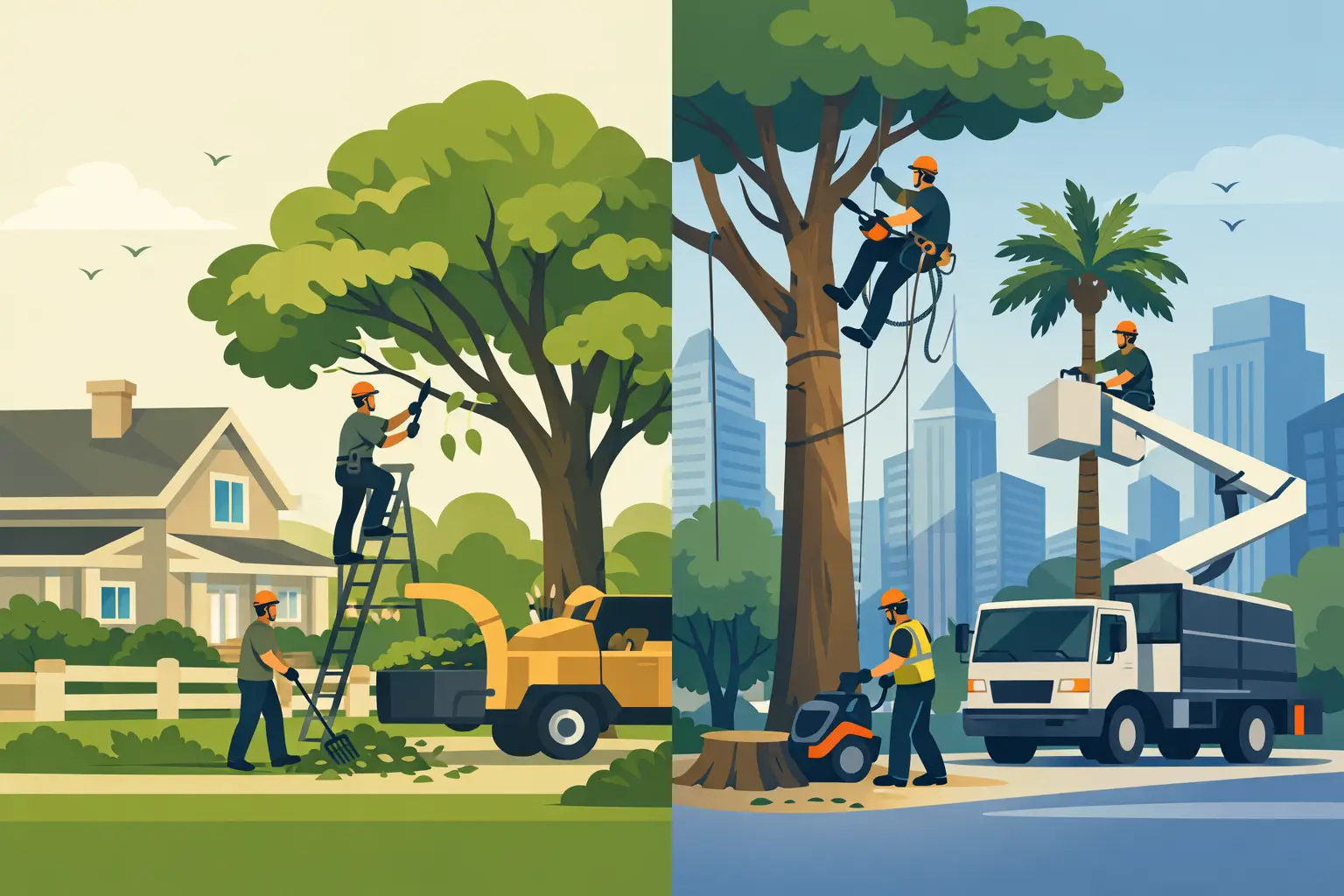
A branch resting on a garage roof needs prompt attention. So does a mature tree overhanging a school car park, but the planning, equipment and safety controls involved can be very different. When comparing a residential vs commercial arborist, the core tree care skills may be similar, yet the scale of responsibility, site conditions and project management often change considerably.
For homeowners, the priority is usually making a garden safe, tidy and enjoyable to use. For businesses, landlords and site managers, tree work also forms part of wider property maintenance, public safety and risk management. Choosing the right approach helps ensure work is completed safely, efficiently and with minimal disruption.
What a residential arborist service involves
Residential arborist work is focused on trees and hedges within private gardens, driveways, rural homes and small residential developments. A job may involve reducing an overgrown conifer, removing a dead tree close to a fence, pruning branches away from a house or grinding out an old stump before landscaping begins.
The work is often highly detailed. Gardens can have limited access, delicate planting, sheds, greenhouses, overhead cables and neighbouring properties close by. An experienced arborist needs to plan how timber, branches and machinery will move through the site without causing avoidable damage.
Homeowners commonly need support when a tree has become too large for its setting, blocks light, drops deadwood or appears unsafe after high winds. The right solution is not always felling. Careful crown reduction, thinning, lifting lower branches or removal of hazardous limbs may retain the tree while improving safety and appearance.
A good residential service should feel straightforward from the first visit onwards. That means clear advice, a sensible recommendation, safe working practices and a thorough tidy-up once the work is complete. It also means explaining where permissions may be required, particularly if a tree is protected by a Tree Preservation Order or stands within a conservation area.
Access and neighbour considerations
Private gardens can make even a small job technically demanding. A tree may only be accessible through a narrow side gate, while all arisings need to be removed without crossing a neighbour’s land. In these situations, climbers may dismantle the tree in manageable sections and use specialist lowering techniques to protect fences, patios and garden features.
Neighbouring trees can also create uncertainty. The homeowner may be responsible for managing overhanging branches from their own tree, but ownership and boundary matters should be understood before work starts. An arborist can advise on practical tree care, while legal disputes may require separate professional guidance.
Residential vs commercial arborist work: the main differences
Commercial tree care covers a broader range of sites, including business parks, schools, estates, farms, housing developments, public-facing premises, industrial land and managed grounds. The tree work itself may include pruning, felling, pollarding, hedge cutting, stump removal and emergency response, but the operational requirements are usually more involved.
The biggest difference is the number of people and assets that could be affected. A tree beside a warehouse entrance, pavement, car park or access road presents risks not only to the client, but also to employees, visitors, vehicles and members of the public. Work must be planned around those risks from the outset.
Commercial clients may also need an arborist who can work to agreed schedules, coordinate with site contacts and provide dependable maintenance across the year. One-off emergency work matters, but planned inspections and routine pruning can help prevent unnecessary callouts, disruption and deterioration.
Safety planning is more extensive
Every professional tree job needs proper risk assessment, suitable equipment and competent staff. On commercial sites, there may be additional controls for vehicle movements, pedestrians, deliveries, electrical infrastructure, working near roads or maintaining emergency access.
A commercial arborist may need to establish exclusion zones, arrange traffic or pedestrian management, schedule work outside busy hours and coordinate with other contractors. Larger operations can require a more formal method statement, site induction and clear communication with the person responsible for the premises.
This is not simply paperwork. It protects people and helps work progress without confusion. A well-managed site is safer for arborists, staff, customers and the public.
Scale, equipment and waste handling can change
A homeowner may need one overgrown ash tree reduced. A commercial estate may require several days of work across numerous trees, hedges and stumps. The amount of material produced, the machinery required and the space needed for safe operations can be significantly greater.
For larger sites, access for chippers, stump grinders, lorries or mobile elevated work platforms may be possible. This can speed up work and make certain tasks safer. However, restricted commercial sites can be just as challenging as private gardens, especially where work is close to buildings, underground services or busy public areas.
Waste management should be agreed before the work begins. Timber and green waste can be chipped, removed or, where appropriate, retained for use on site. Clean, organised clearance matters in every setting, but it is particularly important where a business needs to reopen an entrance, car park or public area quickly.
Commercial work often involves ongoing responsibility
For a property manager, grounds team or business owner, tree maintenance is rarely a one-time decision. Trees continue to grow, weather changes their condition and site use can alter the level of risk. A branch that was well clear of a path last year may become a concern as the canopy develops.
A planned programme can include seasonal hedge maintenance, checks following storms, deadwood removal, crown management and work to maintain suitable clearance around buildings, signs, lighting and access routes. This approach allows budgets and timings to be managed more effectively than waiting for an urgent problem.
The arborist skills that matter in both settings
Whether the job is at a family home or a commercial premises, customers should expect the same professional standards. Arborists need the practical ability to assess tree condition, identify hazards, select the right pruning method and carry out work without compromising safety.
Good tree care is not about removing as much as possible. Excessive cutting can leave a tree stressed, poorly shaped or prone to weak regrowth. The right approach considers the species, age, condition, surrounding structures and the client’s aims. Sometimes that will mean a careful reduction. In other cases, a declining or dangerous tree may need removal.
Wildlife awareness is also essential. Trees and hedges can support nesting birds, bats and other protected species. Work should be planned responsibly, with appropriate checks and adjustments where needed. Timing can matter, particularly during the bird nesting season.
Insurance, trained personnel, well-maintained equipment and clean site practices are equally relevant. The job may be different in size, but there is no room for shortcuts when working at height or close to homes, people and property.
Which service is right for your site?
A residential arborist service is normally the right fit for private homeowners who need focused work in a garden or around a house. You may require a one-off visit to deal with a storm-damaged limb, a neglected hedge, a troublesome stump or a tree that has outgrown its space.
Commercial arborist support is better suited to organisations responsible for larger grounds, shared spaces or public-facing areas. This includes managing agents, landlords, schools, farms, retail sites and businesses with trees near buildings, access roads or car parks. The requirement may be a single urgent job, regular grounds maintenance or a structured programme that keeps the site safe and presentable.
There is some overlap. A large country property may need commercial-style planning because of its size, access and number of trees. A small commercial unit may only need a straightforward reduction. The right level of service depends on the risks, the site layout, the volume of work and how the area is used.
When emergency tree work is needed
Storms, high winds, decay and vehicle impacts can create urgent hazards in both residential and commercial locations. A split limb over a driveway, a fallen tree blocking an entrance or a damaged tree close to power lines should be treated seriously.
Keep people away from the area and avoid attempting to cut, climb or move unstable timber yourself. If power lines are involved, contact the relevant network operator immediately. A professional emergency arborist can assess the immediate danger, make the area safe and carry out the necessary clearance with the right equipment.
For customers across Norfolk and Suffolk, T.G. Bird Tree Services provides practical tree care for homes, estates and commercial sites, with safety, careful workmanship and a clean finish at the centre of every job.
The best starting point is a proper assessment on site. Once the tree condition, access, surrounding risks and your priorities are clear, the work can be planned to protect what matters most – whether that is a family garden, a busy workplace or the people using it.