
A mature ash can look reasonably healthy one season and become a serious concern the next, particularly where dead limbs overhang a drive, footpath, roof or public space. When people search for ash dieback treatment options, they are often hoping for a cure that will restore the tree. At present, there is no proven curative treatment for ash dieback. The right response is careful assessment, proportionate risk management and a clear plan for the tree, the site and the people who use it.
Ash dieback is now widespread across Norfolk, Suffolk and much of the UK. That does not mean every ash tree needs to be removed. Some trees decline quickly, while others show limited symptoms and may retain useful strength and habitat value for years. The decision should be based on the tree’s condition, its position and the consequences if a branch or stem were to fail.
What ash dieback does to a tree
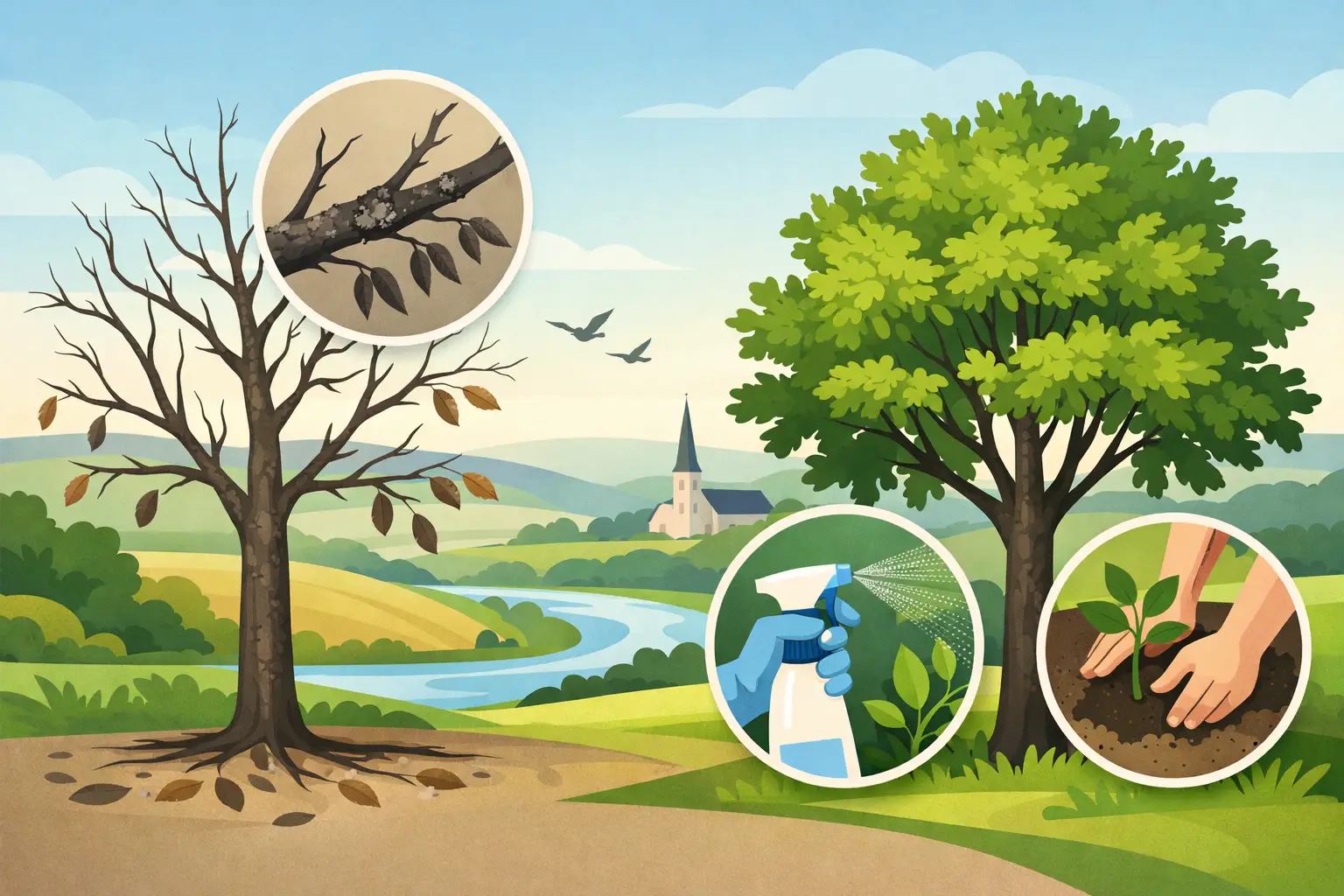
Ash dieback is caused by a fungal disease, Hymenoscyphus fraxineus. It commonly shows as thinning foliage, leaves that wilt or blacken, dead shoots and branches, and lesions where branches join the stem. As the disease progresses, the crown can die back and the tree may become more vulnerable to other problems, including brittle branches and decay around the base.
Symptoms can be easier to spot when the tree is in leaf, but a proper inspection considers more than the canopy. An arborist will look at the stem, major unions, root flare, nearby targets and the overall structure of the tree. A tree with a sparse crown in an open field presents a very different level of concern from a similarly affected tree beside a house, school car park or busy road.
Not every thinning ash has dieback, and not every ash with dieback is immediately dangerous. Drought, compacted ground, root damage and other diseases can also affect vigour. This is why an on-site assessment is more reliable than making a decision from a photograph alone.
Ash dieback treatment options: what can and cannot help
The most honest answer is that treatment focuses on managing the effects of the disease, rather than eliminating it. Fungicides, fertilisers and other products cannot be relied upon to cure an infected ash tree. Spending money on a supposed cure can delay the practical safety work that is actually needed.
For some trees, monitoring is the right option. An ash with mild symptoms, sound structure and no high-value target beneath it may be retained and inspected regularly. This can be particularly appropriate in larger gardens, estates, woodland edges and rural land, where there is space to manage risk without removing every affected tree. Monitoring should be planned rather than informal, with inspections brought forward after high winds or visible changes in the canopy.
Selective pruning can be suitable where the main concern is deadwood or a limited number of compromised branches. Removing dead or failing limbs can reduce immediate risk and improve clearance over paths, gardens and buildings. It is not a cure for ash dieback, and heavy pruning of a declining tree can create further stress. The work needs to be measured, with cuts chosen to improve safety while preserving as much sound structure as possible.
Crown reduction may occasionally be considered where a tree has a sound lower stem but an overextended or deteriorating crown close to a target. This is a specialist judgement. Reducing weight and leverage can sometimes extend a tree’s safe retention, but it will not stop the disease progressing. Where decay, extensive dieback or instability is present, reduction may simply postpone a removal that is already necessary.
Removal is often the safest option for trees that are severely affected, structurally unsound or positioned where failure could cause harm. This includes ash trees close to homes, garages, roads, play areas, power lines and frequently used access routes. A controlled dismantle allows sections to be lowered safely, protecting surrounding property and avoiding the uncertainty of waiting for the tree to fail in poor weather.
When felling becomes the sensible decision
The condition of the tree matters, but location often decides the urgency. A dead branch above an unused corner of a field may be manageable through exclusion and monitoring. The same branch above a parked vehicle or garden seating area needs prompt attention.
Warning signs that warrant a professional inspection include large dead branches, bark loss, cracks, cavities, fungal growth at the base, a noticeably leaning stem or a crown that has rapidly thinned. If branches have already fallen, do not work beneath the tree or attempt to remove hanging limbs yourself. Diseased ash can fail unpredictably, and climbing or cutting it without the right equipment and training carries significant risk.
Storm damage changes the picture quickly. High winds can expose weaknesses that were not obvious from ground level, leaving split limbs or partially detached crowns. In these situations, an emergency tree service can make the area safe, remove immediate hazards and advise on the remaining tree.
Before felling work begins, checks may be needed for Tree Preservation Orders, conservation area status and nesting birds. Bats and other protected wildlife can use cracks, cavities and loose bark on mature ash. These considerations do not necessarily prevent essential safety work, but they can affect how and when the job is carried out. A professional contractor should identify potential issues early and ensure the work is planned responsibly.
Retaining habitat without retaining unnecessary risk
Ash trees support a wide range of wildlife, and a declining tree can still have ecological value. Where an affected ash is well away from people and property, retaining it as a standing deadwood habitat tree may be possible. In other locations, a shortened stem or habitat monolith can sometimes provide a safer compromise after the hazardous crown has been removed.
This approach depends on the site. A retained stem is not suitable beside a public footpath, neighbouring boundary or building, and it will still need periodic review as it breaks down. On estates, farms and larger grounds, carefully chosen habitat retention can preserve value while keeping key areas safe.
If full removal is necessary, replacement planting is worth considering from the outset. Avoid relying on one species. A mixed selection suited to the soil, available space and future size will create a more resilient landscape. Native species may be appropriate in many settings, while gardens and commercial sites may need trees selected for their form, root behaviour and tolerance of urban conditions.
A practical plan for homeowners and site managers
Start by keeping people away from any obvious hazard. Move vehicles, garden furniture or equipment from beneath dead limbs where possible, and do not put up ladders or try to pull branches down. Take clear photographs from a safe distance and note any recent changes, such as fallen limbs or a suddenly bare section of crown.
The next step is a professional assessment. For a straightforward garden tree, this may result in a recommendation for monitoring, targeted pruning or removal. Larger sites with multiple ash trees benefit from a surveyed management plan that ranks trees by condition and risk. This helps property managers budget sensibly and deal with the highest-priority trees first, rather than reacting only after a failure.
Ask what the proposed work is intended to achieve. A clear recommendation should explain whether it is reducing immediate risk, providing clearance, retaining habitat or removing a declining tree altogether. It should also cover access, protection of lawns and nearby features, safe lowering methods, waste removal and the condition in which the site will be left.
At T.G. Bird Tree Services, ash dieback work is approached with the same practical focus as any hazardous tree job: assess the risk, use the right method for the location and leave the area clean and safe. For homeowners, landowners and commercial sites, early advice usually creates more options than waiting for a branch to fall.