
A tree can look solid from the drive or pavement and still be hiding serious structural weakness. That is why knowing the top signs of tree decay matters for homeowners, landlords and site managers alike. When decay is left unchecked, what starts as a health issue can quickly become a safety problem, especially near houses, roads, footpaths, fences and parked vehicles.
Not every decaying tree needs immediate removal, and not every odd-looking mark means the tree is dangerous. The key is knowing what to look for, what can wait, and when to bring in a qualified arborist for a proper assessment.
Top signs of tree decay you should not ignore
Tree decay usually develops over time. In many cases, the earliest signs are easy to miss unless you know where decay tends to show first – around the base, at old pruning wounds, in major branch unions, and where bark has already been damaged.
1. Fungal growth on the trunk or around the base
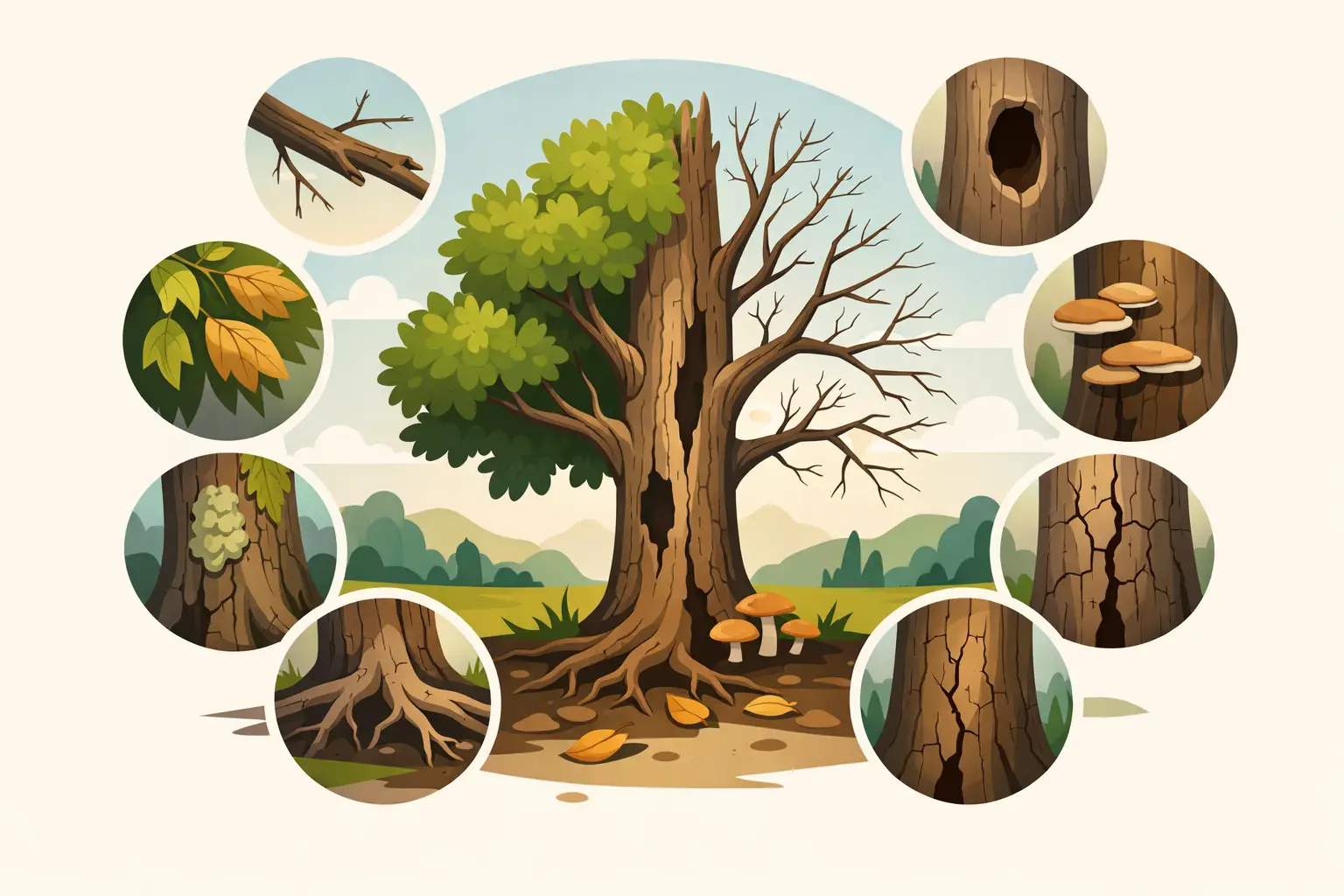
One of the clearest warning signs is fungal fruiting bodies, such as brackets, toadstools or crust-like growths on the trunk, roots or surrounding soil. Fungi feed on dead or decaying wood, so visible fungal growth often suggests there is internal decay somewhere in the tree.
That does not always mean the whole tree is beyond saving. Some fungi indicate localised decay, while others are linked to deeper structural failure in the root plate or lower stem. The position, type and extent of fungal growth all matter. A mature tree with a single bracket fungus may be manageable with pruning and monitoring, while a tree with decay fungi at the base near a target area may need more urgent attention.
2. Cavities and hollow sections
A hollow trunk, open cavity or deep pocket in a scaffold limb is another common sign that decay has been progressing for some time. Trees can survive with hollow areas, and some remain stable for years, but the level of risk depends on how much sound wood is left and where the defect sits.
A cavity in a secondary limb is very different from major decay at the base of the main stem. If the hollow area is large, expanding, or paired with cracks or deadwood, it should be professionally assessed. Internal decay is not always obvious from the outside, which is why a visual check only tells part of the story.
3. Cracks, splits and weak branch unions
Long vertical cracks, fresh splits and weak unions where large limbs meet the trunk can all point to structural stress. Decay often develops in these areas because water gets in, fungi follow, and the wood starts to lose strength from the inside.
This is particularly concerning after strong winds or prolonged wet weather. A crack does not always mean immediate failure, but if it is widening, weeping, or linked to movement in the canopy, it needs prompt attention. Trees overhanging buildings, driveways or public spaces should not be left to chance.
4. Dead branches in the crown
A few small dead twigs are normal on many trees, especially in shaded areas. Larger dead branches, repeated dieback through the crown, or whole sections failing to leaf properly can suggest a bigger problem. In some cases, the issue is disease, drought stress or root damage. In others, decay in the stem or main limbs is disrupting the tree’s ability to support healthy growth.
Deadwood also creates a direct hazard in its own right. Even if the main tree is still standing soundly, large dead branches can fall without much warning. That is one reason routine inspections are so valuable on older trees and those close to homes or access routes.
What decay looks like around the base
The base of the tree is one of the most important places to inspect. If decay affects the butt roots or lower stem, stability can be compromised even if the canopy still looks reasonably healthy.
5. Bark falling away or sunken areas
Loose bark, missing sections, soft patches or visibly sunken areas on the trunk can all indicate dead tissue beneath. Healthy bark protects the tree. When it starts to detach or collapse in irregular sections, there may be decay underneath.
This is especially worth noting if the exposed wood feels soft or crumbly, or if there is dark staining around the affected area. Damage from mowers, strimmers, vehicles or previous poor pruning can all open the door to infection and rot.
6. Soft, crumbling or discoloured wood
If exposed wood at a wound, cavity or broken branch looks spongy, flaky or unusually dark, the timber may already be breaking down. Sound wood should feel firm. Decayed wood often loses that density and can sometimes be probed easily.
Different types of decay affect timber in different ways. Some produce a brittle, dry texture, while others leave wood stringy or fibrous. For a property owner, the exact category matters less than the practical point – if the wood is no longer sound, the tree may no longer be structurally reliable.
7. Soil movement or lifting roots
If the ground around the base appears raised, cracked or disturbed, especially after wind, the root plate may be moving. That does not always mean decay is the cause, but root decay is one possible reason. A tree can fail from below while still carrying a full green canopy.
This is one of the more urgent signs because root instability can lead to sudden collapse. If you notice recent leaning, exposed roots, or movement in the soil around a large tree, it is best to keep people clear and arrange an inspection quickly.
Signs higher up in the canopy
Some of the top signs of tree decay appear in the crown rather than on the trunk. A tree under internal stress often shows it through reduced vigour, patchy growth or repeated branch failure.
8. Sparse leaves, early leaf drop or one-sided decline
A thinning canopy, poor leaf size, early autumn colour or dieback on one side of the tree can all point to underlying health problems. Decay is not the only possible cause, but it should be considered, especially in older or previously damaged trees.
One-sided decline can be particularly revealing. If one major limb or one side of the crown is struggling while the rest looks fair, there may be decay or dysfunction linked to that section. Trees do not always decline evenly.
When a decaying tree becomes a safety issue
The real question is not simply whether a tree has decay. It is whether the decay has reduced the tree’s strength enough to create unacceptable risk. A veteran tree in open ground may tolerate a degree of hollowing without posing much danger. The same level of decay beside a house, school entrance or car park is a very different matter.
That is where context matters. Size, species, age, location, wind exposure and previous pruning history all affect how serious the issue is. Fast-growing species can become brittle as decay progresses. Large limbs over targets deserve more caution than defects tucked away in low-use corners of a garden.
For that reason, there is no one-size-fits-all answer. Some trees can be managed with selective pruning, deadwood removal, reduction work or ongoing monitoring. Others are too compromised to leave standing safely.
What to do if you spot the signs
If you notice any of these warning signs, avoid trying to diagnose the full problem yourself from ground level. A close visual inspection by an experienced tree surgeon or arborist is the sensible next step. They can assess whether the decay is superficial, localised or structurally significant, and advise on the safest option.
Do not climb the tree, cut heavy limbs without the right equipment, or assume a green canopy means the structure is sound. Trees often keep producing leaves long after decay has taken hold internally.
For properties in Norfolk and Suffolk, this is where a practical local service makes a difference. T.G. Bird Tree Services deals with trees in real working environments – gardens, driveways, boundaries, commercial grounds and storm-damaged sites – where safety, access and tidy completion all matter just as much as the diagnosis.
A good inspection should leave you with a clear recommendation, whether that is no immediate action, maintenance work, or removal before the tree becomes hazardous. Peace of mind comes from acting early, not waiting for the next spell of strong wind to make the decision for you.
If a tree on your property is showing fungal growth, cavities, cracks or deadwood, treat it as a prompt to get it checked rather than a reason to panic. Catching decay early often gives you more options, and safer ones too.