
A tree can look solid from the drive and still be one strong gust away from dropping a limb over a fence, car or roof. That is why knowing how to spot dangerous trees matters for homeowners, landlords and site managers alike. You do not need to be an arborist to notice when something is wrong, but you do need to know which warning signs should never be ignored.
In Norfolk and Suffolk, we see trees dealing with high winds, heavy rain, dry spells and compacted ground around homes, roads and work sites. All of that affects stability. Some problems build slowly over years, while others appear after a storm or ground disturbance. A quick look now and then can help you catch issues early, before they become expensive or unsafe.
How to spot dangerous trees from the ground
The first step is simple – stand back and look at the whole tree. Do not start by focusing on one branch. Check the overall shape, the lean, the canopy density and how the tree sits in relation to nearby buildings, roads, parked vehicles and footpaths. A healthy mature tree will not always look perfectly symmetrical, so this is not about neatness. It is about change.
If a tree has recently started leaning, that is a serious concern. A long-standing lean can be normal, especially in trees shaped by light or prevailing wind, but a fresh lean, lifted soil around the base, or cracking ground can point to root plate movement. That means the tree may already be unstable. If you see this after strong winds, do not wait to see if it settles.
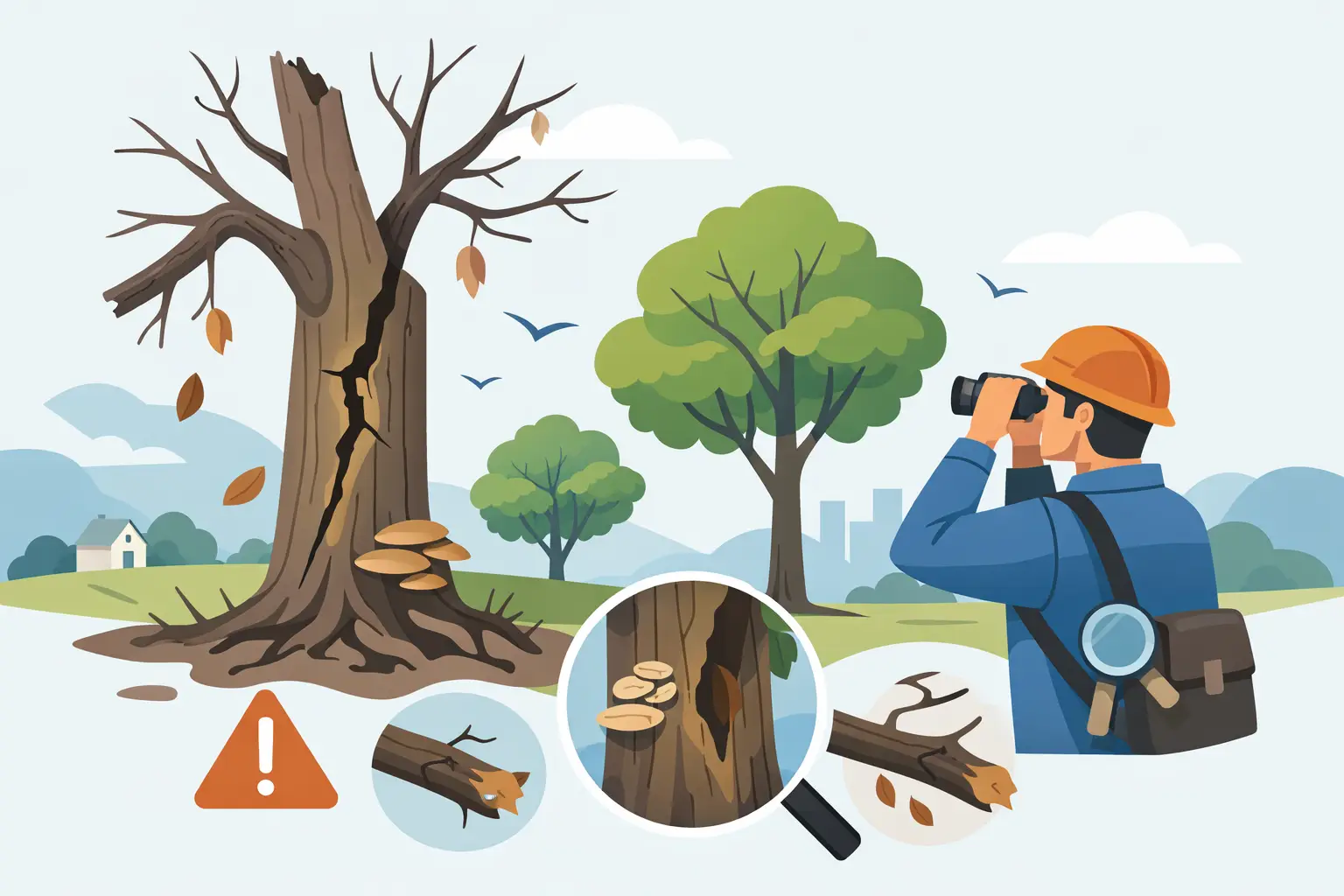
Dead or hanging branches are another obvious hazard. Large limbs caught up in the canopy can fall without much warning, especially in windy weather. Smaller deadwood may seem less urgent, but over paths, gardens, play areas and car parks it still presents a real risk. If a branch has no leaves in season, brittle bark and a dry, lifeless appearance, it may already be dead.
Canopy thinning also matters. If one side of the crown is sparse while the rest looks healthy, the tree may be under stress or suffering from disease, root damage or structural weakness. Sudden dieback in the upper crown is often more concerning than a few bare twigs lower down.
Warning signs on the trunk and base
The trunk and the base often tell you more than the canopy does. Cracks in the stem, splits where major limbs join, and areas where bark is missing can all indicate structural failure. Not every scar means a tree is dangerous, but deep fissures, widening seams or fresh splits should be checked properly.
Cavities and hollow areas are another sign to treat with care. A tree does not need to be completely solid to remain standing, but internal decay can reduce strength significantly. The difficulty is that a hollow trunk may still carry a full leaf canopy, which makes it look healthy from a distance. That is where people get caught out.
Look closely around the base for fungal growth. Brackets or mushrooms growing from the trunk flare, roots or nearby soil may indicate decay inside the root system or lower stem. The type of fungus matters, and not every fruiting body means immediate failure, but it always deserves attention. Decay at the base is often more serious than decay higher up because it affects the tree’s anchor point.
Peeling bark can also be a clue. Some species naturally shed bark, so context matters, but if bark is falling away in dead patches and the wood underneath looks dry or rotten, the tree may be in decline. Combine that with dieback above and you are no longer looking at a cosmetic issue.
Root problems often go unnoticed
When people ask how to spot dangerous trees, roots are often missed because most of the problem sits below ground. Yet root damage is one of the main causes of sudden instability.
If building work, trenching, paving, driveway installation or heavy vehicle traffic has taken place near a tree, its root system may have been compromised. The effect is not always immediate. A tree can lose key roots and then begin to decline months later, or fail during the next storm.
Watch for lifted soil, fresh mounding, exposed roots that have snapped, or a tree that seems to have shifted position. Waterlogging around the base can also weaken the ground’s hold, especially after prolonged wet weather. In contrast, very dry conditions can shrink and crack soil, placing different stress on roots and surrounding ground.
Trees close to new extensions, outbuildings, service trenches or resurfaced access areas should be checked carefully. The work may be finished, but the tree could still be reacting.
Common signs a tree may be unsafe
Some warning signs are more urgent than others. The most concerning usually involve movement, decay and dead sections over targets such as roads or homes. A few examples include:
- a sudden lean or soil lifting around the base
- major deadwood or broken branches hanging in the crown
- deep cracks in the trunk or unions
- fungal brackets at the base or on structural roots
- significant dieback in the canopy
- cavities combined with visible weakness or decay
One sign on its own does not always mean removal is needed. Several signs together usually mean the tree needs professional assessment sooner rather than later.
Storm damage and hidden risk
After high winds, do not assume a tree is safe just because it is still standing. Storm damage is not always obvious from the ground. Branch unions can split without falling apart completely. Root plates can loosen before the trunk starts to move. Limbs can become suspended in the canopy and drop later when the weather is calm.
This is especially important if the tree overhangs a public area, neighbouring property or access route. If you notice fresh cracks, torn bark, snapped tops or new leaning after a storm, keep people away and arrange an inspection. The same applies if another tree has fallen nearby. Shared exposure can reveal weakness in surrounding trees too.
When a tree is unhealthy, not just untidy
An overgrown tree is not necessarily a dangerous one. Equally, a neatly shaped tree is not always safe. Appearance can be misleading.
Some signs point more to poor health than immediate hazard, such as small leaves, early autumn colour, patchy growth or reduced vigour. Even so, these changes can be the start of a wider issue. Pests, disease, restricted rooting space and repeated poor pruning can all weaken a tree over time. If the tree is close to buildings or frequently used areas, it is worth acting early rather than waiting for obvious failure.
Poor previous pruning is worth mentioning here. Heavy topping or badly cut limbs often lead to weak regrowth, decay at cut points and unstable branch attachments later on. The tree may have been cut back years ago and only now be showing the consequences.
When to call a professional arborist
If you are ever unsure, the safest decision is to have the tree inspected. That is especially true where there is visible decay, storm damage, major deadwood, root disturbance or any risk to people and property. A professional arborist can tell the difference between a tree that needs monitoring, one that needs pruning, and one that has become unsafe.
That matters because the right response is not always felling. Some trees can be made safe through crown reduction, removal of deadwood, pollarding, cable bracing or targeted management. Others are too compromised and need to come down before they fail. It depends on the species, condition, location and level of risk.
For commercial sites, schools, managed estates and rental properties, regular inspections make even more sense. They help with risk management, site safety and maintenance planning. For homeowners, they offer peace of mind, especially after storms or if a tree has changed noticeably.
A sensible approach to how to spot dangerous trees
You do not need specialist equipment to notice the first signs of trouble. Look for change, not perfection. A new lean, dead limbs, fungal growth, trunk cracks, root disturbance and canopy dieback all deserve attention, particularly when the tree stands near something valuable or well used.
Never climb a suspect tree, never try to remove heavy hanging branches yourself, and never assume a quiet day means the danger has passed. Trees often fail after the warning signs have been visible for some time. Catching those signs early is the safest and most cost-effective way to deal with the problem.
If a tree on your property does not look right, trust that instinct and get it checked. A professional opinion now is far better than an emergency callout after a branch or whole tree has come down.