
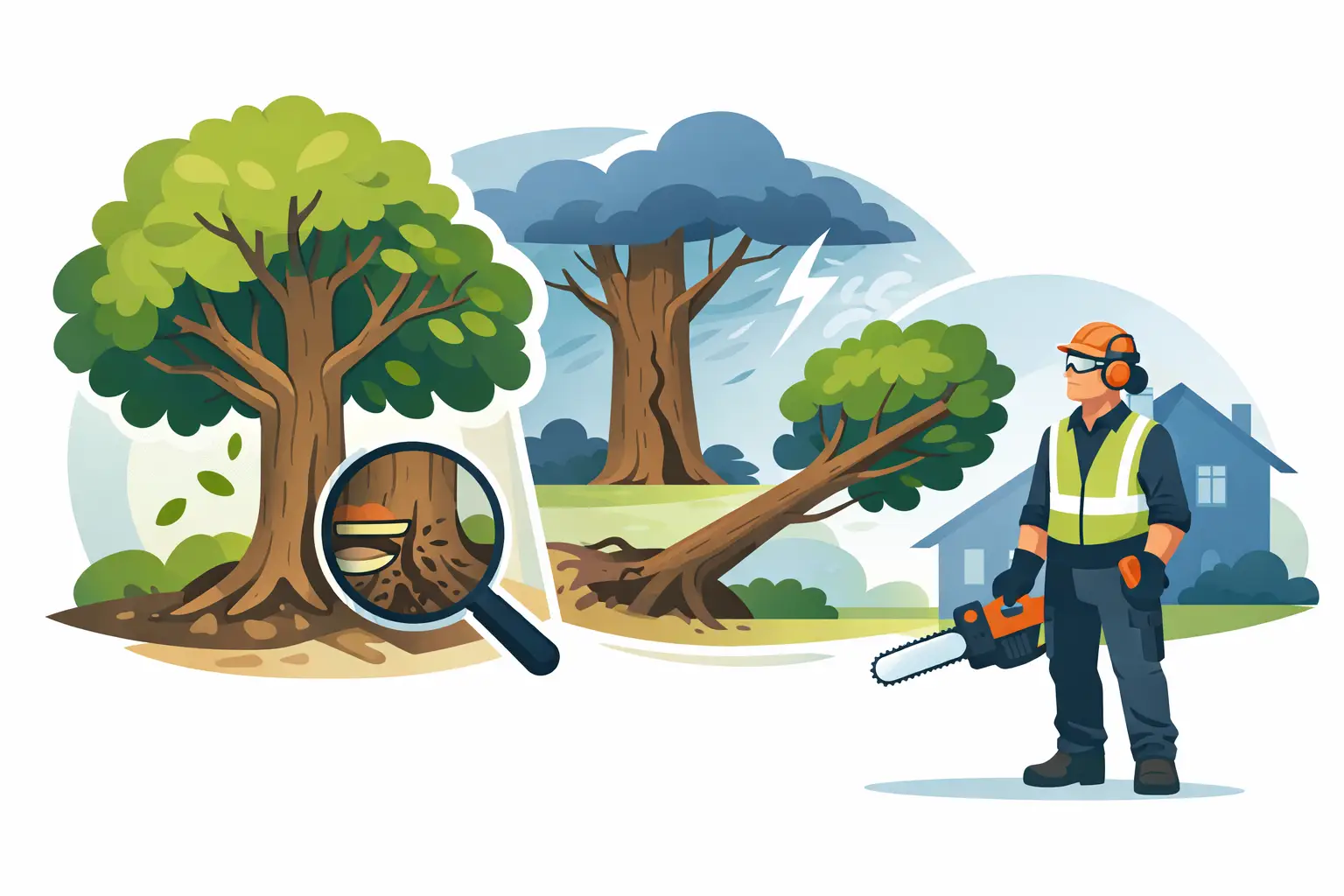
A tree can look healthy from the ground while hiding serious decay, storm damage or structural weakness higher up. If you are asking when should a tree be felled, the answer is rarely based on its size alone. The deciding factors are its condition, location, risk to people or property, and whether careful pruning could provide a safer alternative.
For homeowners, landowners and site managers, acting at the right time can prevent damage, disruption and an urgent call-out after bad weather. A professional assessment gives you a clear view of the work required, the safest method, and any restrictions that need checking before a saw is started.
When should a tree be felled for safety?
Felling may be the right option when a tree presents a clear and ongoing risk that cannot be managed through pruning or bracing. Dead trees are a common example. Once a tree has died, its timber gradually becomes brittle and unpredictable. Branches may fail without warning, while the main stem can become unsafe to climb or dismantle.
Visible cracks, splits in major limbs, a leaning trunk, large cavities and roots lifting from the ground all deserve prompt attention. These signs do not always mean the whole tree must come down, but they do mean it should be inspected by an experienced arborist. The risk is higher where the tree stands close to a house, road, footpath, play area, fence, overhead line or neighbouring property.
Storm damage can change the situation quickly. A partly fallen tree, a hanging branch or a cracked limb over a driveway should be treated as an immediate hazard. Keep people away from the area and avoid attempting to pull, cut or climb the tree yourself. Tensioned timber can move suddenly, and even a small branch can cause significant injury or damage.
Tree health problems that may justify felling
Disease and decay are another reason a tree may need removal, particularly when the defect affects its structure. Fungal growth around the base can indicate internal decay, although the type of fungus and the tree species both matter. Likewise, thinning foliage, dead crowns, premature leaf drop and extensive dieback can point to declining health, but they are not a diagnosis on their own.
Some trees can be retained with targeted deadwood removal, crown reduction or ongoing monitoring. This is often the preferred route where the tree has good amenity value, supports wildlife or provides useful screening. Felling becomes more likely when disease has caused substantial weakness, when the tree is in irreversible decline, or when it poses an unacceptable risk in a busy location.
Ash dieback is a familiar concern across Norfolk and Suffolk. The disease can cause leaf loss, crown dieback and brittle branches, with affected trees deteriorating at different speeds. An ash in an open field may be monitored for a period, while one beside a public path, garden or building may need action much sooner. Each case needs to be assessed on its own condition and setting.
Location can make a manageable tree high risk
A sound tree in the wrong place can still create a practical problem. Roots may be affecting paving, drains, retaining walls or foundations, while a dense canopy can block light, overhang a roof or repeatedly shed branches onto parking areas. However, felling is not automatically the first answer.
Pruning may reduce weight from extended limbs, improve clearance from a building, let more light into a garden or remove deadwood safely. In other situations, a carefully planned crown reduction can keep a mature tree in place without spoiling its shape. This is why a site visit matters. A proper recommendation considers the tree’s species, age, condition, growth pattern and the targets around it.
Removal is usually the sensible long-term choice where a tree has outgrown a confined space, has major structural defects, or is repeatedly causing damage that cannot reasonably be controlled. For commercial sites, planned felling can also reduce liability and keep access routes, car parks and shared outdoor areas safe for staff, visitors and residents.
Check protection before a tree is felled
Before arranging tree felling, check whether the tree is protected by a Tree Preservation Order or sits within a conservation area. In many cases, permission or formal notice is required before work can take place. Removing, lopping or wilfully damaging a protected tree without the correct consent can lead to enforcement action and substantial fines.
If you are unsure, your local planning authority can confirm the tree’s status. Boundary trees need extra care too. Even if a trunk sits on your land, branches, roots, access arrangements and ownership can involve a neighbour. Clear communication before work starts helps prevent avoidable disputes.
Wildlife should also be considered at every stage. Trees can provide nesting sites, roosting features and shelter for birds, bats and other species. Bird nests in use are protected, and bat roosts are protected by law. A responsible tree contractor will assess obvious habitat features and advise if specialist ecological checks are needed before work proceeds.
Is there a best time of year for tree felling?
There is no single month that suits every tree and every site. Winter is often practical because deciduous trees have fewer leaves, access may be easier, and gardens tend to be used less. It can also make it easier to see the tree’s structure and plan the dismantling process.
That said, ground conditions matter. Heavy rain can leave lawns, paddocks and access routes soft, making machinery and timber removal more difficult. Summer felling can be completed safely where needed, especially for urgent hazards, but nesting bird activity needs careful consideration. For protected species and sensitive sites, timing may be dictated by ecological advice rather than convenience.
The best time is therefore when the work can be completed safely, legally and with the least disruption to your property. A dangerous tree should not be left in place simply because it is not the ideal season for routine work.
Why professional felling is the safer choice
Tree felling is not just a matter of cutting through a trunk. The work involves assessing lean, weight distribution, decay, nearby obstacles, escape routes and the likely direction of fall. Where space is limited, a tree may need to be dismantled in sections rather than felled from the ground. This often involves controlled rigging, climbing equipment and careful lowering of branches and timber.
Attempting the job with domestic equipment can put people, buildings and surrounding trees at risk. It can also leave a dangerous stump, damaged lawn or large volumes of waste to deal with. Professional tree surgeons plan the work around the site, protect nearby surfaces where possible, manage the timber and leave the area clean and safe.
At T.G. Bird Tree Services, recommendations are based on what the tree and the site actually need. That may mean selective pruning and monitoring, or it may mean a carefully controlled removal where there is no safe alternative. The aim is always straightforward: reduce risk, protect your property and leave the site looking properly cared for.
Do not wait for the tree to fail
If a tree has recently changed shape, dropped unusually large branches, developed a crack, begun leaning or shown obvious signs of decline, arrange an inspection before the next spell of high winds. Early action gives you more options and usually allows the work to be planned calmly rather than carried out as an emergency.
A well-timed professional assessment can preserve a tree worth keeping. Where felling is necessary, it ensures the work is carried out with the right equipment, suitable controls and respect for the people, property and wildlife around it.