
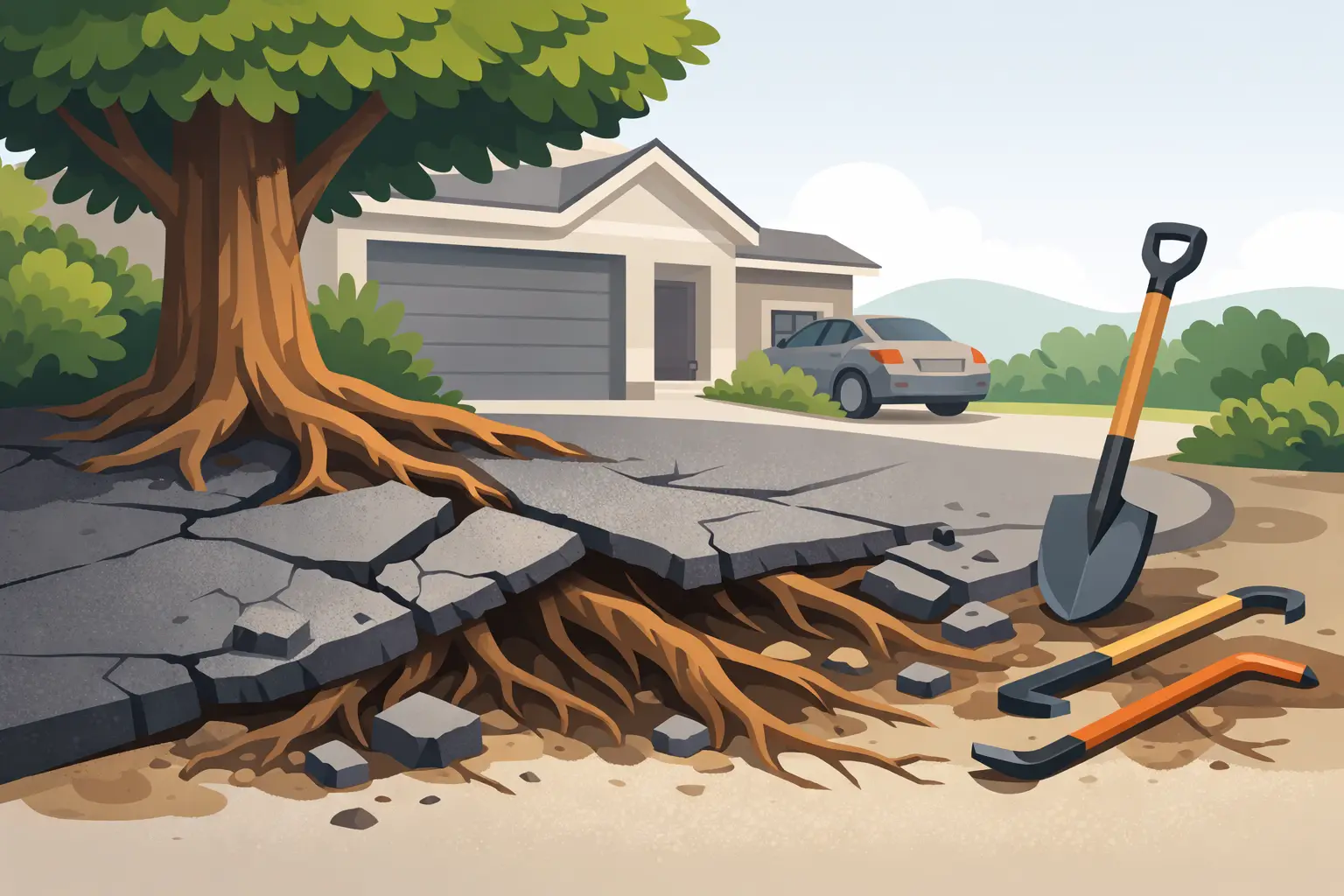
A driveway rarely fails all at once. More often, you notice one raised edge, a small crack, or a patch that never seems to sit level again. When tree roots damaging driveway surfaces are the cause, the problem usually gets worse gradually – and then becomes expensive quickly.
For homeowners and site managers, the real concern is not just appearance. Lifted paving and broken concrete create trip hazards, affect drainage, and can make parking awkward or unsafe. If the tree is close to the house, garage or boundary, there may also be wider questions about root spread, long-term stability and the right fix.
Why tree roots damaging driveway problems happen
Roots do not usually break through solid materials because they are strong enough to smash them apart. In most cases, they exploit weaknesses that are already there. A driveway may have shallow foundations, slight movement, poor compaction underneath, or cracks that let moisture in. As roots thicken over time, they place pressure on the surface from below and push sections upward.
This is why the same species of tree can cause obvious damage in one garden and very little in another. Soil type, driveway construction, tree age, moisture levels and distance from the trunk all matter. Clay soils are especially worth watching because they expand and shrink with changing moisture, which can add to movement around roots.
Older tarmac and block paving often show the issue sooner than a well-laid reinforced slab, but no surface is completely immune if a large root system is close enough. Drives that were installed after the tree was already established can be particularly vulnerable, as the roots were there first and continue to expand beneath the new surface.
Signs the driveway damage is root-related
Not every crack near a tree means roots are to blame. Ground settlement, heavy vehicle use and poor installation can produce similar symptoms. That said, there are a few signs that point more clearly towards roots.
A localised ridge or hump running away from a nearby tree is one of the most common. You may also see blocks lifting in a line, tarmac bubbling upward, or concrete slabs tilting rather than simply sinking. If the damage sits between the tree and the driveway edge, that can also be a clue.
In some cases, surface roots are visible in nearby borders or lawn areas, which supports the diagnosis. But visible roots are only part of the picture. Significant structural roots can sit below the surface and still affect paving and sub-base layers.
Which trees are more likely to cause trouble
Fast-growing, vigorous species tend to create the most concern, especially if planted too close to hard surfaces. Willow, poplar, sycamore, ash and some maples are common examples, but any tree with a large, healthy root system can contribute to driveway movement in the wrong setting.
That does not mean the answer is always to remove the tree. A mature tree adds value, privacy and character, and in many cases the damage can be managed without losing it. The right decision depends on the species, condition, location and how severe the root conflict has become.
Young ornamental trees near narrow driveways can still cause problems if the planting space is too tight. Small tree size above ground does not always mean a small issue below ground. Root spread can extend well beyond the visible canopy.
Can you just cut the roots?
This is the question most people ask first, and the honest answer is: sometimes, but not casually.
Cutting roots without assessing the tree can create bigger problems than the driveway damage itself. Structural roots help anchor the tree and support its health. If too much is removed, or the wrong roots are cut close to the trunk, the tree may become unstable or decline over time. That risk increases with mature trees, trees exposed to strong winds, and trees already under stress.
There is also the practical issue that root pruning does not always give a permanent result. If the surface is rebuilt at the same level and in the same way, further root growth may simply lead to the same problem again. A proper solution looks at both the tree and the construction of the driveway.
This is where a professional assessment matters. An experienced arborist can identify whether selective root pruning is realistic, whether the tree is likely to tolerate it, and whether the work should be combined with other measures such as driveway redesign or, in some cases, tree removal.
Repair options for a driveway damaged by roots
The best repair depends on how advanced the damage is and whether the tree is staying.
If the movement is minor, lifting and relaying small sections of block paving may be enough for the short term. This can remove trip hazards and improve the finish, but it is rarely a long-term answer if active roots remain directly underneath.
For more established damage, the affected area may need to be excavated and rebuilt with a root-aware approach. That could mean adjusting levels, using a suitable sub-base, or bridging over roots rather than cutting through all of them. In some cases, a flexible surface performs better than a rigid one where some movement is unavoidable.
Concrete can be the hardest to repair neatly once roots have caused major lifting. Replacement often gives a better result than patching. With block paving, there is usually more flexibility to rework sections, though the sub-base still needs to be right or the problem returns.
If the tree is unsuitable for the location, removal and stump grinding may be the more practical long-term solution. That is not always the first choice, but where repeated repairs are likely, it can be the most cost-effective route.
When tree removal is the sensible option
Removing a tree is a significant decision, particularly if it is mature or important to the look of the property. But there are situations where it is clearly the better option.
If the tree is in poor condition, structurally unsound, heavily leaning, diseased, or simply far too close to the driveway and property, spending money on repeated paving repairs may not make sense. The same applies where root pruning would seriously affect stability or where multiple large roots are already lifting a wide section of the drive.
For commercial sites and rental properties, there is also the issue of liability. A raised or broken surface can become a health and safety concern for staff, tenants, customers and visitors. Prompt action is often the wiser course.
Where protected trees are involved, always check whether consent is needed before carrying out works. A professional tree contractor can advise on that process and help avoid costly mistakes.
How to stop the problem from coming back
Prevention is usually cheaper than repair. If you are planning a new driveway, tree position should be considered from the start, not once cracks appear.
Allowing enough distance between trees and hard surfaces makes a major difference. So does choosing species that suit the available space. If there is already an established tree nearby, the driveway design should work around realistic root spread rather than ignoring it.
A properly built sub-base, suitable edging and the right surface material all help. In some locations, minor design changes can preserve both the driveway and the tree. This is often a better result than heavy-handed root cutting after the problem has already developed.
For existing sites, regular inspection helps catch early signs before the damage becomes severe. A slight lift in paving is much easier to deal with than a full section of broken concrete.
Getting the right advice early
Driveway damage linked to roots is one of those jobs where guesswork can cost more than the original problem. A builder may focus on the surface. A tree owner may focus on keeping the tree. The best outcome usually comes from assessing both together.
At T.G. Bird Tree Services, that practical approach matters. The aim is not to recommend the most drastic option by default, but to identify what is safe, sensible and worth doing for the long term. Sometimes that means careful tree work and a targeted repair. Sometimes it means accepting that the tree has outgrown the space.
If you have a raised, cracked or uneven drive near a tree, it is worth dealing with it before the next winter freeze, heavy rain or daily traffic makes the damage worse. A clean, safe driveway and a properly managed tree can often coexist – but only when the problem is handled properly from the start.
The sooner you understand what is happening below the surface, the easier it is to make a sensible decision above it.