

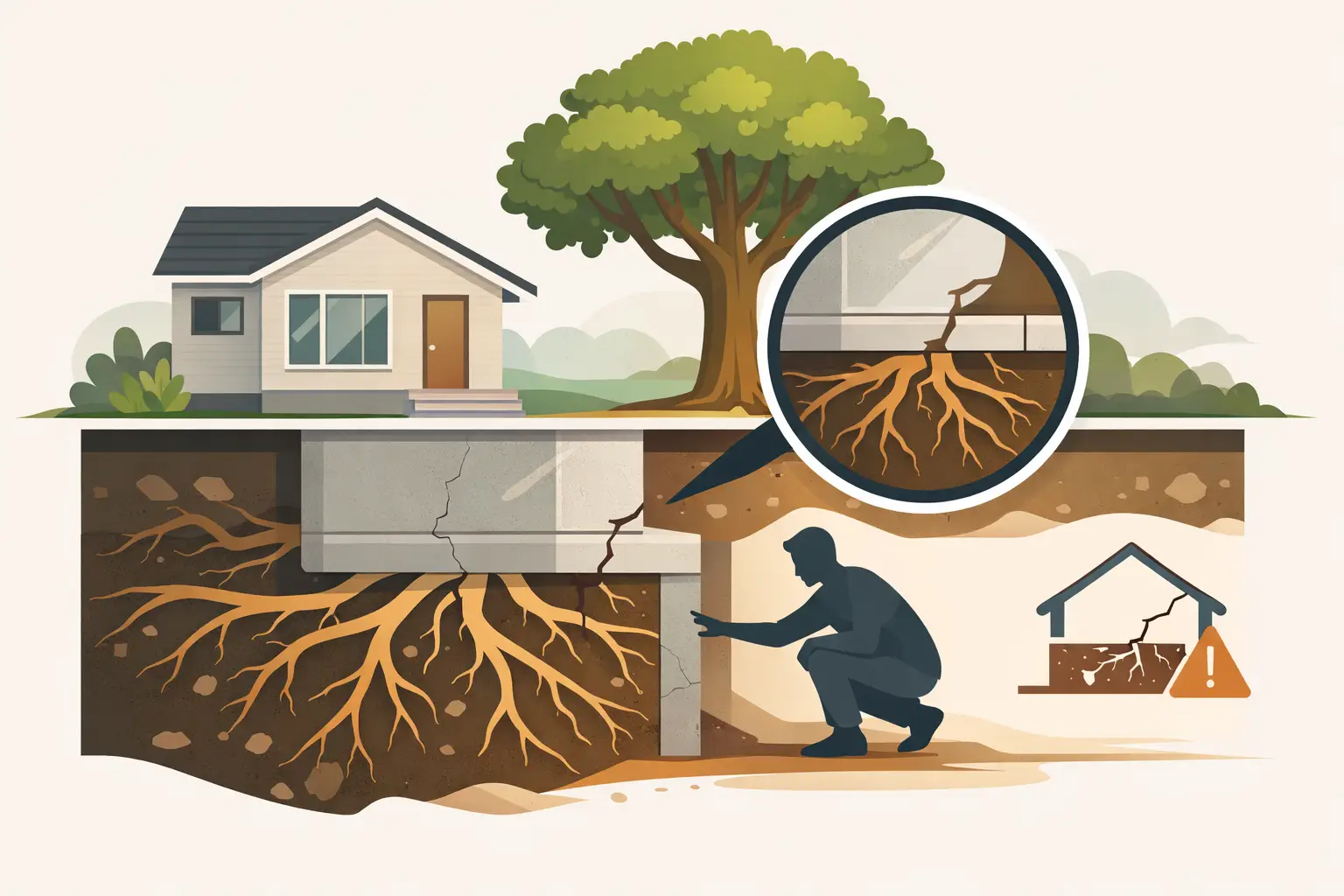
A mature tree beside a home can be a real asset, but cracks in brickwork or a sticking door can quickly raise a worrying question: can tree roots damage foundations? The short answer is yes, but not always in the way people expect. In many cases, roots do not physically force their way through sound concrete. The greater risk is often the effect a tree has on the soil beneath and around a building.
Getting the cause right matters. Removing a healthy tree unnecessarily can be costly and may even make certain ground movement issues worse. Leaving a tree that is contributing to damage, however, can allow the problem to continue. A proper assessment gives you a safe, proportionate route forward.
Can tree roots damage foundations directly?
Tree roots naturally grow towards moisture, oxygen and spaces in the ground where they can travel more easily. They can exploit existing defects in old drains, damaged paving and already weakened masonry. If a foundation, retaining wall or drainage pipe has a crack or poor joint, roots may enter it and increase the damage over time.
However, healthy roots are not usually strong enough to break through modern, well-built foundations simply by growing against them. A tree close to a property is therefore not automatically a problem. The age of the building, foundation depth, soil type, tree species, distance from the property and condition of nearby drains all need to be considered together.
Older properties can be more vulnerable because their foundations may be shallower or less consistent than those used in modern construction. Extensions may also have different foundation depths from the original house, which can create a point where movement shows more clearly.
The main concern: soil movement
Across parts of Norfolk and Suffolk, ground conditions vary significantly from one property to the next. Where a building sits on shrinkable clay soil, trees can contribute to subsidence by drawing moisture from the ground during dry periods. As clay dries, it shrinks. If the soil beneath one part of a property shrinks more than elsewhere, foundations can move unevenly and cracks may appear.
This does not mean every tree near a clay-soil property will cause subsidence. Large, high-water-demand trees planted close to a building are more likely to be a concern than a small ornamental tree further away. Mature willow, poplar, oak and leylandii can have substantial root systems, but species alone never tells the whole story.
The opposite issue, known as heave, can occur after a mature tree is removed from clay ground. Once the tree is no longer taking moisture from the soil, the clay can rehydrate and expand. That is why tree removal should not be treated as an automatic cure for suspected subsidence. The work needs to be planned around the property, the soil and professional advice.
Roots and drains are a separate issue
Roots are often blamed for blocked drains, and sometimes they are responsible. They are particularly attracted to leaking pipes because those leaks provide a steady water source. Once roots enter a damaged joint or crack, debris can collect around them and restrict the flow.
Even so, the root growth usually reveals an existing fault rather than creating a perfect pipe break from nothing. A drainage survey can establish whether a damaged drain is present and whether it is linked to local ground washout, damp patches or movement near the property.
Warning signs worth taking seriously
One hairline crack does not prove tree-related damage. Buildings settle, plaster moves with seasonal temperature changes, and minor cracks can develop for many reasons. What matters is the pattern, position and progression of the issue.
Keep an eye on cracks that widen over time, particularly diagonal cracks running from the corners of doors or windows. Doors and windows that begin to stick, gaps appearing between extensions and the main building, rippling wallpaper, or movement in patios and paths may also need investigation.
Outside, look for persistent damp ground, blocked or slow drains, lifted paving and visible roots close to walls. Record when you first noticed the issue and take clear photographs at intervals. This gives a surveyor or structural engineer useful evidence and helps distinguish a new problem from an old, stable defect.
Do not assume that the nearest tree is to blame. Poor drainage, leaking water pipes, failed gutters, nearby construction work and historic settlement can produce similar signs. An accurate diagnosis protects both your property and any trees that do not need work.
What to do if a tree is close to your home
Start with a visual assessment from a qualified, experienced tree professional. They can identify the species, assess the tree’s condition, estimate its likely root spread and consider its proximity to buildings, walls, paving and services. They can also spot separate safety concerns, such as dead limbs, decay or storm damage.
If there is evidence of structural movement, speak to your building insurer before arranging major work. Insurers may require a structural engineer’s report, soil testing, crack monitoring or drainage investigations before agreeing on a solution. Acting without this information can complicate a claim or remove evidence needed to establish the cause.
An arborist can then work alongside the recommendations from the structural assessment. Depending on the findings, the best outcome may involve careful crown reduction, ongoing management, root barrier considerations, drain repairs or, where justified, controlled tree removal. There is no single distance from a house that makes every tree safe or unsafe.
Avoid cutting roots yourself
It can be tempting to cut exposed roots near a wall, driveway or patio. This is rarely a good idea. Removing major roots can make a tree unstable, create a route for decay and affect its long-term health. It may also fail to address the actual cause of a cracked surface or building movement.
Root pruning requires careful judgement. The size, location and number of roots involved matter, as does the species and condition of the tree. On protected trees, works may also need formal consent. A professional assessment should come before any cutting, excavation or stump removal close to a structure.
When pruning can help, and when it cannot
Appropriate pruning can reduce a tree’s canopy and may reduce its water demand over time. It can be useful where a tree is healthy, valuable and suitable for long-term management. It is not an instant fix for established subsidence, and heavy, poorly timed pruning can leave a tree stressed, misshapen or unsafe.
A sensible programme is usually more effective than drastic cutting. The aim is to maintain the tree’s form and condition while managing its size in line with the site. For homeowners and property managers, this also makes future maintenance more predictable.
Where removal is necessary, stump grinding may be considered once the tree has been felled. This removes the visible stump and allows the area to be reused, but it does not mean every root can or should be extracted from the ground. Aggressive excavation near foundations, drains or utility services can create further risk.
A practical approach for property owners
If you are concerned about a tree near your foundations, avoid making a rushed decision based on a crack or an online rule of thumb. Photograph the signs, check whether they are changing, and arrange the right inspections. Tree condition and safety can be assessed by an arborist, while suspected structural movement may need input from a structural engineer and drainage specialist.
For tree work in Norfolk and Suffolk, T.G. Bird Tree Services can assess the condition, position and management options for trees close to homes and commercial buildings. Work is planned with safety, site cleanliness and the wider condition of the property in mind.
A well-managed tree and a well-maintained property can often sit comfortably together. The key is acting early, protecting the evidence, and choosing work that solves the real problem rather than simply removing the nearest tree.