
A mature tree can be one of the best features of a property – until it becomes overgrown, damaged or too close to a building. Deciding between tree surgery or full felling is not simply a question of removing what is in the way. The right option depends on the tree’s condition, its position, the level of risk and what you want your outdoor space to look like in the years ahead.
For many homeowners and site managers, careful tree work can preserve a valued tree while making it safer and more manageable. In other cases, removal is the most responsible course of action. A professional assessment gives you a clear answer without unnecessary work or guesswork.
Tree surgery or full felling: start with safety
Safety should always lead the decision. A tree with dead branches, storm damage, decay, a split trunk or visible movement at the base may pose a risk to people, vehicles, roofs, fences and neighbouring land. The risk is often greater where trees stand beside roads, footpaths, driveways, schools, commercial premises or power lines.
Tree surgery can often reduce that risk. Removing deadwood, reducing long or heavily weighted limbs, taking out crossing branches and improving the tree’s overall shape can make a significant difference. This approach is particularly useful where the tree is fundamentally healthy but has grown too large for its setting.
However, pruning cannot repair every problem. Extensive decay, major root damage, severe instability or a structurally unsound trunk may mean the tree cannot be retained safely. In those situations, full felling may be the sensible option. Retaining a dangerous tree simply because it still has foliage can lead to greater damage and cost later on.
A visual inspection from ground level does not always reveal the full picture. Cavities, fungal growth, cracks, old wounds and decay can indicate internal weakness, but they need to be assessed in context. The condition of the canopy, trunk, roots and surrounding ground all matter.
When tree surgery is the better choice
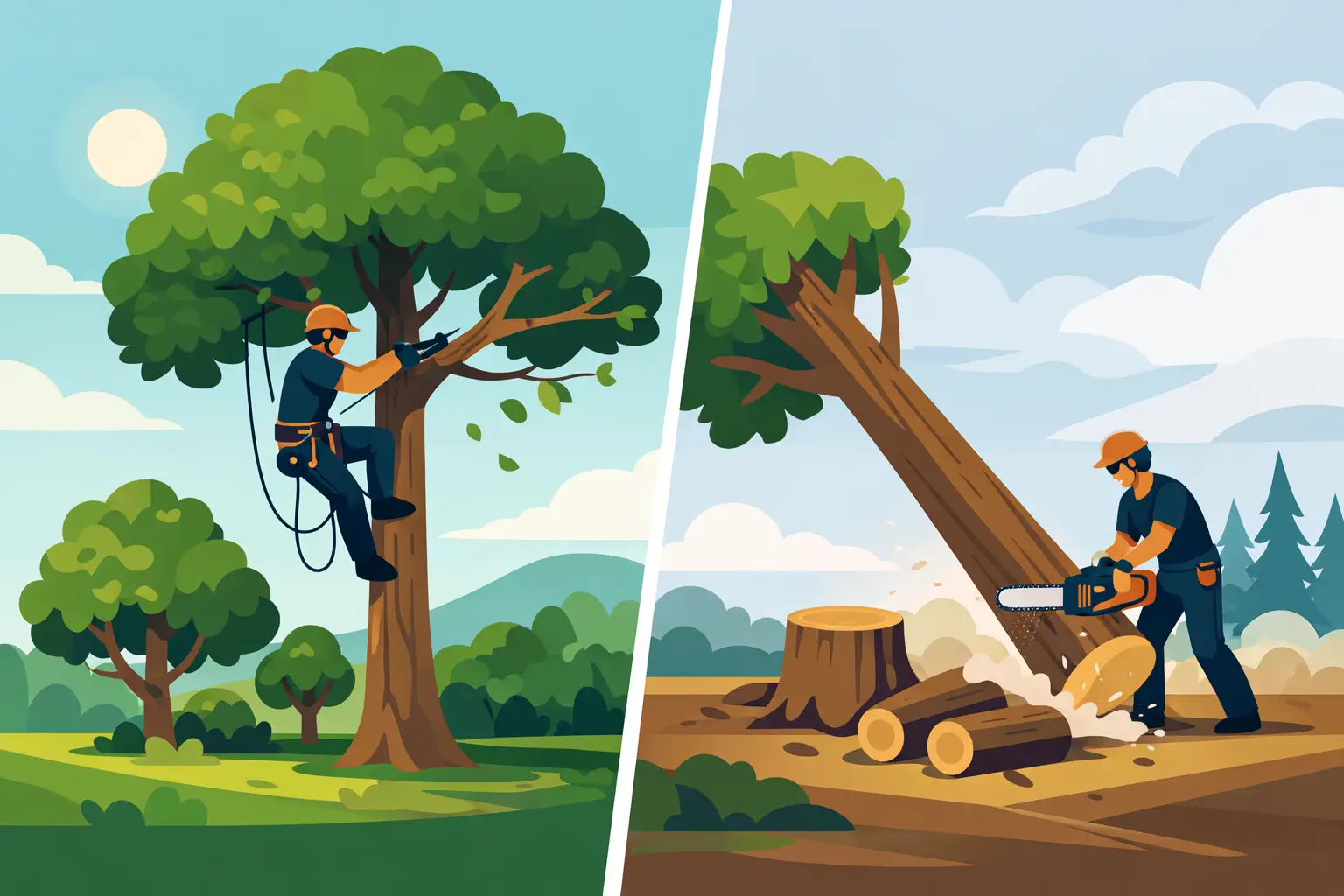
Tree surgery is designed to improve the health, safety and appearance of a tree while retaining it wherever possible. It is not one single service. The work may involve crown reduction, crown thinning, crown lifting, deadwood removal, formative pruning or pollarding, depending on the species, age and condition of the tree.
A well-planned crown reduction can reduce the spread and height of a tree without leaving it bare or misshapen. This may be appropriate when branches are reaching towards a roof, blocking light, overhanging a drive or becoming too heavy in high winds. The work must be carried out with care, using suitable pruning points that support healthy regrowth.
Crown lifting removes selected lower branches to create clearance above paths, lawns, driveways or access routes. It can make a garden feel more open while allowing the main tree to remain in place. Crown thinning is different again: it selectively removes smaller branches throughout the canopy to reduce density and wind resistance without dramatically changing the tree’s overall size.
Tree surgery is often the right choice when a tree has long-term value. It may provide privacy, shade, wildlife habitat, screening from a road or a strong visual feature in a garden. A healthy established tree can take decades to replace, so preserving it is usually worth considering when safe and practical.
That said, aggressive cutting is not the answer to every overgrown tree. Removing too much canopy at once can stress a tree, encourage weak regrowth and leave it looking poor. The best results come from work that respects the species, growth pattern and future management needs of the tree.
Trees close to homes and buildings
A tree growing near a property does not automatically need to be removed. Roots, branches and leaf fall are common concerns, but each needs a measured response. Branches can often be reduced away from gutters, chimneys and windows. Regular maintenance may also prevent a manageable issue becoming an urgent one.
Where subsidence is suspected, specialist advice may be needed before any work takes place. Felling a tree without understanding the cause of movement can sometimes create further problems, particularly on shrinkable clay soils. A responsible contractor will not treat every nearby tree as the cause.
When full felling is the right decision
Full felling is appropriate when a tree is dead, dying, dangerous, badly diseased, severely storm-damaged or unsuitable for its position. It can also be the practical answer where repeated pruning would be needed every few years but would not resolve the underlying issue.
For example, a large conifer planted too close to a house may block light, dominate a small garden and continue to outgrow the space. Heavy reduction can provide temporary relief, but it may leave the tree unattractive and create an ongoing maintenance commitment. Removing it and choosing a more suitable replacement can be better for the property in the long run.
Felling may also be needed to clear space for an extension, new access, redevelopment or essential repairs. On commercial sites, removing a hazardous or poorly located tree can help protect staff, visitors and the public while reducing future liability.
The method matters as much as the decision. Where there is enough clear space, a tree may be felled in one controlled operation. In tight gardens or beside buildings, sheds, greenhouses and roads, sectional dismantling is usually safer. The tree is carefully taken down in manageable sections, often using ropes and rigging to lower timber where necessary.
This is skilled work. Large branches and timber can cause serious damage if they are not handled correctly, and access restrictions often make a job more complex than it first appears. Professional equipment, safe working practices and a clear plan protect both the site and the people around it.
Consider the future of the space
The decision is not only about what the tree looks like today. Think about how you use the area and what you need from it over the next five to ten years. A tree that currently shades a patio may become welcome during hot weather, while the same tree may be unsuitable if it prevents a planned extension or continually drops large amounts of debris into a pond or guttering.
Ask whether regular pruning will keep the tree at a suitable size without harming its form. Consider the cost of ongoing maintenance against the cost of removal. Also think about replacement planting. Removing one unsuitable or failing tree can create an opportunity to plant a smaller, better-placed species that will suit the garden for decades.
For landowners and property managers, planned maintenance is often more cost-effective than waiting for a problem. Routine inspections and sensible pruning can identify weak limbs, clearance issues and early signs of decline before they lead to an emergency call-out.
Permissions and wildlife checks come first
Before arranging major pruning or felling, check whether the tree is protected by a Tree Preservation Order or stands within a conservation area. Permission or formal notice may be required, and carrying out unauthorised work can lead to serious consequences. The rules can apply even when the tree is on private land.
Wildlife also needs careful consideration. Birds may be nesting in hedges and trees, while bats can use cavities, loose bark and other features as roosting sites. Work should be planned around the conditions on site and stopped or adjusted if protected wildlife is found.
A professional tree contractor will assess access, protection status, surrounding structures and likely disposal requirements before starting. This preparation helps the work run safely and avoids unpleasant surprises on the day.
Do not overlook the stump
After felling, the stump remains. Leaving it can be suitable in some areas, particularly where it is out of the way and there is no plan to replant, pave or build nearby. But a stump can create a trip hazard, encourage regrowth, harbour fungal decay or obstruct landscaping work.
Stump grinding removes the visible stump and major surface roots below ground level, leaving the area ready for turfing, planting or other garden improvements. It is generally less disruptive than digging out a stump with machinery, especially in smaller gardens with limited access.
The choice depends on your plans for the space. If a new tree is being planted in the same area, the old stump and root system should be considered carefully to give the replacement the best chance of establishing well.
Choosing a contractor you can rely on
Whether the work involves a modest crown reduction or a complex dismantle beside a house, choose a contractor with the right experience, insurance, equipment and safety procedures. Ask what work is proposed, why it is recommended and how the site will be left afterwards. Clear answers are a good sign.
At T.G. Bird Tree Services, every job is approached with practical planning, safe working and a tidy finish in mind. The aim is not to remove trees unnecessarily, but to provide the right solution for the tree, the property and the people using it.
If you are unsure whether a tree needs pruning, reducing or removing, do not wait for the next storm to make the decision for you. A professional inspection can turn an uncertain problem into a clear, manageable plan.