
A mature tree can add real character to a property, but it also needs attention when its condition changes. This guide to tree risk assessments explains how homeowners, landowners and site managers can spot concerns early, understand what an inspection involves and make sensible decisions before a small issue becomes an emergency.
What is a tree risk assessment?
A tree risk assessment is a structured inspection of a tree and its surroundings. The aim is not to remove every tree with a defect. It is to identify whether a defect could fail, what it could strike if it did, and what practical work may reduce the risk.
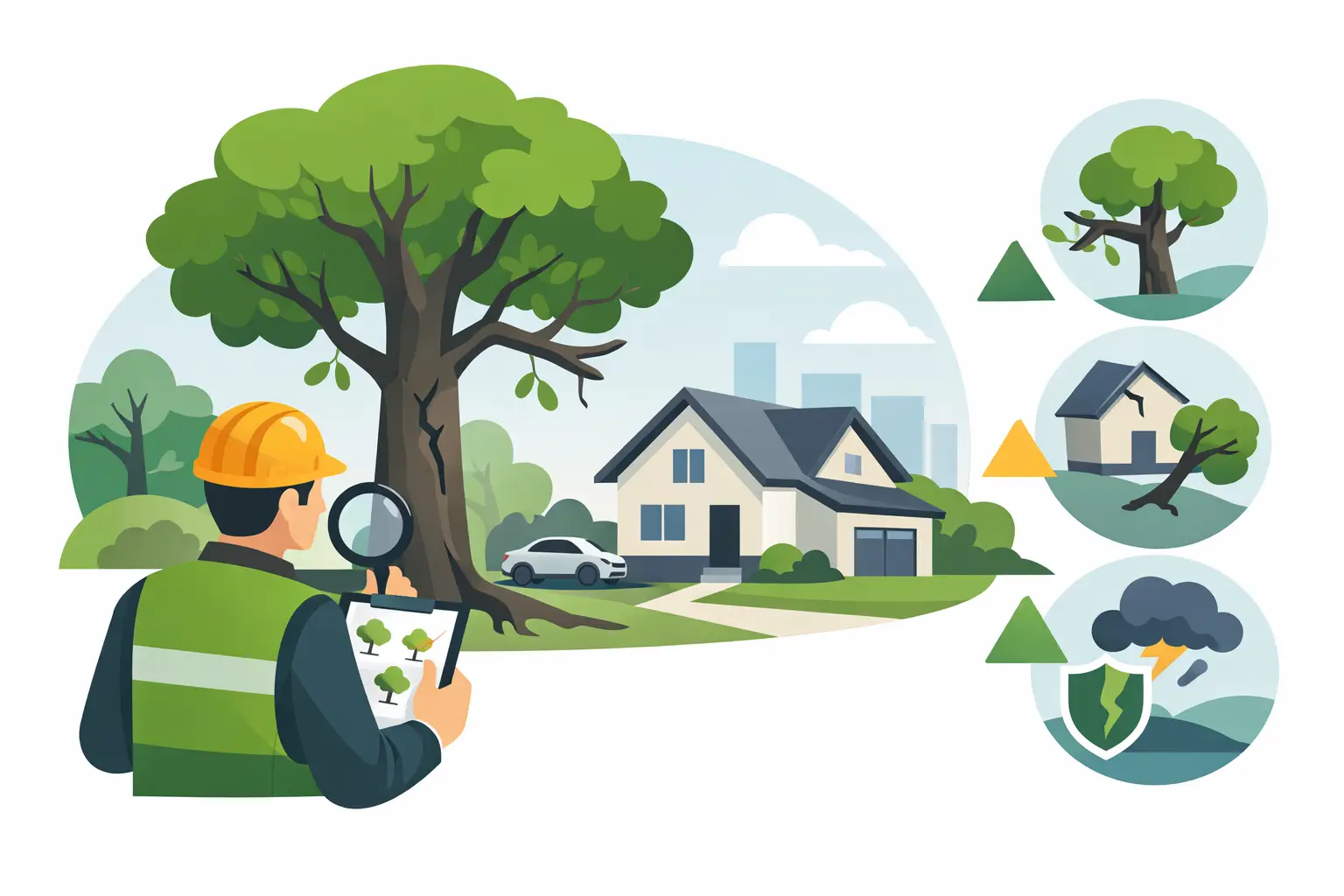
A professional arborist will consider the tree’s species, age, condition and position. They will also look at nearby targets such as homes, garages, footpaths, roads, play areas, fences, vehicles and overhead lines. A hollow or leaning tree in an open field may need monitoring, while the same tree beside a busy driveway may require prompt action.
Risk is therefore about more than whether a tree looks healthy from a distance. It comes down to the condition of the tree, the likelihood of failure and the consequences if a branch, stem or root plate fails.
Why assessments matter for homes and commercial sites
Storms, prolonged wet weather, high winds and dry periods can all expose weaknesses that were not obvious before. Trees can also decline gradually through disease, pest damage, poor past pruning, compacted soil or root disturbance caused by building work.
For a homeowner, an assessment provides clear advice before arranging pruning, tree removal or emergency work. For property managers and commercial operators, routine checks help support a safer site for residents, staff, visitors and the public. They also make maintenance easier to plan, rather than reacting only when a branch has already fallen.
There is a balance to strike. Trees bring privacy, shade, wildlife value and visual appeal, so removal is not always the right answer. Skilled pruning, crown reduction, deadwood removal or monitoring may be enough. The appropriate option depends on the tree’s condition, its location and the level of use around it.
Warning signs that deserve attention
Many tree defects are visible from ground level, although they still need professional interpretation. If you notice a sudden change after a storm, keep people and vehicles clear of the area until it has been checked.
Look out for the following signs:
- Dead, hanging or broken branches, especially over paths, parking areas or roofs.
- Fresh cracks, splits or cavities in the trunk or major limbs.
- A new or worsening lean, raised soil or cracking around the base of the tree.
- Fungal growth around the trunk base, which can indicate decay in roots or timber.
- Peeling bark, extensive dieback in the crown or leaves appearing much thinner than usual.
- Ivy concealing the trunk, damaged roots from excavation, or soil piled against the base.
None of these signs automatically means that a tree will fail. For example, some fungi are harmless to a living tree, while a cavity may be contained within sound surrounding wood. Equally, a tree can look green and full of leaf while having a serious defect at its base. This is why a close inspection by an experienced arborist is worthwhile.
How a professional tree risk assessment is carried out
Most assessments begin with a visual ground inspection. The arborist reviews the tree from different angles, checks the crown, trunk, root flare and surrounding ground, and records defects alongside potential targets. They will ask about recent changes too, such as storm damage, construction work, drainage problems or branches that have previously failed.
The inspection may lead to one of three broad outcomes. The tree may be suitable for normal monitoring, it may need planned tree work to reduce a specific risk, or it may need urgent action where failure appears more likely and the consequences could be serious.
Where the initial findings are unclear, a more detailed inspection may be advised. This can involve climbing inspections, specialist decay detection equipment or further investigation of roots and soil conditions. Not every tree needs this level of testing. It is normally reserved for higher-value trees, complex defects or trees close to significant targets.
A useful assessment should leave you with practical next steps, not vague warnings. That may include removing deadwood, reducing an overextended limb, removing a failing section, installing temporary exclusion zones, carrying out further investigation or arranging a review at a suitable interval.
Do not overlook the tree’s surroundings
The same defect carries different weight depending on what is below it. This is one of the most important parts of any tree risk assessment.
A large limb over a rarely used corner of a garden is not assessed in the same way as a smaller limb over a school entrance or public pavement. Frequency of use matters. A car parking space used daily, a neighbour’s conservatory and a pedestrian route all increase the potential consequences of failure.
Ground conditions matter as well. Waterlogged soil can weaken root anchorage, while recent trenching, new driveways and changes in ground level can damage roots or alter drainage. Trees often respond slowly to root damage, so the effect may not become clear until months or years after the work took place.
If you are planning an extension, patio, driveway or utility works near a mature tree, seek advice before work begins. Protecting roots and allowing enough space around the tree can avoid expensive problems later.
When to arrange an assessment
There is no single inspection schedule that suits every property. Trees beside occupied buildings, busy roads, public areas or regular parking should be checked more frequently than trees in low-use areas. Larger, older specimens and trees with known defects also deserve closer attention.
As a sensible starting point, arrange an inspection when you first take responsibility for a property with mature trees, after significant storms, or whenever you notice a visible change. A routine review can then be planned around the level of risk and the arborist’s recommendations.
Do not wait for a dramatic event if there are clear warning signs. A branch rubbing against a roof, a cracked limb over a drive or soil lifting around the base are all reasons to seek advice promptly. In an immediate danger situation, keep well away from the tree and arrange emergency assistance rather than attempting to cut or climb it yourself.
Tree work is not always the answer
It can be tempting to remove a tree simply because it is large or close to a building. Size alone does not make a tree unsafe. In fact, unnecessary or poorly specified pruning can create new problems, including weak regrowth, decay at large wounds and an unbalanced crown.
The right work should address the actual issue. Deadwood removal can reduce the chance of brittle branches falling. Selective pruning may reduce loading on a heavy limb. Crown reduction may be appropriate for a tree with certain structural limitations, but it must be carefully specified to retain a natural shape and long-term health. Where decay, instability or severe structural defects cannot be managed acceptably, felling may be the safest option.
This is where experienced advice makes a practical difference. T.G. Bird Tree Services assesses each site individually, carrying out tree work with safe working methods and leaving the area tidy once the job is complete.
Permissions, wildlife and good timing
Before authorising work, check whether the tree is protected by a Tree Preservation Order or stands within a conservation area. Permission or formal notice may be required before pruning or felling can take place. Your local planning authority can confirm the position, and an arborist can help explain the work that may be needed.
Wildlife also needs consideration. Birds may nest in trees and bats can use cavities, loose bark and cracks for roosting. Tree work should be planned with this in mind, particularly during the nesting season. An urgent safety issue may still need action, but it should be handled responsibly and with the correct advice.
Keeping a clear record
For managed estates, commercial premises and rental properties, keeping basic records is good practice. Note the inspection date, the trees assessed, defects found, recommended actions and completion dates for any work. Photographs can help show changes over time.
Homeowners may not need a formal management system, but it is still useful to keep written recommendations and invoices. If an arborist advises monitoring, make a diary note for the next review rather than relying on memory.
A tree rarely becomes hazardous without giving some clue, but those clues can be easy to miss from a kitchen window or across a large site. Regular, proportionate checks give you time to choose the right work, protect the people around your property and keep valued trees in good condition for years to come.