

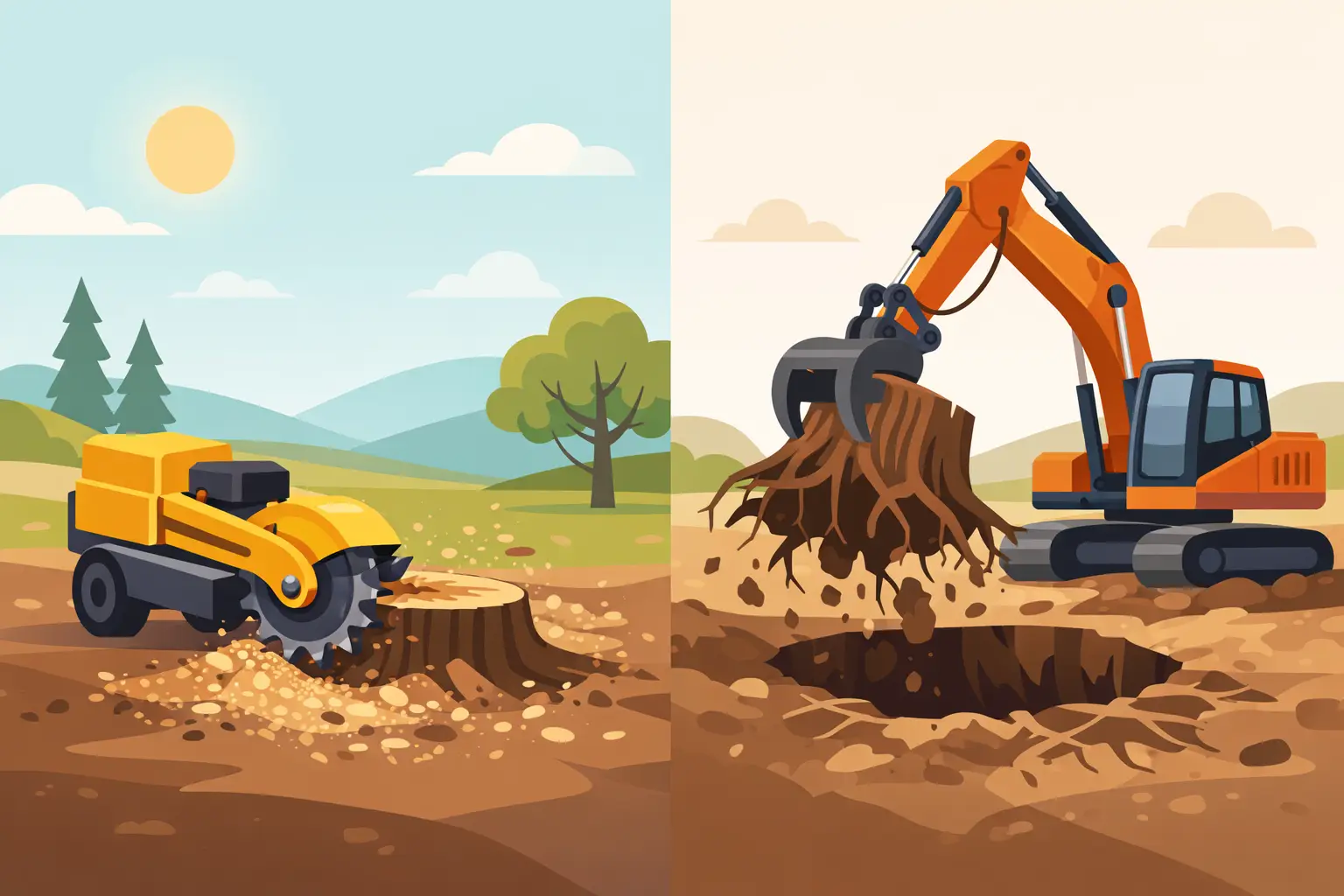
A tree has come down, the site is cleared, and then you are left with the awkward bit in the ground. When people compare stump grinding vs stump removal, they are usually trying to answer one practical question: what is the best way to finish the job without causing extra cost, mess or disruption?
The right answer depends on what you want from the space afterwards. If you simply want the stump gone below ground level so the area is safer, tidier and easier to maintain, grinding is often the most efficient choice. If you need the entire root plate taken out for building work, hard landscaping or replanting in exactly the same spot, full removal may be the better route.
What is the difference between stump grinding and stump removal?
Stump grinding means mechanically reducing the stump into woodchip using specialist machinery. The visible stump is ground down below soil level, leaving the main root system in the ground to decay naturally over time. This is usually the faster and less disruptive option.
Stump removal is more extensive. It involves extracting the stump and as much of the root ball as necessary from the ground. That can mean digging out a substantial area, especially with older trees or species with broad, stubborn root systems. It creates a larger void and typically involves more labour, more spoil and more reinstatement afterwards.
In simple terms, grinding deals with the stump itself. Removal deals with the stump and the root mass beneath it.
Stump grinding vs stump removal for most gardens
For many domestic properties, stump grinding is the option that makes the most sense. It is usually quicker to carry out, less invasive to lawns and borders, and more cost-effective than full extraction. If your aim is to improve the appearance of the garden, remove a trip hazard or make mowing easier, grinding usually delivers exactly what you need.
It is also a strong choice where access is limited. In gardens across Norfolk and Suffolk, side passages, gates and established landscaping often make heavy excavation difficult. A stump grinder can often complete the job with far less disturbance than digging out the whole root system.
That said, grinding is not the same as making the whole underground structure disappear. The roots remain in place and break down gradually. In most situations that is perfectly acceptable, but it is worth knowing before any work begins.
When full stump removal is the better option
There are situations where complete removal is the more sensible investment. If you are planning an extension, laying foundations, installing new drainage, putting in a driveway or carrying out other groundworks, remaining roots can get in the way. In those cases, leaving the root mass underground may create delays or extra site work later.
The same applies if you want to replant in the exact same position. A new tree or large shrub needs suitable soil volume and space for root establishment. A ground-out stump may still leave buried roots where you want the new planting hole to go, whereas removal gives you a clearer start.
Commercial sites also sometimes require full extraction. If a property manager needs an area completely cleared for resurfacing, fencing lines or construction access, removal can be the more practical long-term choice even if the upfront cost is higher.
Cost, time and disruption
For most customers, budget and site impact matter just as much as the technical difference. Grinding is generally the more economical option because it is quicker and involves less excavation. The machine reduces the stump where it stands, and the site can often be left neat and ready for topsoil, turf or seed with minimal further work.
Removal tends to cost more because it is a heavier job. Digging out a stump can mean more machinery, more manual work, more waste to move and a greater amount of making good once the stump is out. It is not just the extraction you are paying for, but the extra disruption around it.
Time is another factor. A straightforward grind can often be completed efficiently, while full stump removal may take longer depending on size, species, access and ground conditions. If speed matters, grinding often has the advantage.
What about roots, regrowth and future problems?
This is where some of the confusion comes from. People often assume that if roots stay in the ground after grinding, they will continue spreading aggressively or cause trouble straight away. In most cases, that is not how it works. Once the tree has been felled, the root system no longer has the support of a living canopy and begins to die back.
Some species can sucker or regrow from the stump or roots if not dealt with properly, which is why the method needs to match the species and the site. A professional assessment helps identify whether grinding alone is enough or whether additional treatment or fuller removal is advisable.
As for subsidence or structural issues, there is no one-size-fits-all answer. Nearby buildings, soil type, moisture demand and the species involved all matter. That is another reason not to treat stump work as a simple one-method job.
Access and machinery matter more than people expect
The best option on paper is not always the best option on site. Narrow access, steps, walls, utility covers, delicate paving and established planting can all influence what is realistic.
Grinding equipment comes in different sizes, and a skilled contractor will choose machinery that suits the location rather than forcing a larger machine into a tight space. Full removal, by contrast, may need more room to dig, lift and remove spoil. On a confined residential plot, that can become disruptive quite quickly.
This is often the deciding factor for customers who originally assumed they wanted complete removal. Once the impact on lawns, borders or surfaces is considered, grinding can become the more attractive option.
Which option is better for lawns, paving and replanting?
If you want to turf over the area or return it to a neat, usable lawn, stump grinding is usually enough. The stump is taken below the surface, the area is backfilled as needed, and the ground can be reinstated with far less upheaval than a full dig-out.
If you are laying paving, creating a patio base or building over the exact area, stump removal may be necessary. Hard landscaping needs stable preparation, and buried root material may not suit the specification of the project.
For replanting, it depends on scale and position. If you are moving the planting slightly away from the original stump, grinding is often fine. If you want to plant a replacement tree in exactly the same location, full removal may save problems later.
Stump grinding vs stump removal: how to choose properly
The quickest way to choose is to start with the end use of the space. If your priority is tidiness, safety and practical garden maintenance, grinding is often the right fit. If your priority is construction, exact replanting or total ground clearance, removal is often worth the added work.
You also need to consider stump size, tree species, access and what sits nearby. A small ornamental stump in an open lawn is very different from a mature stump near walls, drains or services. Good stump work is not just about getting rid of timber. It is about doing it safely, cleanly and in a way that suits the property.
That is why a site-specific recommendation matters. At T.G. Bird Tree Services, the aim is always to match the method to the job rather than push a one-answer solution.
Why professional stump work makes a difference
Stump work can look straightforward until it is not. Hidden roots, buried stone, awkward access and nearby structures all add complexity. The right machinery, careful setup and proper clean-up make a visible difference to the result.
Professional stump grinding or removal should leave the site safer, more usable and easier to move on with, whether that means re-turfing a garden, clearing land for a project or improving the look of a managed property. It should also avoid unnecessary damage to the surrounding area.
If you are unsure which route is right, think less about the stump itself and more about what needs to happen next. Once that is clear, the best option usually is too.