
A tree can look solid from the kitchen window and still be unsafe. That is often the problem. By the time obvious failure signs appear, the risk to people, vehicles, fences, sheds or buildings can already be high. If you are wondering how to know if a tree is dangerous, the key is to look for changes in structure, health and stability rather than relying on appearance alone.
Some warning signs are easy to spot. Others are less obvious and need a trained eye. A mature tree may still have leaves, still cast shade and still seem firmly rooted, while carrying major internal decay or weakened limbs. That is why tree safety is not just about whether a tree is alive. It is about whether it can safely remain where it is.
How to know if a tree is dangerous from the ground
A sensible first check starts at ground level and works upward. You do not need specialist equipment to notice the more common signs of concern, but you do need to be realistic. If a tree is close to a house, public footpath, road, parking area or play space, even a single defect may justify professional inspection sooner rather than later.
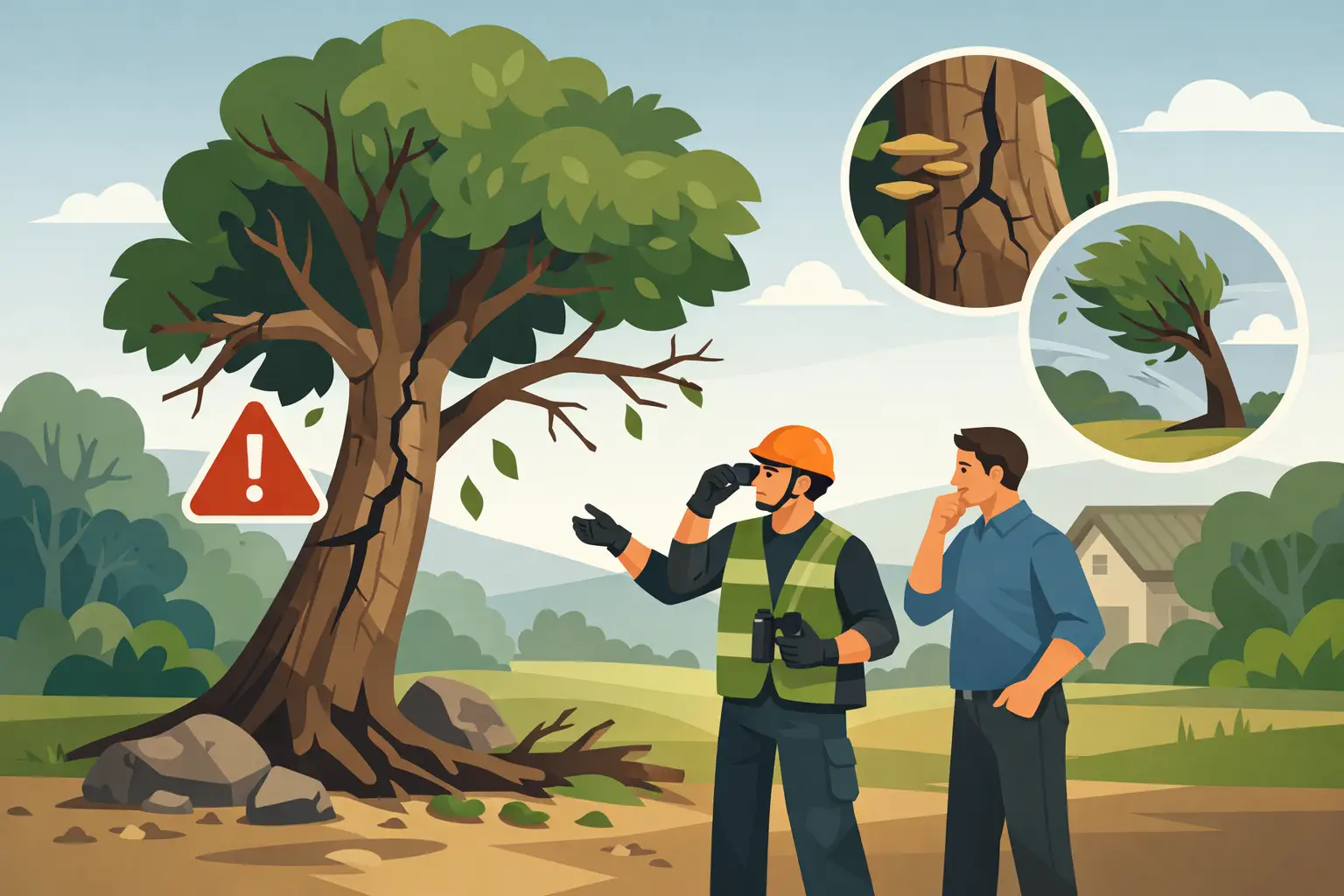
Start with the roots and the base of the trunk. If the soil is lifting, cracking or heaving around one side of the tree, that can point to movement below ground. Exposed roots, severed roots after building work, and fungal growth around the base can all suggest a loss of stability. A tree does not need to be fully uprooted to become dangerous. Small shifts can be enough to weaken its hold, especially after prolonged wet weather or strong winds.
Move up to the trunk and look for deep splits, cavities, peeling bark, dead sections or obvious wounds. Not every hollow tree is immediately unsafe, and not every crack means failure is imminent. It depends on where the defect is, how large it is, and how much sound wood remains. Still, visible damage to the main stem is never something to ignore.
In the crown, look for dead branches, hanging limbs, sparse leaf cover on one side, or large sections that no longer seem in balance with the rest of the tree. If branches are rubbing, overextended or heavily weighted over a target area such as a drive or conservatory, the level of risk goes up.
Clear signs a tree may be unsafe
One of the biggest warning signs is a recent lean. Some trees naturally grow at an angle and have done so for years without issue. A new lean, however, especially after a storm, can indicate root failure or structural weakness. If the trunk has shifted position, the soil has risen at the base, or nearby paving has lifted, do not wait to see if it settles.
Deadwood is another common sign. A few small dead twigs in a mature tree can be normal. Large dead branches are different. They become brittle, lose flexibility and can fall without much warning. This matters even more over gardens, paths, schools, car parks and commercial premises where people pass underneath.
Fungal fruiting bodies also deserve attention. Brackets or mushrooms growing on the trunk, buttress roots or from cavities may indicate internal decay. Fungus itself is not the whole story, but it can be a visible clue that the tree is breaking down inside. Some species of fungi are strongly associated with root rot or stem decay, and that can affect whether pruning is enough or whether removal is the safer option.
Cracks and splits need careful judgement. A superficial mark in the bark is one thing. A deep crack that runs into the wood, especially at a union where major limbs meet, is much more serious. Weak branch unions, particularly where bark is trapped between two stems, can fail under load even if the tree otherwise looks healthy.
Storm damage and sudden changes
Bad weather often turns a manageable issue into an urgent one. Strong winds can expose faults that were already present, while heavy rain can loosen saturated ground and reduce root support. Snow and ice can add weight to weak limbs. After any major weather event, it is worth checking trees again, especially large specimens close to buildings or access routes.
Freshly torn limbs, dangling branches and split crowns are obvious hazards, but the less dramatic signs matter too. If the canopy suddenly looks thinner, a branch union has opened slightly, or the trunk seems twisted compared with before, there may be hidden structural damage.
Do not attempt to cut or pull down damaged limbs yourself if they are under tension or hanging overhead. That is where accidents happen. Emergency tree work needs the right equipment, safe access methods and proper control of the work area.
Health problems that affect safety
A tree can become dangerous because it is declining, but decline does not always mean immediate danger. That distinction matters. Some trees with poor vigour can remain structurally stable for years. Others deteriorate fast once disease or decay takes hold.
Look out for premature leaf drop, unusually small leaves, dieback at branch tips, bleeding patches on the bark, and sections of the crown that fail to leaf up in spring. These symptoms may point to stress, disease or root damage. On their own, they do not automatically mean the tree must come down. Combined with cracks, decay or weak branch structure, they may point to a higher level of risk.
Different species also fail in different ways. Willow, poplar and Leylandii, for example, often present different management issues from oak, beech or ash. Age, soil conditions, pruning history and previous storm exposure all play a part. That is why a one-size-fits-all answer rarely works.
Trees near houses, roads and boundaries
Location matters as much as condition. A tree with defects in the middle of open land may be low priority. The same tree leaning over a road or close to a neighbour’s garage is a very different matter. Risk is always a combination of likelihood and consequence.
Branches touching roofs, gutters, chimneys, telecoms lines or outbuildings should not be ignored. Even if the tree is not in immediate danger of full collapse, repeated contact can cause damage and may point to overextension or poor previous pruning.
Boundary trees also need sensible handling. If a tree is overhanging neighbouring land and showing signs of instability, leaving it too long can create avoidable problems. Early inspection is usually the more straightforward and cost-effective route than dealing with storm damage or emergency clearance later.
When you should call an arborist
If you can see a major crack, a recent lean, large dead limbs, fungal growth at the base, root disturbance, or storm damage near a target area, it is time to call a professional arborist. The same applies if you are simply unsure. Trees can fail for reasons that are not obvious to an untrained eye, and reassurance is valuable when a tree is close to people or property.
A proper inspection looks beyond surface appearance. An arborist will assess the tree’s species, age, form, defects, vitality, surroundings and likely failure points. They can then recommend the right course of action, whether that is crown reduction, deadwood removal, bracing, monitoring or full removal.
At T.G. Bird Tree Services, that practical approach matters. Not every concern needs drastic work, but every safety concern does need clear, experienced judgement.
What not to do if you think a tree is dangerous
The biggest mistake is putting it off because the tree still looks green. The second is trying to fix it yourself with a ladder and chainsaw. Unsafe trees can behave unpredictably, and tension in damaged timber is not always visible.
It is also worth avoiding poor pruning. Topping a tree or removing the wrong limbs can make it less stable, not more. Good tree work should reduce risk while preserving structure where possible. Cheap, rushed work often leads to larger problems later.
A practical way to judge urgency
If the tree has changed recently, is close to something valuable, or shows more than one warning sign, treat it as urgent. If the issue seems minor and the tree is in open space, there may be time for a scheduled inspection rather than emergency work. Even then, it is better to have a concern checked than to rely on guesswork.
A dangerous tree is not always the one that looks worst at first glance. It is the one whose structure, roots or condition no longer match the demands of its setting. Catch that early, and you usually have more options, less disruption and a safer result for everyone around it.