
A dead tree can stand for years without causing trouble, then fail without much warning after a spell of wind or heavy rain. That is why a dead tree removal service is not just about tidying a garden or site. It is about reducing risk before branches fall, roots give way, or the whole tree comes down where it should not.
For homeowners, landlords, estates and commercial sites across Norfolk and Suffolk, the main concern is usually the same. Is the tree actually dead, and if it is, how quickly does it need dealing with? The answer depends on the tree’s position, size, condition and what is nearby. A dead ash beside a road, driveway or building is a very different job from a dead tree in an open field with space around it.
Why dead trees should not be left too long
Once a tree has died, it starts to lose structural strength. Timber becomes brittle, limbs can crack more easily, and decay may set in through the trunk, branch unions or root plate. From ground level, a dead tree might still look solid enough. Up close, an experienced arborist often finds weak points that are not obvious at first glance.
That matters because dead trees rarely improve with time. The longer they are left, the more unpredictable they become. A tree that might have been dismantled cleanly a few months earlier can turn into a more complex and hazardous removal later, especially if sections have become unstable or access has worsened.
There are also practical reasons to act sooner. A dead tree can shed bark, drop limbs over fences or parked vehicles, interfere with footpaths, and affect the appearance of a property. For commercial premises, schools, rental properties and managed grounds, there is the added pressure of keeping the site safe for visitors, tenants and staff.
Signs you may need a dead tree removal service
Some signs are clear. A tree with no leaf growth in season, brittle twigs throughout the canopy, peeling bark and obvious deadwood is often beyond recovery. In other cases, the picture is less straightforward. A stressed or diseased tree may look dead in part but still be living in other sections.
Common warning signs include a hollow-sounding trunk, fungal growth around the base, large sections of bark missing, cracks in major limbs, and branches snapping off in modest winds. Root movement is another serious issue. If the ground is lifting around the base or the tree has started to lean suddenly, removal may need to be prioritised.
It is worth saying that not every bare tree is dead. Season, species and previous pruning all affect appearance. That is why assessment matters. The right approach starts with identifying whether the tree is dead, dying, structurally unsafe, or suitable for management rather than removal.
What makes a dead tree high risk?
Location is a big factor. A dead tree overhanging a house, garage, conservatory, pavement or public road carries a very different level of risk from one at the back of a large plot. Even smaller trees can cause expensive damage if they fall the wrong way.
Tree species also play a part. Some become very brittle once dead. Others decay quickly at the base while still standing upright, which can create a false sense of security. Height, canopy spread and access constraints all influence how a job should be planned.
Then there is weather. Wind, saturated soil and repeated storms increase the likelihood of failure. In coastal and exposed parts of East Anglia, this can turn a manageable situation into an urgent one. If a dead tree is already shedding limbs or moving in the wind more than it should, it needs prompt attention.
How a professional dead tree removal service works
A proper removal begins with a site assessment. This covers the tree’s condition, nearby structures, access points, drop zones and any hazards such as overhead lines, greenhouses, sheds or narrow garden boundaries. The aim is to remove the tree safely and efficiently while protecting the surrounding area.
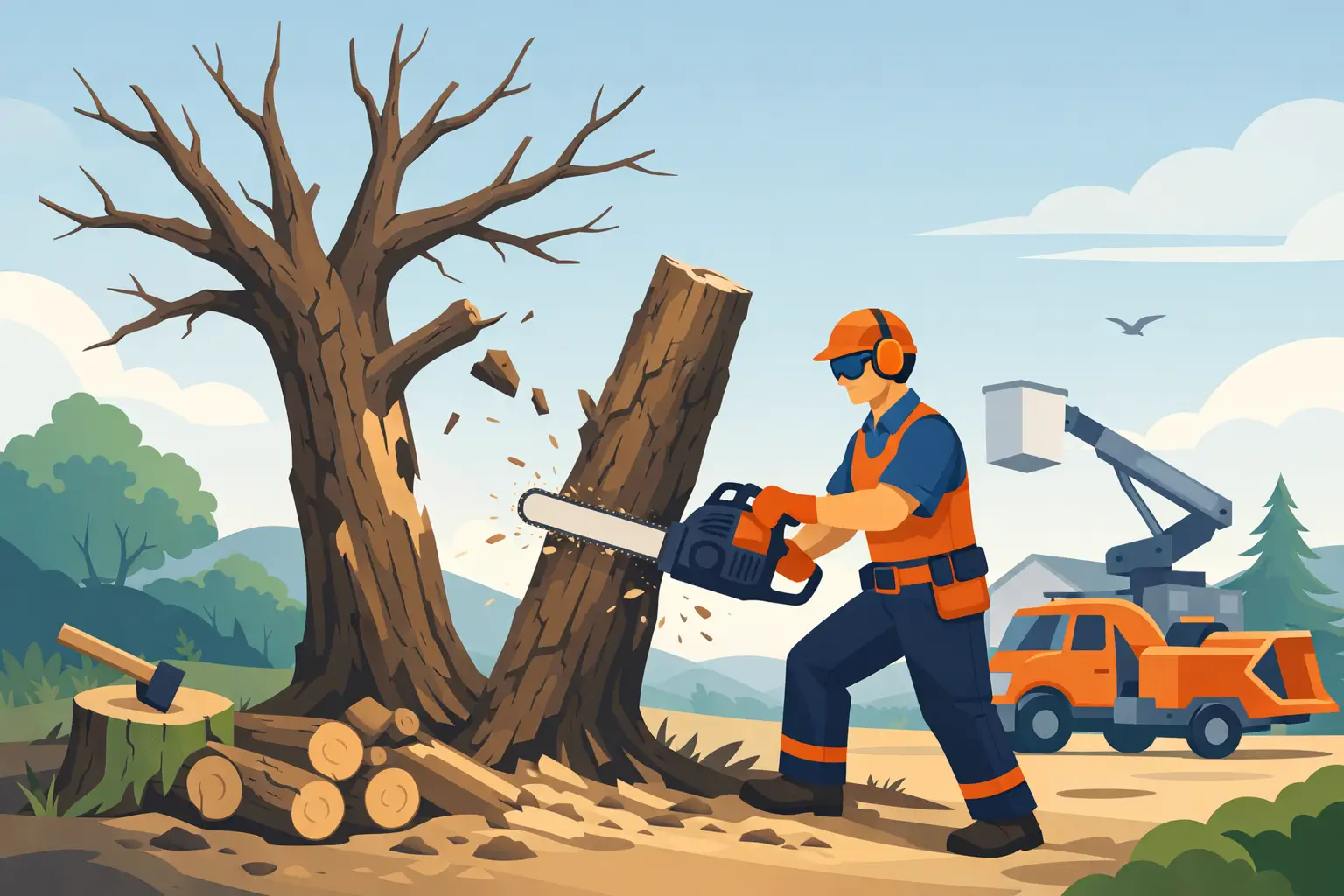
For some dead trees, straight felling is possible. If there is enough open space and the stem is sound enough to control the direction of fall, that can be the simplest route. More often, especially in domestic gardens or tighter commercial sites, the tree is dismantled in sections. This means removing the canopy and stem piece by piece using climbing equipment, rigging, or elevated access where required.
Dead trees often need more careful handling than live ones. Limbs can fail unexpectedly under load, and anchor points may be compromised by decay. That is one reason this is not routine garden work. It calls for the right equipment, trained judgement and a method that suits the condition of the tree rather than forcing a standard approach.
Once the tree is down, the timber and brash can be removed from site, processed into manageable sections, or left in a format agreed in advance. Stump removal is a separate decision. Some customers want the stump ground out so the area can be replanted, turfed or paved. Others are happy to leave it low if the ground is not being reused straight away.
Dead tree removal service for homes and managed sites
For homeowners, the main priorities are usually safety, tidy working practices and clear communication. People want to know what will happen, how long it will take, whether access is needed through the house or side gate, and what the site will look like afterwards. A professional service should make that straightforward.
On managed sites, farms, business premises and shared grounds, the considerations can be broader. Access for vehicles, traffic management, public safety, timing of works and record keeping may all matter. In these settings, dead tree removal is part of wider risk control as much as property maintenance.
This is where experience counts. The best outcome is not simply getting the tree down. It is planning the work so disruption stays low, hazards are controlled properly, and the site is left clean and safe at the end of the job.
When removal is urgent and when it can wait
Not every dead tree is an emergency. If the tree is standing in a low-use area, away from structures and with no obvious sign of imminent failure, the work may be schedulable rather than urgent. That said, dead trees do not become safer by standing longer.
Urgent removal is usually the right call if the tree has partially failed, is leaning after a storm, is dropping sizeable limbs, or is close to places where people regularly pass or park. The same applies if a tree has died and sits beside a boundary, highway, building or play area.
Sometimes the need is less immediate but still clear. A dead ornamental tree in a front garden may not be in danger of collapsing tomorrow, but if it is brittle, unsightly and beginning to break up, arranging removal sooner can avoid a more awkward job later.
Choosing the right contractor for dead tree removal
This is not a service where the lowest quote should be the only test. With dead trees, the risk level can change quickly, and poor workmanship creates problems for the property owner as well as the contractor.
Look for a business that assesses the tree properly, explains the proposed method clearly, works with safety in mind and leaves the site tidy. Insurance, training and practical experience all matter, but so does attitude. You want a team that turns up prepared, respects the property and treats even a smaller job with care.
It also helps to choose a local contractor who understands the kinds of trees, conditions and weather patterns common in the area. For clients in Norfolk and Suffolk, that local knowledge can make a real difference when a dead tree is exposed, awkwardly positioned or affected by storm damage. That is the standard T.G. Bird Tree Services aims to deliver on every job.
The value of acting early
There is a common temptation to watch a dead tree for another season and deal with it later. Sometimes that works out. Sometimes it leads to broken fencing, blocked access, damaged roofs or a much harder dismantle once the structure has weakened further.
Early action usually gives you more control. There is more freedom to schedule the work, access can be managed more easily, and the removal can often be carried out in a cleaner, more efficient way. It can also reduce the chance of needing an emergency callout after bad weather.
If you suspect a tree is dead or no longer safe, the sensible next step is to have it looked at properly. A clear assessment and a practical plan are often all it takes to turn a worrying problem into a straightforward job, with the site left safer, cleaner and easier to manage.