
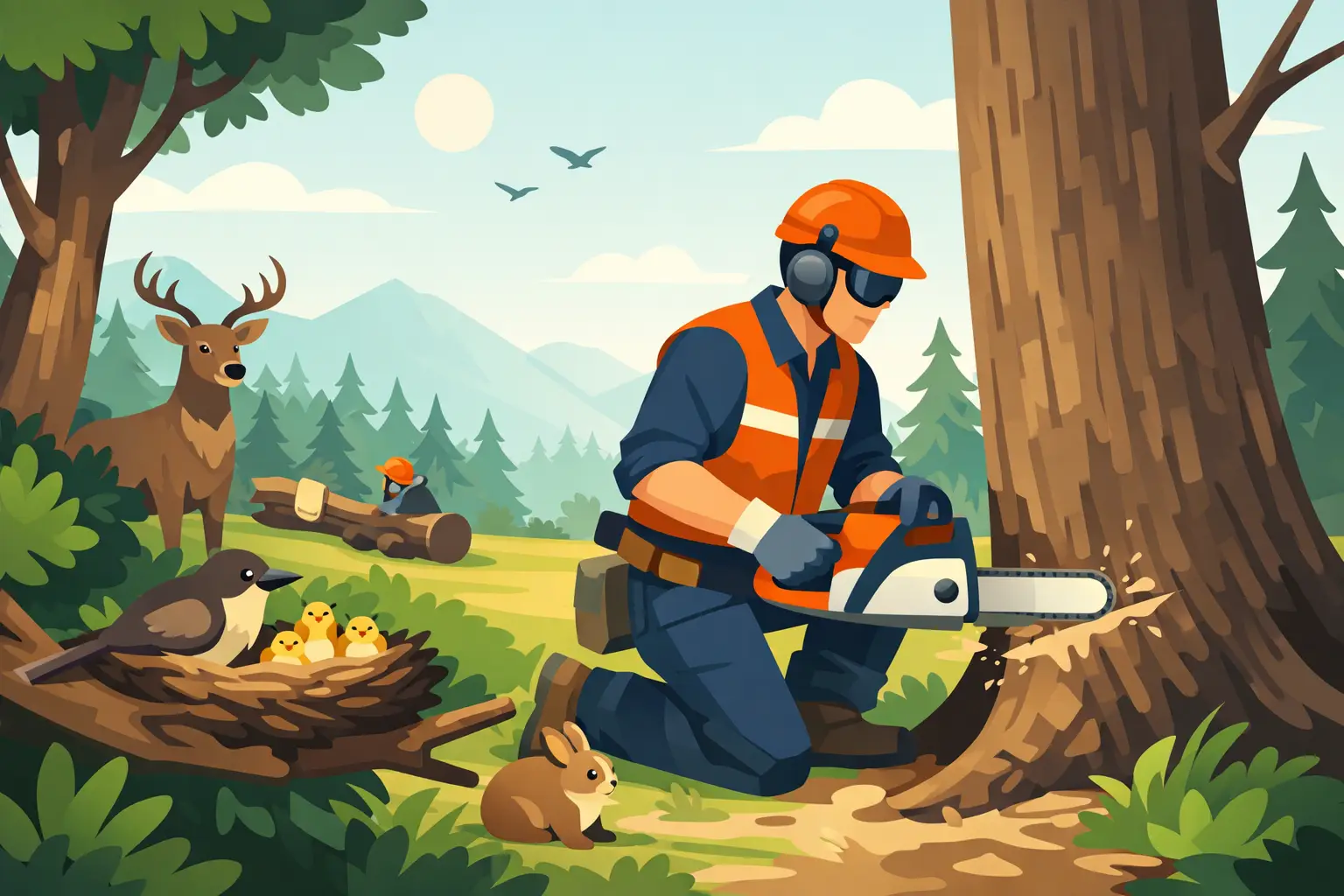
A tree can look like a simple clearance job from the ground, then a climber gets up into the crown and finds an active nest, a bat roost feature, or dense ivy full of sheltering wildlife. That is why wildlife safe tree cutting matters. It is not just about getting the work done neatly. It is about protecting habitats, meeting legal duties, and making sure the right tree work happens at the right time.
For homeowners, landlords and site managers, the challenge is usually practical. A tree may be overgrown, storm-damaged, shading a property or starting to affect access. The need for work is real, but rushing straight to felling or heavy pruning can create avoidable problems if wildlife is using the tree. A professional approach balances both sides – safety and site management on one hand, and responsible treatment of wildlife on the other.
What wildlife safe tree cutting really means
In straightforward terms, wildlife safe tree cutting means planning and carrying out tree work in a way that reduces harm to birds, bats and other species that may be living in or using the tree. It starts before the first saw is started. The tree is assessed, the timing is considered, and the method is adjusted if there are signs of nesting, roosting or sheltering wildlife.
This is where experience matters. Not every cavity is occupied, not every tree with ivy contains a nest, and not every job has to be delayed for months. At the same time, assuming a tree is clear without proper checks is poor practice. Good arborists look for the details that can easily be missed – hollows, split limbs, peeling bark, woodpecker holes, dense climbers, heavy ivy cover and old decay pockets.
Why timing makes such a difference
The busiest period for nesting birds is generally spring and summer, although exact timing can vary depending on species and weather. That does not mean tree work is impossible during those months, but it does mean more care is needed. If an active nest is present, work may need to stop or be adapted until the nest is no longer in use.
Outside the main nesting season, many tree jobs become simpler to schedule. Visibility is often better in deciduous trees, ground conditions can be more manageable, and there is usually less risk of disturbing breeding birds. Winter work is often a sensible option for larger reductions, crown thinning or removals, provided the tree has still been properly checked.
Bats are another important consideration. They can use cracks, cavities and loose bark for shelter, and some roosting features are not obvious from ground level. If a tree has bat roost potential, the next step depends on the level of risk and the proposed work. In some cases, further ecological input is needed before work can safely proceed.
Wildlife safe tree cutting for homes and managed sites
Domestic and commercial jobs tend to have the same core issue – the tree needs attention, but the site cannot afford unnecessary disruption or risk. The difference is usually scale and urgency.
For a homeowner, that might mean a garden tree pressing towards a roofline or blocking light to the house. For a commercial site, it could involve boundary trees affecting access routes, parking areas or public safety. In both cases, wildlife considerations should be part of the planning, not an afterthought once a team is already on site.
This matters even more on estates, schools, business parks and larger grounds where recurring maintenance is scheduled across multiple trees. A planned programme allows work to be phased sensibly, with higher-risk trees prioritised and non-urgent work timed to reduce ecological impact.
How professional arborists assess the risk
A proper assessment is not guesswork. It combines practical arboricultural knowledge with awareness of likely wildlife use. The tree species, condition, age and surroundings all play a part. Mature trees with cavities, deadwood and dense cover often need a closer look than young ornamental trees in open ground.
Signs that may affect the job include visible nests, repeated bird activity, droppings, feathers, scratching, cavities, loose bark and thick ivy. Nearby habitat also matters. If a tree sits beside woodland, water, hedgerows or undisturbed margins, the chances of wildlife use can be higher.
The outcome is not always yes or no. Often, it is about adjusting the scope of work. Instead of a full removal on the planned date, a client may be advised to delay, reduce the extent of cutting, or split the work into stages. That can be frustrating if the tree is causing concern, but it is often the safest and most responsible route.
When urgent tree work still has to happen
There are situations where delay is not realistic. A storm-damaged tree leaning over a road, a split stem above a driveway, or a hung-up limb over a public footpath may need immediate attention. In emergency cases, safety has to be managed quickly, but that does not mean wildlife checks are ignored.
The job may need a more controlled method, partial dismantling, or temporary making-safe works before further action is taken. The exact solution depends on the hazard and the tree itself. The key point is that emergency response and wildlife awareness are not opposites. Skilled contractors work carefully under pressure and make measured decisions on site.
Wildlife safe tree cutting and legal responsibility
For clients, the legal side can feel uncertain, but the practical message is simple. Protected wildlife cannot be disturbed or harmed through careless tree work. Birds, nests and bats are the clearest examples people need to be aware of.
That is another reason to use a competent arborist rather than treating tree work as basic garden clearance. A professional contractor should know when a job can go ahead, when it needs adapting, and when specialist ecological advice may be required. That protects the wildlife, but it also protects the client from avoidable mistakes.
Good tree work is about method, not just machinery
There is a common assumption that wildlife-friendly work simply means cutting less. In reality, method matters just as much. Sectional dismantling can reduce disturbance compared with rough felling. Careful access planning can prevent damage to surrounding habitat. Retaining selected deadwood, where safe to do so, can preserve useful habitat features.
Not every site allows for that level of retention. If a tree is directly over a building, next to a busy road or structurally unsound, safety may limit what can be left in place. That is where balanced judgement comes in. The best result is not always the most drastic option, and it is not always the lightest touch either.
What clients should expect from a responsible contractor
If you are arranging tree work, you should expect clear advice from the start. That includes an honest view of what the tree needs, whether timing is a factor, and whether wildlife checks may affect the schedule. You should also expect the site to be left safe and tidy once the work is complete.
A dependable contractor will explain the trade-offs. If a tree can wait until a better season, they should say so. If it cannot wait because the risk is too high, they should explain how the work will be managed. That straightforward approach helps avoid delays, confusion and unnecessary cost later on.
For local clients across Norfolk and Suffolk, this is often the difference between a stressful job and one that is handled properly from start to finish. T.G. Bird Tree Services takes that practical view – safe work, careful assessment and a clean finish, without losing sight of wildlife responsibilities.
Planning ahead saves time and trouble
One of the simplest ways to make wildlife safe tree cutting easier is not to leave everything until a tree becomes an urgent problem. Regular inspections and timely maintenance create more flexibility. A light reduction or crown lift planned early is often easier to schedule responsibly than a full removal needed at short notice.
The same applies to hedges, boundary lines and larger plots. When vegetation is maintained routinely, there is more room to choose the right window for the work. That tends to be better for wildlife, better for access and better for cost control as well.
If you suspect a tree needs attention, the sensible next step is to have it looked at properly. A good arborist will tell you whether the issue is immediate, whether the timing is right, and how the work can be carried out with care. That kind of planning keeps people safe, protects the site, and gives wildlife the consideration it deserves.