
A tree at the bottom of the garden can look simple enough to remove until you start asking the right questions. Can I cut down a tree in my garden if it is on my land, or are there rules, risks and permissions to deal with first? In many cases, you do have the right to manage trees on your property, but that does not always mean you can go straight ahead with felling.
The real answer depends on the tree, its location, its condition, and whether legal protections apply. It also depends on whether the job can be carried out safely. A small ornamental tree in open space is very different from a mature conifer leaning towards a fence, greenhouse or neighbouring property.
Can I cut down a tree in my garden legally?
Owning the garden is only part of the picture. Before any tree is removed, you need to check whether it is protected by a Tree Preservation Order, whether your property is in a conservation area, and whether there are wildlife considerations such as nesting birds or bats.
A Tree Preservation Order, often shortened to TPO, means the local authority has placed legal protection on a tree or group of trees. If a tree is covered, you will usually need formal consent before carrying out work, including felling. Carrying out unauthorised work on a protected tree can lead to serious consequences, including fines.
If your home is in a conservation area, you may also need to give notice to the council before carrying out work. This gives the authority time to review the proposed removal and decide whether further protection is needed. Many homeowners are caught out here because they assume only large or historic trees are covered. In practice, the rules can apply more widely than people expect.
It is also worth checking title plans and boundaries if the trunk sits close to a fence line. A tree may appear to be yours, but ownership is generally determined by where the trunk stands at ground level. If it straddles a boundary or raises neighbour disputes, it is best to clarify that before any work starts.
When permission is not the only issue
Even where no formal consent is needed, there are still legal and practical responsibilities. Wildlife law matters. If birds are nesting in the tree, or if bats are present, work may need to be delayed or handled in a very specific way. Removing a tree without checking can create avoidable legal and environmental problems.
There is also a duty of care angle. If a tree is unsafe and poses a risk to people or property, it should be dealt with properly. But that still does not mean rushing into a dangerous job. Storm-damaged trees, split stems, deadwood and hanging limbs all increase the risk during removal.
That is often the turning point for homeowners. The question stops being can I cut down a tree in my garden and becomes should I be the one doing it at all.
The safety side is where many jobs go wrong
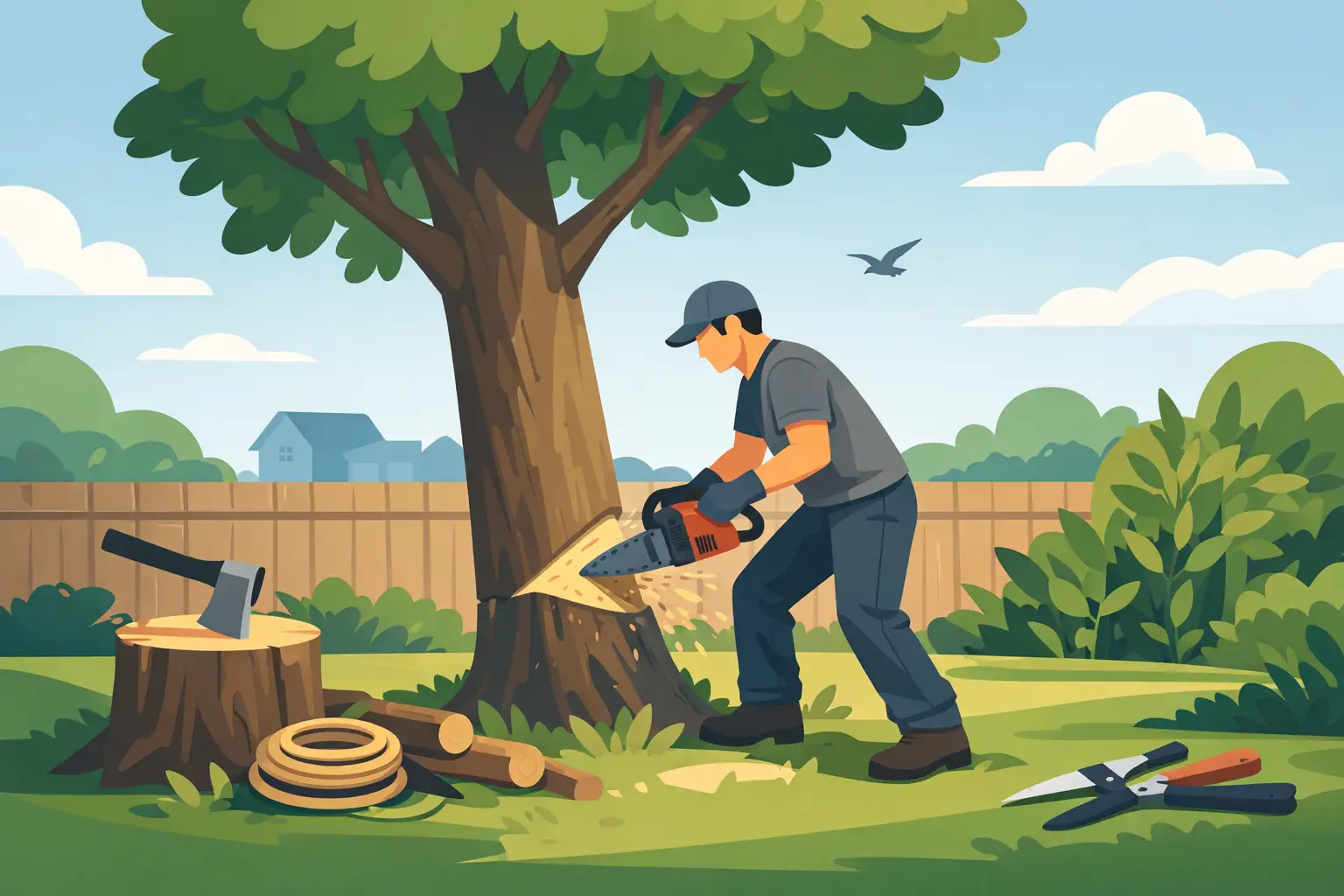
Tree felling looks straightforward in online videos because the difficult parts are often edited out. In real gardens, there is usually very little clear drop zone. Sheds, fences, washing lines, parked cars, power lines, conservatories and neighbouring gardens all reduce your margin for error.
A tree does not always fall where you expect. Hidden decay, uneven weight distribution, wind, lean and branch spread can all affect the direction of fall. Chainsaw work adds another level of risk, especially for anyone without the right training or protective equipment.
The danger is not limited to large trees. Smaller trees can kick back, split unexpectedly or hang up in surrounding branches. Working at height, using ladders, or attempting to dismantle a tree in sections without the right rigging knowledge can quickly turn a garden job into an emergency callout.
For that reason, professional tree surgeons assess far more than just height. They look at species, structure, access, anchor points, nearby targets, ground conditions and the safest method of removal. Sometimes straight felling is possible. Often, especially in tighter gardens, sectional dismantling is the safer option.
Signs a tree should be assessed before removal
Some trees are clearly problematic. Others are less obvious. If a tree is dead, declining, storm-damaged, leaning more than it used to, shedding large limbs or causing structural concerns, it is worth having it assessed before deciding what to do.
Roots lifting patios, branches touching roofs, excessive shading and nuisance debris are common reasons people consider removal. Those issues matter, but they do not always mean full felling is the best answer. In some cases, pruning, crown reduction or deadwood removal may solve the problem while keeping the tree.
That is where practical advice makes a difference. A reliable arborist should tell you when a tree can be retained safely, not just when it can be removed.
What happens if the tree is near a house or road?
The closer a tree is to buildings, roads or public spaces, the less suitable it is as a DIY job. Nearby structures raise the stakes because mistakes can cause expensive damage very quickly. Public footpaths and roads create an additional responsibility to control the site properly and prevent injury.
Access also becomes a factor. A tree in a rear garden with narrow entry may need careful dismantling and waste removal by hand. That is slower than dropping a tree in an open field, but it is often the only safe way to complete the work without damage.
For commercial premises, rented properties and managed sites, there may also be insurance and health and safety expectations to consider. Using a qualified contractor helps demonstrate that the job was planned and carried out properly.
Can I cut down a tree in my garden myself?
Technically, you may be able to if the tree is unprotected, there are no wildlife issues, and the work can be done safely. That said, there is a big difference between what is legally possible and what is sensible.
A very small tree or self-seeded sapling may be manageable for a homeowner with the right tools and a clear understanding of the job. Once a tree has any real height, spread or weight, or sits near anything valuable, the risks rise sharply. Most of the costly mistakes we see come from jobs that started as an attempt to save money.
There is also the question of what happens afterwards. Felling the tree is only part of the task. Timber has to be processed or removed, branches chipped or cleared, and the stump dealt with if you want to replant, pave or improve the area. Stumps left in place can continue to cause inconvenience, and some species may try to regrow.
What a professional service usually covers
When a qualified tree surgeon handles the work, the process is usually far more controlled than most people expect. The tree is inspected, legal constraints are considered, the safest removal method is chosen, and the site is protected before cutting starts.
Waste removal matters too. A tidy finish is part of a professional job, not an extra. That includes clearing brash, processing timber where needed, and leaving the area safe and usable. If stump removal is required, that can often be arranged at the same time so the job is fully finished rather than half done.
For homeowners in Norfolk and Suffolk, that practical, safety-led approach is often what matters most. T.G. Bird Tree Services works with domestic and commercial customers who want tree work carried out properly, without the mess, guesswork or unnecessary risk.
The best first step before you do anything
If you are asking whether you can remove a tree, start by checking protection status with the local authority and taking an honest view of the risks. If there is any doubt over safety, ownership, access, wildlife or nearby property, get it looked at before lifting a saw.
A good tree contractor will not overcomplicate it. They will tell you whether permission is needed, whether removal is the right option, and how the job can be done safely and cleanly. That gives you a clear answer based on the actual tree in front of you, not a general rule pulled from the internet.
Sometimes the right outcome is removal. Sometimes it is careful pruning. The important thing is making the decision with proper information, so the garden ends up safer, tidier and easier to manage.