
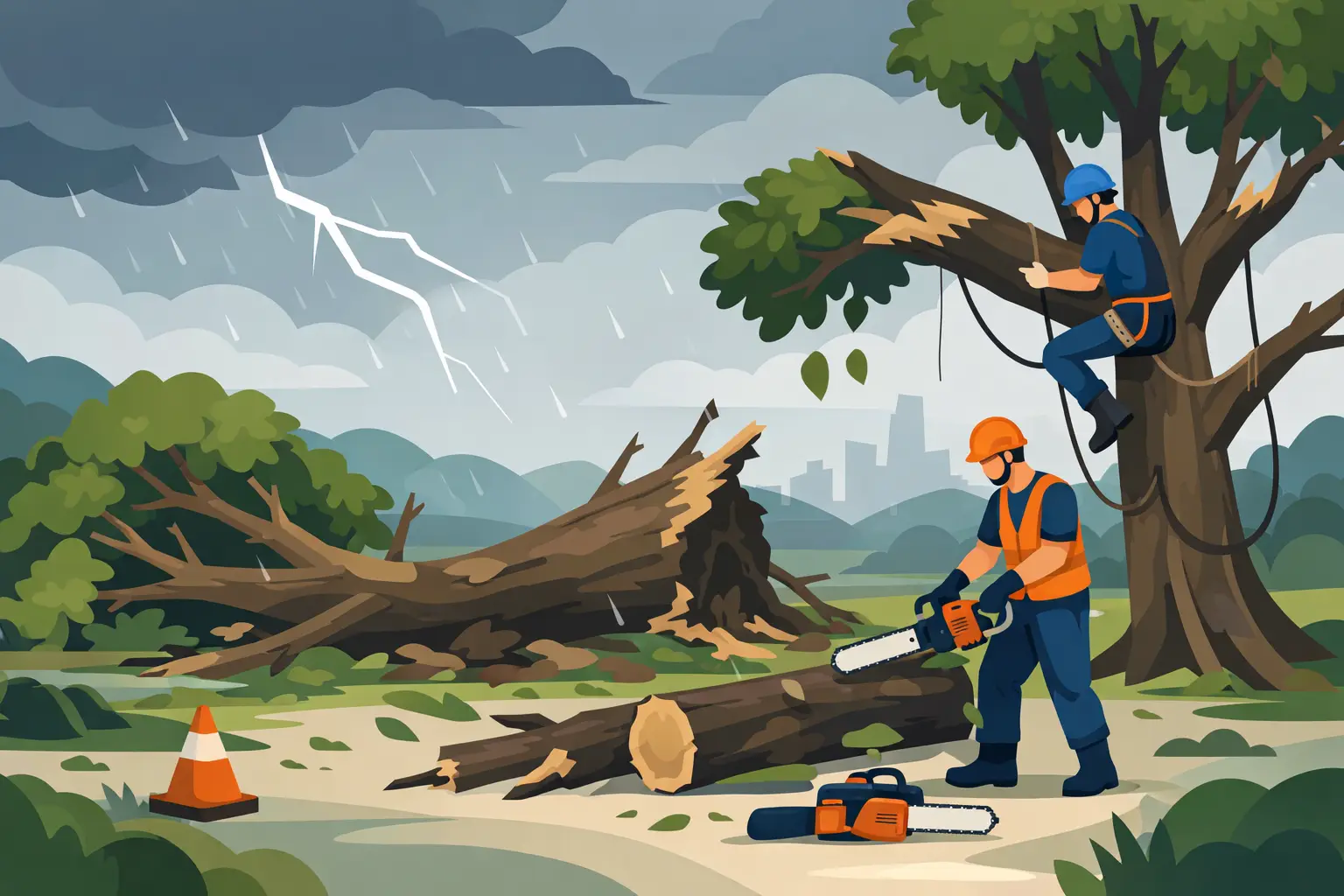
The morning after a storm often tells the real story. A split limb over the drive, a leaning tree near the house, or branches scattered across a garden can quickly turn from an eyesore into a serious safety issue. If you are wondering how to deal with storm damaged trees, the first priority is always safety – not speed.
Storm damage is not always obvious from ground level. A tree may still be standing and look mostly intact, but the root plate could have shifted, heavy limbs may be hanging under tension, or the trunk may have developed fresh cracks that weaken the whole structure. That is why the right response starts with caution, a clear assessment, and professional help where needed.
How to deal with storm damaged trees straight away
The first few minutes matter. Keep people, pets, and vehicles well away from the affected area. If a tree or branch is close to a road, footpath, power line, parked car, fence, shed, or roof, treat it as potentially unstable. Wind-damaged timber can move without warning, especially if branches are partially broken and still supported by the canopy.
It is sensible to cordon off the area as best you can and avoid any attempt to pull branches down yourself. A branch that seems loose can be carrying a surprising amount of weight, and one wrong cut can make it swing, twist, or drop suddenly. If the damage is affecting access to your property, it can be tempting to clear it quickly, but this is where many injuries happen.
If power lines are involved, stay clear and contact the relevant utility provider immediately. Do not touch the tree, nearby fencing, or anything else that may be conducting electricity.
Start by assessing the level of damage
Not every storm-damaged tree needs to be removed. Some can be made safe with careful pruning and ongoing monitoring, while others are too badly compromised to remain in place. The difference depends on the type of damage, the tree species, its age and condition, and where it is growing.
A few things usually point to more serious structural failure. One is a pronounced lean that was not there before. Another is exposed roots or lifting soil around the base, which can suggest the root system has started to fail. Deep vertical cracks in the trunk, a major split where limbs join, or a large section of canopy torn away can also leave the tree unsafe.
Lighter damage may be more manageable. Smaller broken branches, torn but localised limbs, and minor crown damage can often be dealt with through skilled pruning. The key is whether the remaining structure is sound and whether the tree can recover without creating an ongoing hazard.
Hidden risks homeowners often miss
One of the biggest problems after bad weather is assuming that visible damage is the full extent of the issue. In practice, storm impact often creates internal stress points that are not easy to spot. A branch may be cracked but not detached. The trunk may have twisted slightly. Root damage may be below the surface but enough to reduce stability.
This is especially important with mature trees near buildings, driveways, gardens, public access areas, and boundary lines. A tree that survives the first storm may fail later in the next spell of wind because the earlier damage weakened it more than expected.
Different species also respond differently. Some trees recover well from selective pruning. Others are more prone to decay after large wounds or major limb loss. That is why a proper assessment is worth getting right from the start rather than relying on guesswork.
What you can do safely yourself
There is a limit to what should be tackled without training and equipment, but there are a few sensible steps property owners can take. You can photograph the damage for records or insurance purposes, note any change in lean or ground movement, and keep the area clear until it has been assessed.
If there are very small twigs or light debris already on the ground and well away from overhead hazards, those can usually be tidied safely. Beyond that, caution is the better option. Ladders, chainsaws, and damaged trees are a poor combination, particularly when timber is twisted or under pressure from the way it has fallen.
For commercial sites, schools, shared access areas, and managed properties, a prompt inspection is even more important. There is a duty to reduce foreseeable risks, and that starts with isolating the area and arranging professional attention quickly.
When to call an arborist
If a tree has split, started leaning, lost a major limb, damaged a structure, blocked access, or come down in part rather than fully, it is time to call a professional arborist. The same applies if the damage is near roads, neighbouring property, power lines, or public spaces.
Emergency tree work is about more than cutting away what is visible. It often involves stabilising the site, removing dangerous sections in a controlled order, and deciding whether the tree can be retained safely or needs felling. In many cases, access, rigging, climbing, traffic awareness, and safe dismantling methods all come into play.
That is where experience matters. A proper tree team will look at the forces within the damaged structure, the safest way to remove weight, and how to protect the surrounding area while the work is carried out. T.G. Bird Tree Services regularly handles this kind of storm response for homes and commercial sites across Norfolk and Suffolk, with safety and tidy completion at the centre of the job.
Repair, reduce, or remove?
Once the immediate risk is under control, the next question is what happens to the tree long term. There is no one-size-fits-all answer. Some trees respond well to crown reduction or selective removal of damaged limbs. Others may need pollarding, structural pruning, or full removal if the damage is too extensive.
Retention is often possible when the main trunk is sound, the root system remains stable, and the damaged sections can be pruned back to suitable growth points. This can preserve an established tree while reducing future risk.
Removal becomes the more practical option when the trunk is badly split, the tree has uprooted significantly, or the location leaves little margin for future failure. A weakened tree over a house, car park, entrance, or heavily used garden area is not something to gamble on. In these situations, a clean, controlled removal is often the safest and most cost-effective route.
Insurance and records
If storm damage has affected buildings, fences, vehicles, or neighbouring property, keep clear photographs and make a note of when the damage occurred. Insurers may ask for evidence of the condition and any emergency action taken. It also helps to record whether the tree had shown previous signs of decline, although many healthy trees can still suffer damage in severe weather.
Where possible, do not start major clearance before documenting the scene unless there is an urgent need to make the area safe. Safety comes first, but a simple photo record can make later conversations much easier.
Preventing repeat problems
The best way to reduce future storm damage is regular tree maintenance before bad weather arrives. Trees that are overextended, poorly balanced, dead in parts, or already carrying weak unions are more likely to lose limbs in wind and heavy rain. Periodic inspection and pruning can identify these issues early.
That does not mean every large tree is a problem. Healthy, well-managed trees are often more resilient than neglected ones. The aim is not to over-prune, but to maintain good structure, remove deadwood where appropriate, and deal with defects before they become emergencies.
For landowners and property managers, this is particularly valuable around access roads, parking areas, boundaries, and buildings. A planned maintenance approach is usually cheaper and less disruptive than an urgent callout after a storm has already caused damage.
How to deal with storm damaged trees without taking unnecessary risks
The safest approach is usually the simplest one. Keep clear, assess the area carefully, and do not rush into cutting or climbing. Storm-damaged trees can be deceptive, and even a smaller tree can become dangerous when the wood is split, suspended, or unstable at the base.
Good decisions early on can prevent injuries, further property damage, and more costly work later. If you are unsure whether a tree is safe, it is worth treating it as unsafe until an expert says otherwise.
After any major weather, a damaged tree is not just a garden problem to tidy up when you have time. It is a structure under stress, and it needs the right handling. A careful assessment today can save a much bigger problem tomorrow.