
If you are looking at an overgrown tree and wondering about tree pruning vs pollarding, the right answer depends on more than appearance. The species, age, condition and location of the tree all matter, along with how much growth needs managing and whether safety is a concern. Two trees in the same garden can need completely different treatment.
For homeowners and site managers, these terms are often used as if they mean the same thing. They do not. Both are established tree care methods, but they serve different purposes and need to be carried out properly if the tree is to remain safe, healthy and well-shaped.
Tree pruning vs pollarding: the main difference
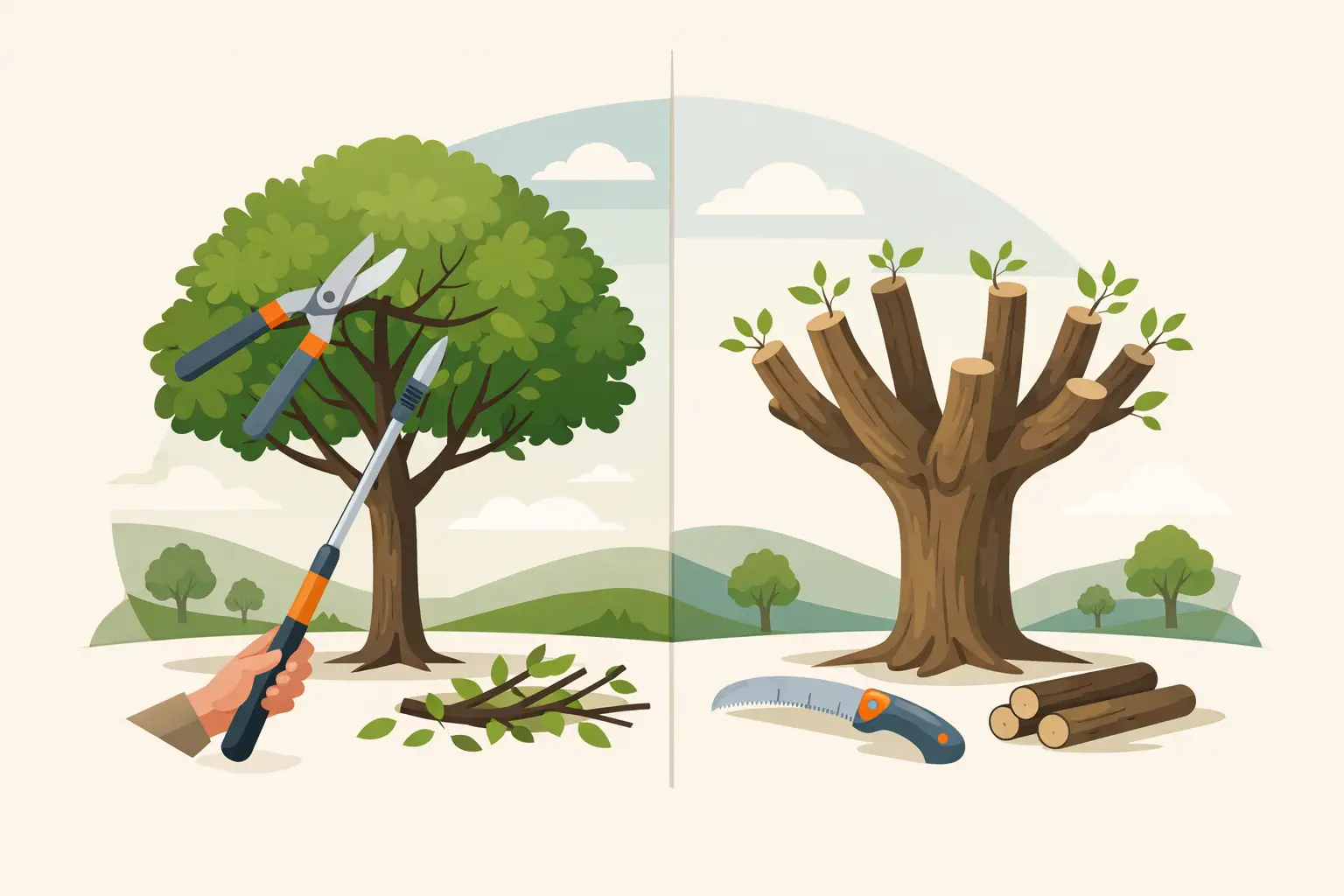
Pruning is the selective removal of specific branches to improve a tree’s structure, reduce risk, clear space or maintain health. It is usually a lighter, more natural form of management. A properly pruned tree should still look like itself, just safer, tidier and better balanced.
Pollarding is much more controlled and much more severe. It involves cutting back the upper branches to a set framework, usually at the same points on a regular cycle. Over time, new shoots grow back from those points and are then cut again during future visits. The goal is not a natural-looking crown. It is to control size and keep growth within strict limits.
That is why tree pruning vs pollarding is not simply a choice between two ways of cutting branches. It is a decision about long-term management. Once a tree is pollarded, it usually needs to stay on that cycle.
What pruning is designed to do
Pruning is often the best option when a tree is healthy overall but needs careful improvement. Dead, damaged or crossing branches can be removed to reduce the chance of failure. Limbs growing too close to roofs, roads, footpaths or overhead lines can be shortened or lifted. Dense crowns can sometimes be thinned where appropriate to allow more light and reduce wind resistance.
Good pruning works with the tree rather than against it. The aim is to retain its natural shape while removing the parts that are causing problems. That might mean a light crown reduction on a garden tree, formative pruning on a younger specimen, or clearance work around buildings and access routes.
Done well, pruning can improve appearance and reduce risk without putting excessive stress on the tree. Done badly, it can leave large wounds, weak regrowth and an unbalanced canopy. That is why careful cuts, correct timing and a clear understanding of the species are so important.
What pollarding is designed to do
Pollarding is usually chosen where space is limited or where a tree needs strong, repeatable size control. You often see it on roadsides, in car parks, around boundaries and on sites where unchecked growth would quickly become a problem. It can also be used for certain ornamental and urban trees where a formal, contained shape is wanted.
The process starts by cutting back the young tree to create a main framework. After that, shoots regrow from the cut points and are removed again on a cycle. In some cases, older trees are reduced into a pollard form, but this needs very careful judgement. Not every mature tree will tolerate that work well.
Pollarding is not a shortcut for dealing with a neglected tree. It is a management system. If it is started on the wrong species, at the wrong age, or left too long between cycles, the result can be heavy weak regrowth and a tree that becomes harder to manage safely.
When pruning is usually the better choice
For most domestic gardens, pruning is the more suitable option. If a tree has outgrown its space slightly, is shading windows, dropping deadwood or pushing toward a structure, selective pruning often solves the issue without changing the character of the tree completely.
It is also the better choice when preserving the natural form matters. Mature oaks, beeches, maples and many ornamental trees generally benefit from skilled pruning rather than severe repeated cutting. A lighter approach can maintain the tree’s health and visual value while still dealing with practical concerns.
Pruning also suits trees that only need occasional attention. Not every tree requires a rigid maintenance cycle. In many cases, periodic inspections and targeted pruning are enough.
When pollarding makes more sense
Pollarding is often the right choice where ongoing height and spread control are essential. That might include trees planted in tight urban spaces, along highways, near public access areas or beside buildings where regrowth must be kept in check. Some species, such as willow, lime, plane and poplar, can respond well when pollarding is started and maintained properly.
There can also be a cost and access benefit over time in some settings. A tree on a regular pollarding cycle can become more predictable to manage than one left to make large gains in size and then cut back irregularly. For commercial premises, schools, housing sites and managed landscapes, that consistency can be useful.
The trade-off is appearance and commitment. Freshly pollarded trees can look stark, especially just after work has been completed. More importantly, they need returning to on schedule. Pollarding only works well when it is maintained.
Why species and age matter
One of the biggest mistakes in tree care is assuming every tree responds in the same way. It does not. Some species tolerate hard cutting and vigorous regrowth far better than others. Some compartmentalise wounds effectively. Others become vulnerable to decay if cut too severely.
Age matters just as much. Younger trees are generally more adaptable. Mature trees can be far less forgiving, particularly if they have existing defects, decay pockets or a history of poor work. A large mature tree that has never been pollarded should not be treated as though it can simply be cut into shape without consequences.
This is where a professional assessment matters. The right method is not just about what you want the tree to look like next week. It is about how it will respond over the next few years.
Tree pruning vs pollarding for safety and appearance
Safety is often what prompts the call in the first place. Low limbs over a driveway, branches touching a roof, trees crowding a road sign or heavy growth after stormy weather all need sensible management. In those situations, pruning is often enough to remove the immediate problem while keeping the tree stable and attractive.
Pollarding becomes more relevant where repeated regrowth would otherwise create recurring hazards or operational issues. If a tree sits in a restricted space and must be kept to a certain size year after year, pollarding can be the safer long-term plan.
Appearance comes into it as well. A well-pruned tree usually retains a more natural silhouette. A pollarded tree has a much more managed look. Neither is automatically better. It depends on the setting, the species and the client’s priorities.
Timing and wildlife considerations
Timing matters with both methods. Trees respond differently depending on the season, and some species are best worked at specific times of year. Nesting birds and other wildlife must also be considered before work starts. Responsible tree care is not just about cutting. It is about planning the job properly.
There is also a difference between urgent works and routine maintenance. If a branch is broken and dangerous, action may be needed quickly. If the issue is general overgrowth, it is often better to schedule the work at the most suitable time for the species and the site.
A professional arborist will look at the whole picture – tree condition, season, safety, access and wildlife constraints – before recommending pruning or pollarding.
Choosing the right approach for your property
If your main goal is to tidy a tree, improve clearance or reduce specific risks, pruning is usually the starting point. If your goal is strict long-term size control in a limited space, pollarding may be the better fit, but only if the tree is suitable and the cycle can be maintained.
For many properties across Norfolk and Suffolk, the best answer is not the most aggressive one. It is the method that solves the problem with the least stress to the tree while keeping the area safe and manageable. That is the approach T.G. Bird Tree Services takes on site – practical advice, careful workmanship and the right treatment for the tree in front of us.
If you are unsure which route is right, avoid guessing or asking for the hardest cut possible. The best tree work is rarely about taking the most off. It is about making the right cuts, at the right time, for the right reason.