

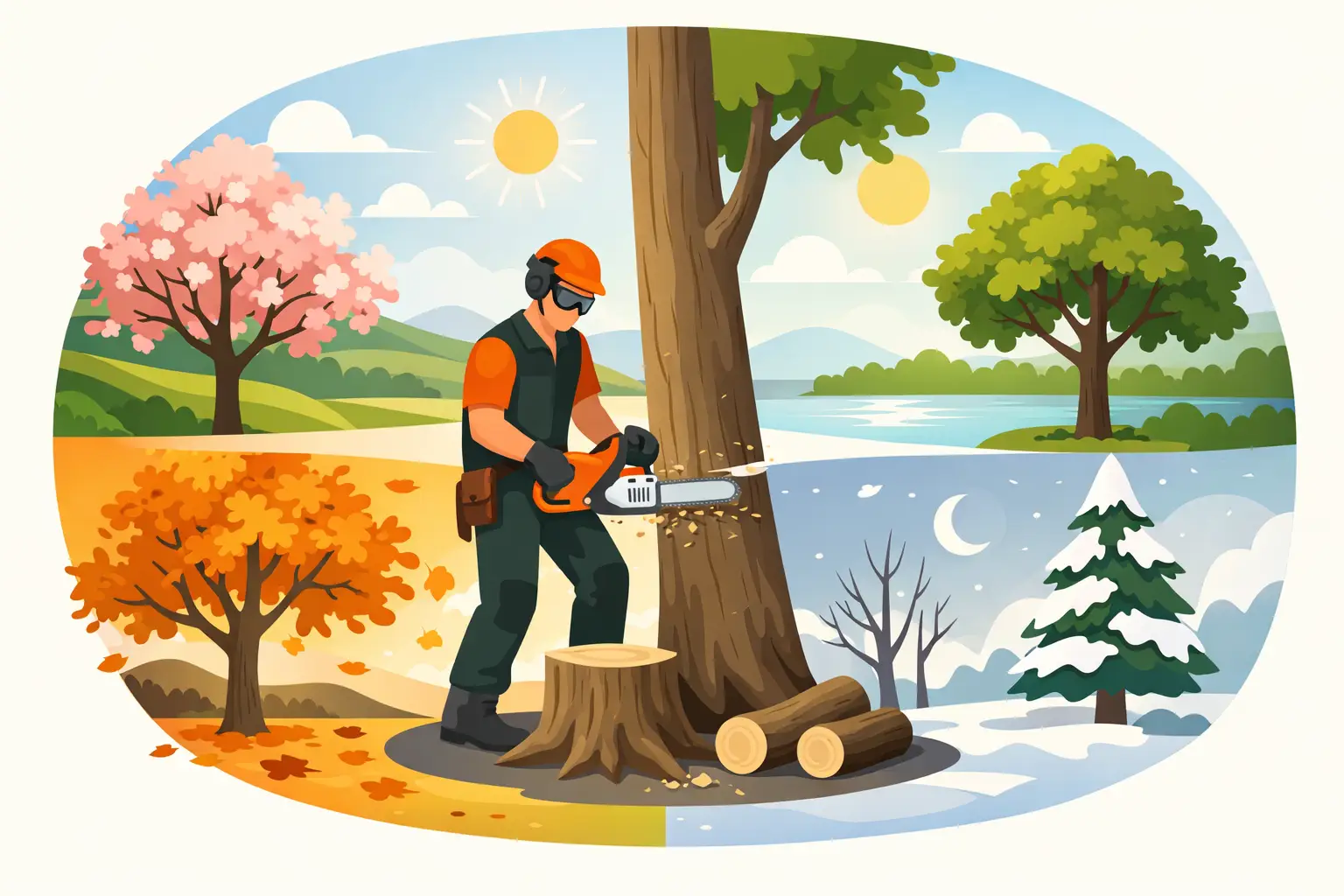
A tree that looks fine in July can become a very different prospect by November. Heavy limbs, hidden decay, storm exposure and fast seasonal growth all affect when work should be done. If you are wondering about the best time of year to cut trees, the honest answer is that it depends on the tree, the reason for the work, and how urgent the risk is.
For most planned tree work, late autumn through to late winter is often the most practical window. Trees are usually dormant, leaf cover is reduced, and the branch structure is easier to assess properly. That makes it simpler to carry out pruning, crown work or felling with a clear view of what is happening. It can also mean less stress on the tree, particularly when the job is focused on shaping, reducing weight or removing deadwood.
That said, there is no single month that suits every species or every site. A healthy ornamental tree in a back garden, a mature oak near a driveway, and a storm-damaged conifer overhanging a commercial car park all need different judgement. Good timing matters, but safe timing matters more.
Why the best time of year to cut trees is not the same for every job
The phrase covers a lot of different work. Light pruning is not the same as major crown reduction. Removing a dead limb is not the same as felling a declining tree near a boundary fence. Timing changes depending on whether the aim is better appearance, improved safety, long-term tree health or immediate hazard control.
Dormant-season work is popular for a reason. In winter, many broadleaf trees have dropped their leaves, which makes defects easier to spot and access easier to manage. There is often less interference from seasonal growth, and the tree’s energy is not being pushed into fresh shoots in the same way it is during spring and summer.
However, some trees respond better to work outside deep winter. Others can bleed sap heavily if cut at the wrong time. Some species are sensitive to disease risk linked to seasonal conditions. This is why a blanket rule can be misleading. The right answer is usually based on species, condition, location and purpose.
Winter is often best for planned cutting
If a tree does not pose an urgent problem, winter is commonly the best time to schedule work. This is especially true for structural pruning, crown thinning, crown lifting and many types of reduction work. With the canopy opened up, an arborist can inspect the branch framework more accurately and carry out cleaner, more targeted cuts.
For property owners, winter work can also be less disruptive. There may be less impact on shade, screening and garden use than there would be in peak summer. Ground conditions still need care, particularly on soft lawns, but a professional team can plan access and clear-up with that in mind.
Felling can also be easier in winter for deciduous trees because there is less sail effect from leaves and less weight in the crown. Again, that does not make every winter day suitable. High winds, frozen conditions and waterlogged ground can all affect how safely the job can be carried out.
Spring and summer are not always the wrong time
People sometimes assume tree work should never happen once growth starts. That is not true. Some pruning is better done in summer, particularly when the goal is to manage vigorous regrowth or to make a lighter corrective cut after the spring flush.
Summer can also help when you need to see how a tree is performing in full leaf. Dead sections, weak unions, overcrowded growth or balance issues may be more obvious once the canopy has developed. In some cases, this makes assessment more accurate, not less.
There are trade-offs. Trees are biologically active in spring and summer, so poor cuts or over-pruning can be more stressful. You also have nesting bird considerations, which are a major factor during the breeding season. Any responsible contractor needs to check carefully before work starts. If active nests are present, work may need to be delayed or adjusted.
The species of tree makes a real difference
Some trees tolerate seasonal pruning well. Others need more careful timing. Birch, maple and walnut, for example, are known for heavy sap bleeding if cut at the wrong time, often in late winter or early spring. That does not usually kill the tree, but it can be undesirable and is best avoided where possible.
Fruit trees also follow their own rules. Winter pruning often encourages growth, while summer pruning can be used to control it. Conifers are another separate case. Some respond poorly to being cut back into old wood, and timing alone will not solve that.
This is where practical arboricultural advice saves money and prevents poor results. The best time of year to cut trees is not just about the calendar. It is about how that species reacts, what condition it is in, and whether the work will improve the tree or leave it struggling.
When safety overrides seasonal timing
If a tree is cracked, storm-damaged, uprooting, resting on a structure or dropping dangerous limbs, it should not wait for the ideal month. Emergency tree work happens when the risk demands it. In those situations, the best time to cut is as soon as it is safe to do so.
This is particularly relevant after strong winds or prolonged wet weather in Norfolk and Suffolk, where exposure can quickly turn a weakened tree into a serious hazard. A split stem over a road, a broken limb over a conservatory, or a leaning tree near a public footpath is not a seasonal issue. It is a safety issue.
Professional assessment is important here because not every damaged tree needs full removal. Sometimes a controlled reduction, sectional dismantle or removal of failed limbs is enough to make the tree safe while retaining it where appropriate. The key is making that decision properly and carrying out the work with the right equipment and controls in place.
Wildlife, regulations and practical site limits
Timing tree work is not only about tree biology. Wildlife law and site conditions also matter. Bird nesting season is the clearest example. Trees and hedges should be inspected before any cutting takes place, especially in spring and summer. If nesting activity is found, work may need to stop until it is lawful and safe to continue.
There may also be Tree Preservation Orders or conservation area restrictions. These do not always prevent work, but they can affect what is allowed and when notice is required. For commercial sites, access windows, customer traffic, school hours or nearby utilities can also shape the best time to carry out the job.
Ground conditions deserve attention too. A well-timed pruning job can still become awkward if access is poor, lawns are saturated or machinery would risk damaging paving, drainage or landscaped areas. Good planning is part of doing the work properly.
Signs it is time to act, whatever the season
Some trees can wait for the ideal window. Others are already telling you not to put it off. Dead branches, visible decay, fungal growth at the base, sudden leaning, cracks in major limbs and repeated branch drop all need checking. So do trees touching buildings, shading roofs excessively, obstructing roads or growing into overhead lines.
Overgrown trees are not always dangerous, but they can become harder and more expensive to manage if left too long. A modest reduction or prune done at the right time is often more sensible than waiting until large limbs need removing or the whole tree has to come down.
For landlords, site managers and commercial clients, regular inspections are usually the better route. They help catch problems early and make seasonal scheduling easier, which keeps disruption down and budgets more predictable.
So, what is the best time of year to cut trees?
For routine, non-urgent work, late autumn to late winter is often the best all-round period. It suits many tree species, allows clearer inspection, and tends to support tidy, efficient work. But that is only the starting point, not a fixed rule.
If the tree species is sensitive, if wildlife is present, if the ground is unsuitable, or if the tree poses an immediate risk, the timing may need to change. That is why experienced advice matters. A good arborist will not just offer a date. They will explain why that timing suits the tree, the site and the type of work required.
At T.G. Bird Tree Services, that practical approach is what keeps jobs safe, efficient and right for the tree wherever possible. If you are unsure whether to prune now, wait until winter, or deal with a problem before it gets worse, the best next step is a proper assessment. The right time is the one that protects your property, respects the tree, and leaves the site safe and tidy when the work is done.