

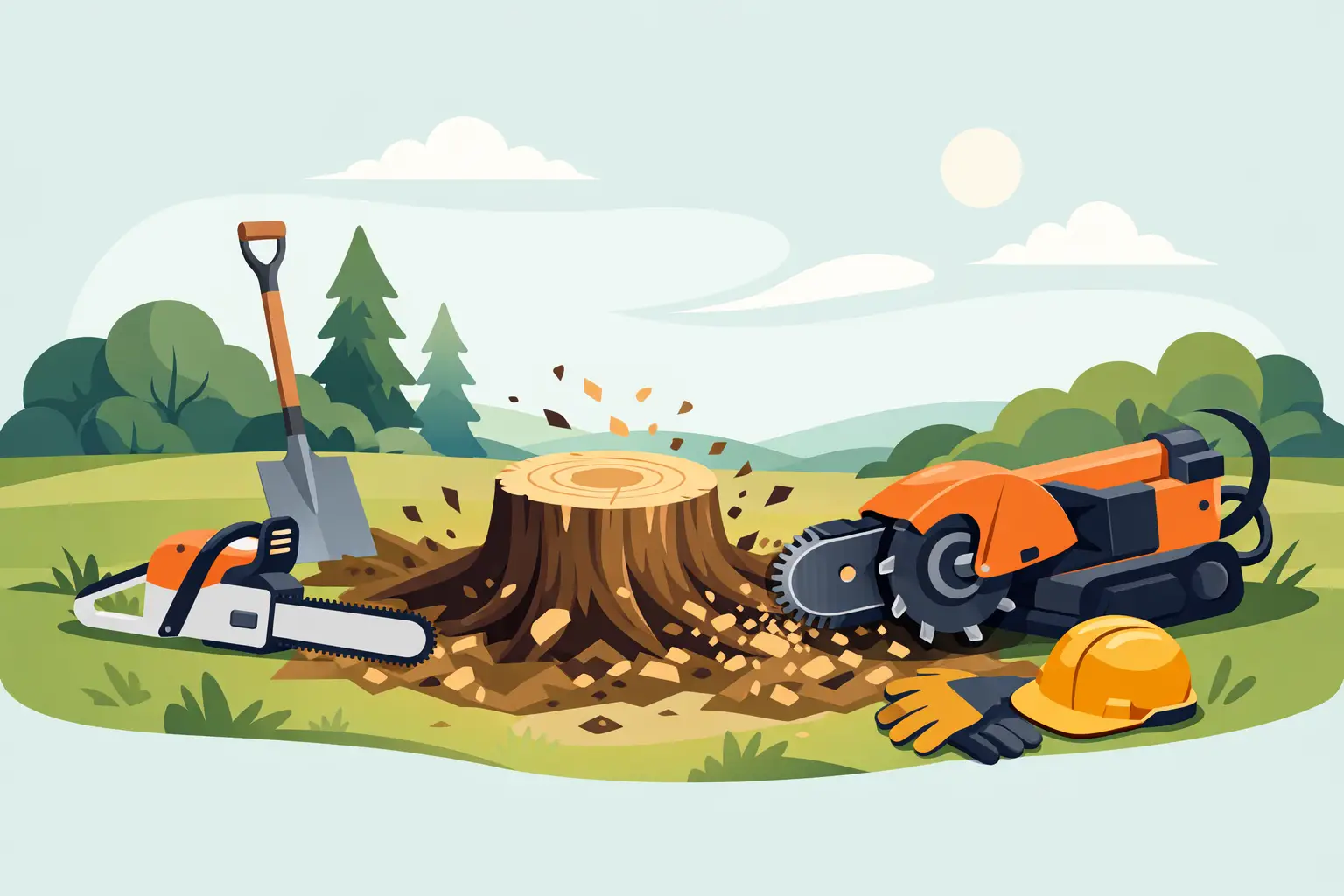
That stump might look harmless, but it can quickly become a trip hazard, damage the look of a garden, attract pests and get in the way of mowing, replanting or landscaping. If you are wondering how to remove a tree stump, the right method depends on its size, age, position and how quickly you need the area cleared.
In some gardens, a small old stump can be tackled with basic tools and patience. In other cases, especially where the stump is close to buildings, fences, services or hard surfaces, removal is better handled with specialist equipment. The key is choosing a method that is safe, practical and suits the site.
How to remove a tree stump: start with the right assessment
Before you do anything, check what you are dealing with. A stump from a young ornamental tree is very different from a mature conifer or broadleaf stump with a large root plate. Diameter matters, but so does root spread, soil condition and access.
If the stump is in a lawn with clear working room, your options are broader. If it sits beside a wall, patio, driveway or outbuilding, removal becomes more delicate. The same applies if there is any chance of underground utilities nearby. Digging or grinding without checking first can create a much larger problem than the stump itself.
It is also worth thinking about what comes next. If you simply want to stop the stump being visible, one approach may be enough. If you want to turf, pave, build or replant in the same spot, you will usually need more complete removal.
Manual stump removal
Manual removal is the most straightforward idea on paper, but it is usually the hardest in practice. It tends to suit smaller stumps, shallow-rooted species and situations where time matters less than cost.
The usual process is to dig around the stump, expose the major roots and cut through them with a mattock, loppers, axe or pruning saw. Once the lateral roots are severed, you work the stump loose and cut any deeper anchor roots underneath before lifting it out.
This can work well on small fruit trees, shrubs and younger specimens. It becomes far less realistic with large established trees. Root systems can be dense, heavy and awkward to reach, particularly in compacted ground or clay soils common in parts of Norfolk and Suffolk.
The main advantage is that you do not need powered machinery. The downside is the physical effort, the time involved and the risk of injury from heavy lifting or misuse of cutting tools. If the stump is larger than expected, many people end up with a half-dug hole and a stump that still will not move.
Using a stump grinder
For most substantial stumps, grinding is the most efficient method. A stump grinder uses a rotating cutting wheel to chip the timber down below ground level. It removes the visible stump and enough of the upper root crown to allow the area to be levelled and reused.
This is the method professionals rely on because it is fast, tidy and effective across a wide range of stump sizes. It is especially useful when access allows the machine in and when a clean finish matters.
Grinding does not normally remove every root in the ground. In most cases, that is not necessary. Once the main stump is ground out, the remaining roots naturally decay over time. For lawns, beds and many landscaping projects, this is more than sufficient.
Where people come unstuck is assuming a hired machine is simple to use. Smaller pedestrian grinders are available, but they are still powerful pieces of equipment. Uneven ground, hidden stones, restricted spaces and nearby structures all add risk. Without experience, it is easy to leave an uneven result or cause accidental damage around the stump.
For larger or awkward sites, professional stump grinding is usually the quickest route to a safe and usable finish.
When grinding is usually the best option
Grinding is often the right choice if the stump is large, if you want the area cleared quickly, or if the stump is creating a hazard in a managed garden or commercial setting. It also suits sites where full excavation would cause too much disruption to surrounding ground.
If access is tight, specialist operators can often assess whether a compact machine will fit through a side gate or narrow passage. That is one of the main benefits of using an experienced local team rather than guessing what equipment might work on the day.
Chemical stump removal
Chemical treatment is sometimes used to speed up decay, but it is best understood as a slow solution rather than immediate removal. Products are applied into drilled holes in the stump to help break down the wood over time.
This method may appeal if the stump is not urgent and you want to avoid heavy digging. However, it does require patience. You are typically looking at months rather than days, and the stump still usually needs breaking apart or removing later once it has softened.
It is also not the best fit for every site. Households with children or pets may prefer to avoid chemical products in the garden, and some customers simply want the job finished properly in one visit. From a practical point of view, chemical treatment is often less useful when the goal is immediate replanting or landscaping.
Burning a stump
People still ask about burning, but it is rarely the sensible option. Even where it is legally permitted, it can be unpredictable, slow and difficult to control. Green timber does not burn cleanly, underground roots can smoulder, and the heat can affect nearby ground, paving or fencing.
There is also the issue of nuisance. Smoke, smell and fire risk are enough to make this a poor choice in most residential areas. For commercial premises, managed sites and properties close to neighbours, burning is generally more trouble than it is worth.
In short, it may sound simple, but it is seldom the safest or most efficient answer.
When not to remove a stump yourself
Knowing how to remove a tree stump also means knowing when not to. If the stump is large, freshly cut, close to a structure, entangled in surface roots or located above suspected services, DIY removal can become unsafe very quickly.
The same applies after storm damage. A stump attached to partially failed roots, cracked ground or nearby unstable timber should be treated with caution. What looks like a routine clearance job may actually involve tension, movement or hidden instability in the root plate.
Commercial sites bring another layer of responsibility. Public access, duty of care and site safety all matter. In those cases, a professional service is not just about convenience. It helps reduce risk and keeps the area usable without unnecessary disruption.
What happens after stump removal
Once the stump is removed or ground down, the site usually needs making good. With manual extraction, you are left with a hole that needs backfilling and levelling. With grinding, you will normally have a mix of woodchip and soil that can be raked, reduced or replaced depending on the final use of the area.
If you are replanting, it is often better not to place a new tree directly into the same spot unless the ground has been properly prepared. Old roots, compacted soil and leftover grindings can affect establishment. If you are laying turf or preparing a border, a clean top-up of soil and careful levelling will usually give the best result.
A tidy finish matters. It is one thing to get the stump out, but the real benefit comes when the space is safe, level and ready to use again.
Choosing the best method for your site
There is no single answer to how to remove a tree stump because every site is different. Small stumps in open soil may be manageable by hand. Stumps that are left to decay naturally may be acceptable in tucked-away corners. But for most customers who want a fast, clean result, stump grinding is the practical choice.
The best approach balances safety, access, budget and the finish you need. A cheaper method is not always the most cost-effective if it leaves a hazard behind, damages the surrounding area or takes far longer than expected.
At T.G. Bird Tree Services, the focus is always on doing the job properly, with the right equipment and a clean, professional finish. If you are looking at a stubborn stump and weighing up your options, the safest next step is often a proper assessment rather than another afternoon of digging. A well-cleared site gives you more than a better view – it gives you back usable space.