
A tree that has outgrown its space can quickly become more than a cosmetic issue. Branches start pressing towards roofs, roads, footpaths and overhead lines, and what looked manageable a few years ago can become a safety concern. That is usually when people start asking when should a tree be pollarded, and the honest answer is that timing matters just as much as technique.
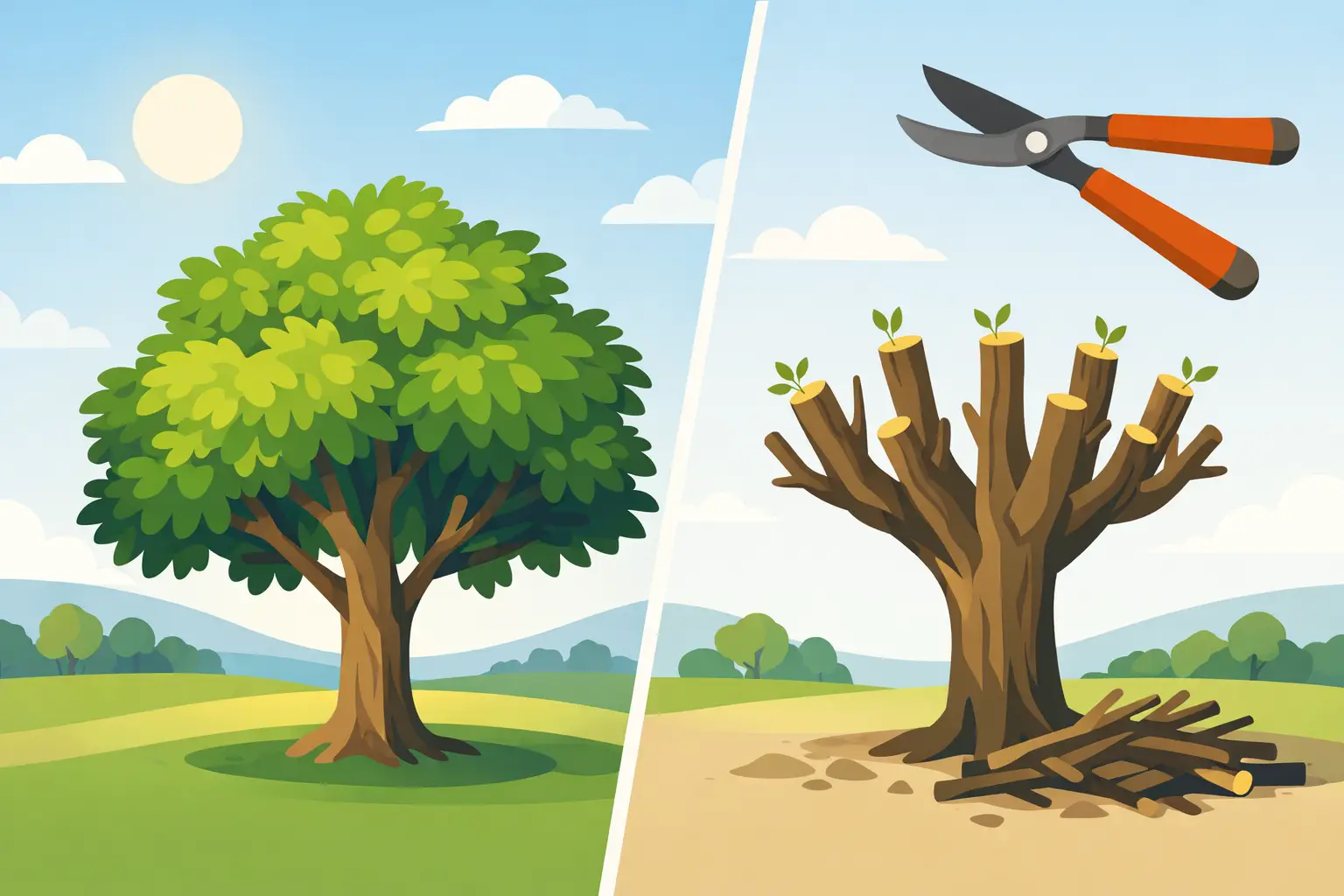
Pollarding is not the same as ordinary pruning. It is a structured management method where the upper branches are cut back to a set framework, encouraging new growth from those points over time. Done properly, it can keep certain trees at a controlled size for many years. Done at the wrong time, or on the wrong species, it can leave a tree stressed, unstable or vulnerable to decay.
What pollarding is meant to achieve
Pollarding is used where a tree needs to be kept within a restricted space without complete removal. You often see it on roadsides, near car parks, in public spaces and in gardens where a tree has become too large for its setting. It can also be useful where light needs to be improved or where regular regrowth is easier to manage than repeated larger reductions.
This approach creates a cycle. The tree is first cut to a framework, then new shoots grow back from those same points. Once that cycle has started, it normally needs to be maintained. That is why pollarding should never be treated as a one-off cut with no long-term plan.
When should a tree be pollarded for best results?
In most cases, the best time to pollard a tree is during its dormant season, usually from late autumn through to late winter. At that point, the tree is not putting energy into active growth in the same way it does in spring and summer, which can reduce stress and make the structure easier to assess.
For many deciduous species, winter pollarding also gives a clearer view of the branch framework because the leaves have dropped. That helps arborists make clean, accurate cuts and spot any weak unions, deadwood or signs of disease before the work begins.
There are exceptions. Some trees bleed heavily if cut at the wrong point in late winter or early spring. Others respond poorly if heavily pruned in colder weather after a hard frost. Nesting bird season can also affect timing, particularly from spring into summer, when wildlife checks become essential before any work goes ahead. So while dormant season is usually the right window, the exact month depends on the species, the tree’s condition and the surrounding environment.
The age of the tree matters as much as the season
One of the biggest factors in deciding when should a tree be pollarded is the age and maturity of the tree. Pollarding is generally best started when a tree is still relatively young. Younger trees adapt better to this type of pruning because they recover faster and form the pollard head more effectively over time.
Starting pollarding on an old, mature tree is more complicated. Large wounds take longer to close, the tree may struggle to respond with healthy regrowth, and the risk of decay is higher. That does not mean it is never possible, but it does mean the work needs careful assessment. In some cases, crown reduction or selective pruning is the better option.
For property owners, this is where professional advice really matters. A tree may look like a good candidate simply because it is too big, but size alone does not make pollarding the right solution.
Which trees cope well with pollarding?
Some species tolerate pollarding far better than others. Common examples include lime, willow, plane, ash and certain maples. These trees are generally capable of producing strong regrowth after cutting, particularly when they are put on a regular maintenance cycle.
Other species do not respond as well. Conifers, for example, are usually poor candidates because they often fail to regenerate properly from older wood. Many ornamental trees can also be spoiled by hard cutting, both in appearance and long-term health.
Even within suitable species, local conditions make a difference. Soil quality, previous pruning, storm damage, fungal issues and root health all affect how well a tree is likely to respond. A pollarding job should always be based on the actual condition of the tree in front of you, not just its species name.
Why poor timing causes problems
If pollarding is carried out at the wrong time, the tree can be pushed into unnecessary stress. Heavy cuts during active growth may remove a large amount of leaf area just when the tree is using it most. That can weaken energy reserves and lead to poor regrowth.
Bad timing can also increase exposure to pests and disease. Fresh pruning wounds are vulnerable, and some pathogens are more active in warmer conditions. If a tree is already compromised by drought, compaction or previous poor pruning, mistimed pollarding adds another layer of pressure.
There is also the practical side. Trees close to roads, houses, gardens and commercial buildings need work planned around access, safety and disruption. A well-timed job is not just better for the tree. It is usually cleaner, safer and easier to carry out properly.
Pollarding is not the same as topping
This is one of the most important distinctions to make. Pollarding is a recognised arboricultural system when it is started correctly and maintained consistently. Topping is a poor pruning practice where branches are cut back indiscriminately, often leaving stubs and weak regrowth.
The two can look similar to an untrained eye straight after the work, but the outcome is very different. Proper pollarding uses deliberate cut points and a clear management plan. Topping often leads to decay, rapid weak shoots and an untidy, short-lived result.
If a tree has previously been topped, it may still be possible to manage it more carefully from that point onward, but the structure is rarely as sound as a properly pollarded tree.
Signs a tree may need pollarding
There is usually a practical reason behind the decision. The canopy may be encroaching on buildings, casting excessive shade, affecting visibility on a driveway or road, or becoming difficult to manage in a smaller garden. In commercial settings, trees near car parks, access routes and service areas often need tighter control for safety and clearance.
That said, pollarding should not be the default answer every time a tree gets large. Some trees are better reduced, reshaped or removed and replaced with a more suitable species. The right choice depends on the tree’s form, location, history and future management needs.
A good arborist will look at what the tree is doing now, what it is likely to do in the coming years, and whether pollarding will genuinely solve the issue rather than postponing a bigger problem.
What happens after a tree is pollarded?
After pollarding, the tree puts out new shoots from the cut points. Those shoots can grow quickly, especially on vigorous species such as willow and lime. This fresh growth is part of the process, but it also means the tree will need ongoing maintenance at suitable intervals.
Leave it too long, and those new stems can become heavy and weakly attached. That defeats the purpose of the original work and can create fresh risk later on. A pollarded tree is therefore a commitment. It needs repeat visits to keep the framework safe, balanced and healthy.
For many clients, that regular cycle is worthwhile because it keeps a valued tree in place while preventing it from becoming unmanageable. It is often a practical middle ground between constant reactive cutting and full removal.
Getting the timing right on site
On paper, the answer to when should a tree be pollarded seems simple – usually in the dormant season and ideally from a younger age. On site, there is always more to consider. Access equipment, nearby structures, public safety, wildlife constraints and the tree’s actual condition all shape the final decision.
That is why a proper assessment matters before any saw leaves the ground. An experienced arborist will check species suitability, growth habit, previous pruning points, structural condition and the likely response to cutting. That approach protects both the tree and the people around it.
For homeowners and site managers in Norfolk and Suffolk, this is exactly the sort of work that benefits from a skilled, safety-led approach. T.G. Bird Tree Services carries out tree work with that practical balance in mind – protecting property, managing risk and leaving sites tidy once the job is complete.
If you are looking at an overgrown tree and wondering whether pollarding is the right next step, the best time to ask is before it turns into a larger problem. The right cut at the right time can keep a tree working well in its space for years to come.