
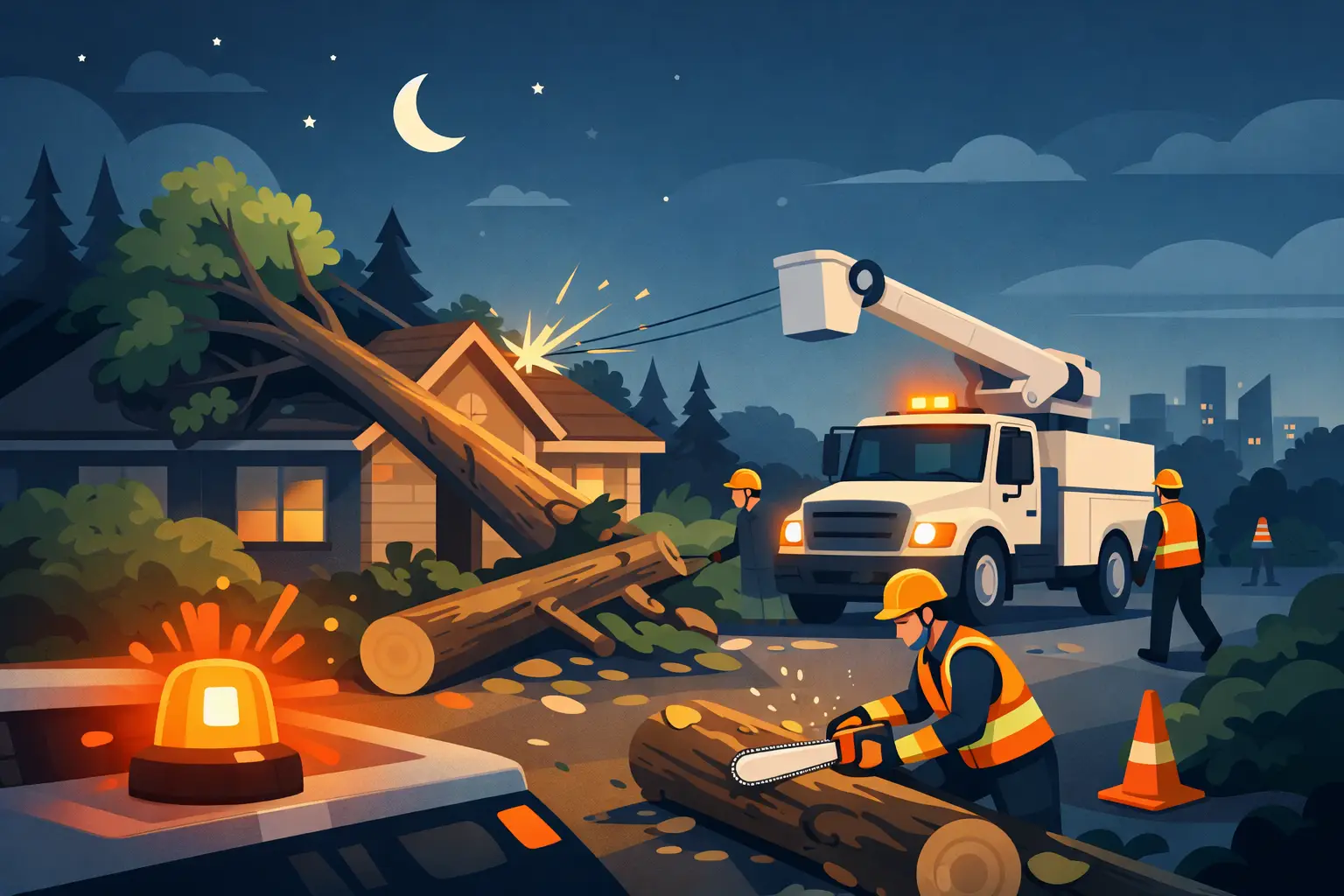
A tree does not wait for business hours to become dangerous. After high winds, heavy rain or sudden failure, you may be left with a split limb over a driveway, a fallen trunk across an access road, or a damaged tree leaning towards a roof. That is when a 24 hour emergency tree service matters – not as a luxury, but as a practical response to a real safety risk.
For homeowners, landlords, site managers and commercial operators, the priority is simple. Make the area safe, prevent further damage and get the problem handled by people with the right equipment and experience. Emergency tree work is very different from routine pruning or planned removals. It needs quick judgement, safe working methods and a clear understanding of how to deal with unstable timber under pressure.
When a 24 hour emergency tree service is the right call
Not every tree issue is an emergency, even if it looks alarming in the dark or after a storm. A few broken twigs in the garden can usually wait. A branch hanging over a public footpath, a tree resting on a building, or a stem blocking access to a property usually cannot.
The clearest sign of an emergency is immediate risk. If there is danger to people, vehicles, buildings, utilities or access routes, the situation needs urgent attention. The same applies if a damaged tree is likely to move further as wind picks up or the ground becomes more saturated.
Storm damage is the most common reason for urgent callouts, but it is not the only one. Trees can fail because of decay, root disturbance, lightning, poor previous pruning, vehicle impact or long-term structural weakness that finally gives way. In some cases, a healthy-looking tree can fail without much warning if the ground has softened and the root plate starts to lift.
What counts as an emergency tree problem?
A genuine emergency usually falls into one of a few categories. The first is a fallen or partially fallen tree. The second is a hanging or snapped limb, often called a widow-maker, because it may look still while remaining highly unstable. The third is a tree that is suddenly leaning, cracking or shifting near a target such as a house, garage, parked car, road or pedestrian route.
There are also cases where access becomes the issue. A tree may not have hit a building, but if it is blocking an entrance, fire route, farm track or commercial yard, speed matters. For some properties, delayed access means much more than inconvenience. It can affect deliveries, site safety, tenant movement or emergency vehicle entry.
It depends on the setting too. A damaged tree in an open paddock is not the same as a damaged tree next to a nursery, office block or neighbour’s conservatory. The level of urgency changes with what is around it.
What to do before the tree team arrives
The safest first step is to keep well clear. That sounds obvious, but many injuries happen after the weather has passed, when people go outside to inspect damage and stand beneath broken limbs or near a stem under tension. Timber can shift suddenly, especially if it is caught on another branch, fence, shed or roofline.
If possible, keep others away from the area as well. Move vehicles if they can be moved safely. Do not attempt to cut branches yourself with a ladder and a household saw. That often turns a manageable job into a serious accident.
If cables are involved, treat the whole area as hazardous and do not go near the tree or anything it is touching. Utility-related risks need extra caution and the correct coordination before work begins.
Good emergency contractors will ask a few direct questions over the phone. They may want to know what has fallen, what it is resting on, whether access is blocked and whether there are nearby structures or services. A clear description helps them attend with the right kit and plan the safest first response.
What to expect from a professional emergency response
A proper 24 hour emergency tree service starts with assessment, not guesswork. The first job is to understand where the risk is, what is under load and what can be removed safely without making matters worse. In emergency work, the obvious cut is not always the safe cut.
In some situations, the priority is full removal. In others, it is temporary risk reduction – taking weight out of a split crown, removing suspended limbs, or clearing a route so the property can be used safely until follow-on work is arranged in daylight. That is why experience matters. A rushed job can leave hidden hazards behind.
You should also expect clear communication. A reliable team will explain what needs to happen first, what can wait, and what the site is likely to look like afterwards. Emergency work is often about stabilising and securing before moving into a fuller programme of remedial tree care.
Cleanup matters too. When a tree comes down, the debris is only part of the problem. Sawdust, splintered timber, damaged hedging and blocked paths can leave a site unsafe even after the main stem has gone. Professional work should leave the area substantially safer, clearer and easier to manage.
Why emergency tree work should never be improvised
It is tempting to think of tree cutting as straightforward if you own a chainsaw. In emergency conditions, it is anything but. Trees that have failed are often twisted, pinched, suspended or supported in unpredictable ways. A branch may spring back. A trunk may roll. A hung-up section may drop without warning.
Working at height, around buildings, in poor light or after severe weather adds another layer of risk. The equipment used for planned tree work can still be needed, but the judgement behind each movement becomes more important. This is where trained arborists earn their keep.
There is also the matter of collateral damage. Poor cutting can worsen roof damage, crush fencing, tear up lawns or bring more of the crown down than necessary. A good emergency response is not just fast. It is controlled.
Local conditions matter in Norfolk and Suffolk
Tree emergencies are shaped by local weather, soil and exposure. Across Norfolk and Suffolk, open landscapes and coastal influence can leave trees more exposed to wind loading than people expect. Heavy rain can soften ground quickly, especially around older trees with broad canopies or where drainage is already poor.
Different property types create different risks as well. In villages, access can be tight and trees may be close to outbuildings, neighbouring gardens or roadside boundaries. On commercial sites or larger landholdings, the concern may be gates, tracks, storage areas and public-facing spaces. A local contractor understands those practical realities and can respond accordingly.
That local knowledge is one reason many customers choose firms such as T.G. Bird Tree Services when urgent tree problems arise. Fast response matters, but so does turning up ready for the type of site, weather and access issues common to the area.
After the emergency, what happens next?
Once the immediate danger has been dealt with, there is often a second stage. A fallen tree may expose weaknesses in nearby trees. A partially dismantled tree may need complete removal. A stump may need grinding out if it affects access, replanting or future use of the space.
This is also the point where prevention becomes worth discussing. Sometimes the emergency was unavoidable. Sometimes there were warning signs – deadwood in the crown, fungal growth at the base, included bark unions, previous storm damage or a canopy that had gone too long without management. Planned inspections and maintenance can reduce the risk of another urgent callout later on.
That does not mean every mature tree is a problem. Many simply need sensible care at the right time. Pruning, pollarding, crown reduction or selective removal can all play a part, depending on the species, condition and location.
Choosing the right 24 hour emergency tree service
In an urgent situation, people often ring the first name they find. That is understandable, but you still want a contractor who takes safety seriously, communicates clearly and has the practical ability to manage high-risk work.
Look for a service that understands both domestic and commercial needs, can respond quickly, and treats cleanup as part of the job rather than an afterthought. Competitive pricing matters, but in emergency tree work the cheapest option is not always the safest or the most cost-effective once damage, delays or poor workmanship are taken into account.
A dependable emergency tree service should leave you with more than a cut-up tree. It should leave you with a site that feels under control again, whether that means a safe driveway, a cleared road, a protected building or simply peace of mind after a difficult night.
When a tree fails, the problem can escalate quickly. Acting early, keeping clear and getting skilled help on site is often the difference between a contained incident and a much bigger one. If you are ever faced with storm damage or a dangerous tree, the right response is the one that puts safety first and gets the job done properly.